
Why Local SEO Isn’t What It Used to Be
Think back to a years ago when you wanted your business to show up in local search results. The plan was pretty simple. You would claim your Google Business Profile. Fill in your name, address and phone number. You would add a photos and then just wait. That was it.
The Google algorithm liked it when your profile was complete. You were close to the person searching. For a while that was enough to get your business to show up in search results.
Things have changed a lot at Google. The local search algorithm is now much smarter. It does not just look at what’s on your Google Business Profile. It looks at what your Google Business Profile’s doing. Is your Google Business Profile active. Is it just sitting there? Is it fresh. Is it old? Are people really looking at your Google Business Profile. Engaging with it? Are you responding to reviews on your Google Business Profile? Are you updating your hours on your Google Business Profile. Posting new things? Are you answering questions on your Google Business Profile?
Google always wanted to show people the relevant and trustworthy businesses. Over time Google figured out that a Google Business Profile that is active and well taken care of is a sign of a trustworthy business, than one that is perfect but not used.
“Setting up your profile is no longer enough. In 2026, if your profile isn’t moving, it’s falling behind.”
This article is going to walk you through exactly what that means in practice — what a dynamic profile actually is, why it matters for your local rankings, what the key elements are, and most importantly, what you can do about it right now.
Also Read: What is a Google Knowledge Panel? Complete Guide for Businesses & Digital Brands (2026)
Understanding Dynamic Google Business Profiles
Before we start talking about strategy and tactics we need to make sure we are using the words. The term dynamic profile is not something Google uses. It is a good way to describe something that is really important. This is what makes some businesses show up near the top when you search for something in your area and what makes others not show up all.
A dynamic Google Business Profile is one that always has things on it. This means the person in charge of the profile is always adding content talking to customers and making sure everything is up to date. This tells Google and the people who might want to be customers that the business is real and is paying attention to what’s going on. A dynamic Google Business Profile is, like a sign that says the business is alive and active. That is what Google likes to see.
- Static Profiles (The Old Way): A static profile is something that you set up one time. Then you do not really do anything with it after that. The person who owns the business or the people who work at the agency will put in the information. The name of the business the address, the phone number, the website, the hours when the business is open and maybe what kind of business it is. And then they think it is finished. The business owner or the agency might also add a pictures when they first set up the profile.Maybe not.
This was the dominant approach for years, and frankly, it worked reasonably well when Google’s algorithm was simpler. The mindset was: optimize it once, let it sit, and reap the rewards. Some businesses still operate this way today — and they’re paying for it in the rankings. - Dynamic Profiles (The New Standard): A dynamic profile is always a work in progress. It is like your social media presence or the emails you send to people. You need to keep putting things on it like special offers or news about your business. You can use Google Posts to do this. People can also leave comments about your business on your profile. It is a good idea for the business owner to respond to these comments. The business owner should do this on a basis because a dynamic profile is never really finished. It always needs things added to it like new Google Posts or responses to comments, from people. The business owner should keep checking the profile to see what people are saying about the business. Photos get added and refreshed. Business hours are kept accurate — including holidays and special events. Questions in the Q&A section get answered. Messages get replied to.
All these activities send signals to Google that show people are engaging with your business. Google uses these signals to figure out how relevant, trustworthy and active your business is. If your profile is active all the time you are more likely to show up in local search results.
The more you do these things the more Google sees your business as active.Google wants to show people businesses that’re alive and well.So if your business profile is always active Google will think it is a business.Google will then show your business to people, in local search results.Your business will rank higher because it seems active and good.This helps your business get attention from people searching locally.
Here’s a quick side-by-side breakdown of what separates the two approaches:
| Aspect | Static Profile | Dynamic Profile |
| Update Frequency | Rarely or never | Weekly / ongoing |
| Google Posts | None or sporadic | Regular posts with offers, news |
| Photos | A few set-and-forget images | Fresh, rotating media content |
| Reviews | Collected occasionally | Actively requested and responded to |
| Business Hours | Updated annually at best | Updated in real-time (holidays etc.) |
| Q&A / Messaging | Ignored or disabled | Actively monitored and engaged |
| Ranking Signal Sent to Google | Low activity, low trust | High activity, high trust |
| Typical Local Ranking Result | Average to poor visibility | Strong visibility in Local Pack |
How Google Evaluates Active Businesses Today
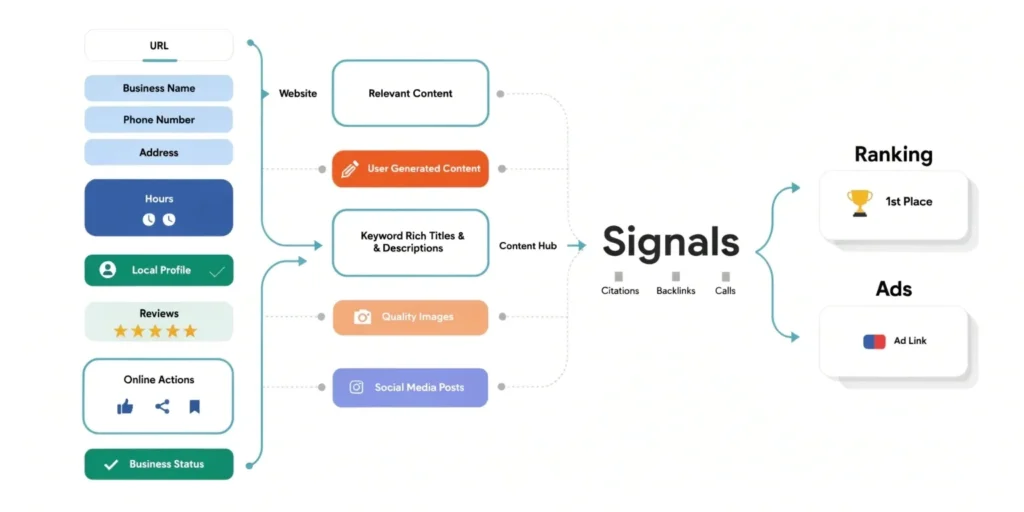
To figure out why dynamic profiles are so important you need to know how Google decides which businesses to show you when you search for something. Google wants to show you businesses that have what you are looking for are near you and can be trusted. So Google looks at three things: how well the business matches what you searched for how close it is to you and how well known it is. These three things. How well it matches how close it is and how well known it is. Are the key to getting your business to show up when people search for things, in your area with Googles ranking. Dynamic profiles matter because they help Google understand your business and show it to the people.
But ‘prominence’ — which used to be mostly about review volume and backlinks — has evolved to include something much more nuanced: activity signals. Google now factors in whether your business profile is actively maintained, because an active profile is a reliable indicator of a business that cares about its customers and its reputation.
“Trust plus activity equals better rankings. Google treats engagement as a proxy for legitimacy.”
The Role of User Interaction Signals
Every time someone looks at your Google Business Profile it sends a message to Google. This message is like a signal that Google pays attention to. When people do things like click on your website make phone calls from your profile ask for directions to your place look at your profile view your photos. Click on your Google Posts it all matters.
When people keep doing these things with your Google Business Profile it tells Google that your listing is something that real people’re interested in. It means your listing is useful and something that Google should show to more people who are searching.
On the hand if nobody is clicking on your Google Business Profile or calling you from it or asking for directions it is, like a quiet signal that maybe your Google Business Profile is not as important as Google thought it was.
This is why just having a Google Business Profile is not enough. You need a Google Business Profile that gets people engaged with it.
And earning engagement starts with maintaining a profile that actually gives people something to engage with.
- Freshness as a Ranking Signal: Google really likes it when you have things on your Business Profile. This is like your website. If you have not updated your profile in two years it looks like nothing is happening. But if you have a Google Post from week a new picture, from yesterday and you replied to a review this morning it looks like your Business Profile is active and people are paying attention to it. Google likes to see that you are doing things with your Business Profile so it is an idea to keep putting new things on it.
Freshness matters because it tells Google that the information on your profile is likely to be accurate and up to date. Outdated profiles create bad user experiences — imagine a customer showing up at a business that still lists old hours or a phone number that’s no longer active. Google has a vested interest in not surfacing that kind of result.
The Basics That Still Matter
Now, before we dive deep into what makes a profile dynamic, it’s important to acknowledge that the foundational elements of local SEO haven’t gone away. They’ve just been demoted from ‘ranking factors’ to what you might call ‘entry tickets.’ You need them to even be in the game — but they’re no longer sufficient to win it.
The three classic pillars of local SEO are still very much relevant: your primary business category (which tells Google what kind of business you are), your physical proximity to the person searching (which remains one of the strongest ranking factors, especially for hyper-local searches), and the presence of relevant keywords in your business name and description.
- Why These Are Now Just the “Entry Ticket”: Here’s the thing though — every single competitor in your local area has (or can have) the same primary category, the same location proximity, and the same keywords. These factors level the playing field. They get you onto the pitch, but they don’t help you win the match.
The differentiation now happens through activity. Two businesses with identical categories, locations, and keywords will almost always see the more active one outrank the static one. That’s the new reality of local SEO, and the sooner you internalize it, the faster you can start closing the gap on your competitors.
What Makes a Profile “Dynamic” in 2026
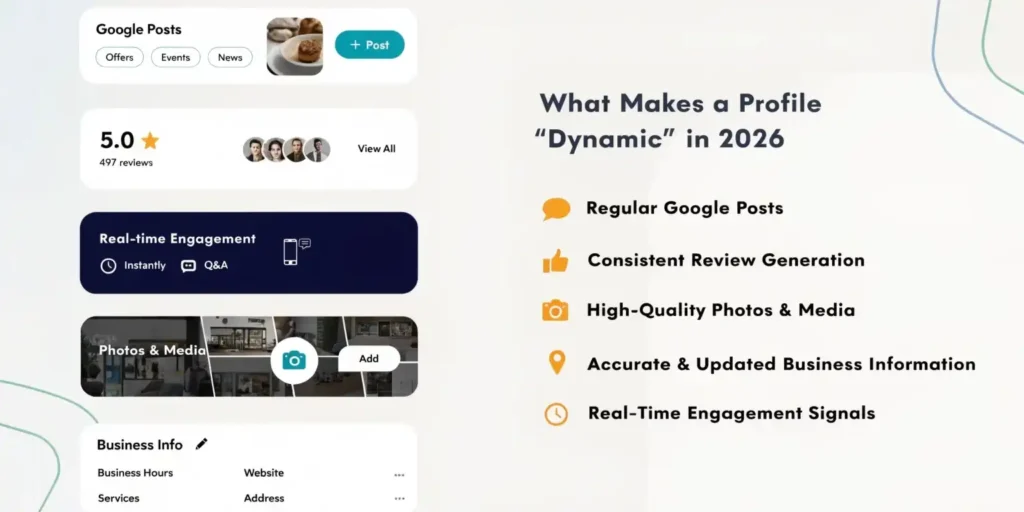
So what does an actually dynamic profile look like in practice? It’s not one big thing — it’s a collection of consistent, ongoing habits that, taken together, tell a compelling story to both Google and your potential customers. Let’s break down each element.
- Regular Google Posts: Google Posts are one of the most underutilized features of the Business Profile platform, and also one of the most powerful. They work similarly to social media posts — you can share offers, news, product highlights, events, or general updates — and they appear directly on your profile in search results.
What makes them particularly valuable from a ranking perspective is that they signal activity. A business that posts regularly is, by definition, a business that is paying attention to its profile. Google rewards that attention. Aim for at least one post per week, and mix up your content — a promotional offer one week, an industry insight the next, a behind-the-scenes photo the week after. - Consistent Review Generation: Reviews have always been important for search engine optimization but the way they are important has become more complicated. It is not about having a lot of reviews or having a high rating although these things are still important. What Google is paying attention to is how often new reviews are coming in.
A business with 200 reviews that it got over five years is actually less impressive to Google than a business, with 80 reviews that gets five or six reviews every month. This shows Google that the business is still actively working with customers and that these customers care enough to share what they think.
The thing to do is to make getting reviews a regular part of how the business works. The staff should ask customers for reviews. The business should follow up with customers. It should be easy for customers to leave reviews by sharing the review link.. The business should always respond to reviews whether they are good or bad. When the business responds to reviews it shows that people are engaged with the business and that is something Google looks at. - High-Quality Photos & Media: Photos are really important for businesses. They help people engage with your company. They also help with rankings. If you have good quality photos on your profile you will do better than people who have old photos. Google looks at how times people view your photos and it helps them figure out if people are interested in your business.
You do not need to hire a photographer to take pictures every time. Just take pictures of the things that are important to your business like the things you sell the people who work for you, where you work and your customers as long as they say it is okay. The main thing is to keep adding photos all the time like every week or every other week. This helps your profile look new and interesting. It gives Google another reason to like your business. Photos like these are very helpful, for your business. - Accurate & Updated Business Information: This one sounds simple. You’d be surprised how often it trips businesses up. Your business name, address, phone number, website URL and business hours need to be accurate all the time. They should be the same on your Google Business Profile and else on the web. If they are not it can confuse Google. Make people lose trust in your business.
Make sure your profile shows all the services you offer. If you serve areas list them. Also add details like if your business is wheelchair has free Wi-Fi or is LGBTQ+ friendly. A profile, with information is more trustworthy. - Real-Time Engagement Signals: Google Business Profiles have features that help businesses connect with customers. Many businesses do not use these features. The features include:
- a Q&A section
- a messaging feature
- the ability to respond to reviews
These features help show Google that your profile is active.
The Q&A section is very important. Customers can ask questions. You can answer them. You can also add questions. Answers yourself. This helps customers. Improves your profile for search. Adding questions and answers, with keywords makes your profile more useful.
It helps customers get answers to questions.The Q&A section helps your profile show up in search results.You should use the Q&A section to add information.Google Business Profiles help businesses connect with customers.The Q&A section is a part of this.You should use it to answer customer questions.Also add questions and answers to help customers.This helps your business.
Reviews Are More Than Just Ratings
Let’s spend a little more time on reviews, because they deserve it. In many ways, your review profile is your reputation made visible — and Google treats it as such. But the way reviews influence your local rankings goes deeper than the star count.
- Review Velocity Explained: Review velocity is about how how many new reviews your business gets. It shows how well your business is doing over time not how many reviews you have. A business that gets reviews every week shows Google it is open helping customers and building trust.
This is why getting reviews at once like fifty in one month after a long time with none can look strange to Google. It might even block some reviews. What you want is growth. A few real reviews coming in all the time. This is more valuable, than getting reviews all at once. - How Reviews Impact Conversions & Rankings: Reviews influence your rankings through the trust and prominence signals they send to Google. But they also directly influence whether a potential customer actually contacts you or walks through your door. Studies consistently show that the vast majority of consumers read reviews before making a local business decision, and that a business’s response to negative reviews is actually a major trust signal for many people.
A business that responds thoughtfully to criticism, thanks customers for positive reviews, and generally treats its review section as a conversation rather than a bulletin board demonstrates a level of customer care that resonates — both with Google and with prospective customers. That’s the kind of differentiation that wins business.
Why “Open Now” Matters More Than Ever
Here’s a ranking factor that very few people talk about, but that has real, measurable impact on your local search visibility: your business hours, and specifically, whether your profile accurately shows when you are open versus closed.
- Impact of Being Closed During Search: When someone searches for a business type and Google determines that your business is currently closed, it significantly reduces the chance of your profile appearing prominently in the results. Think about it from Google’s perspective — if a user is searching for a plumber at 7 PM and your profile says you close at 5 PM, serving your listing to that user creates a bad experience. Google doesn’t want that.
This means that if your hours are inaccurate (for example, you’re actually open until 8 PM but your profile still says 5 PM), you’re actively losing ranking and visibility during those hours. And if you’re a business with extended evening or weekend hours, not reflecting those accurately is leaving real opportunity on the table. - Best Practices for Updating Hours: Keeping your hours accurate is not a one-time task. You need to update them whenever they change — seasonally, for public holidays, for special events, for temporary closures. Google actually allows you to set ‘special hours’ for holidays and specific dates, and using this feature proactively is both good for customers and good for your ranking.
A quick practical tip: put a recurring reminder in your calendar to review your business hours at the start of every month. It takes five minutes and the impact on your visibility — especially around public holidays when search volumes are high — can be significant.
Why Most Businesses Still Fail at Local SEO
If all of this sounds logical and straightforward, you might be wondering: why aren’t more businesses doing it? The honest answer is that consistency is hard. Most businesses start out with good intentions and then fall back into old habits. Let’s look at the most common failure modes.
- “Set It and Forget It” Approach: This is by far the most common mistake. A business owner or their marketing person spends a few hours setting up the profile, feels good about it, and then never really comes back to it. Months pass. The profile goes stale. Competitors who are actively managing their profiles start to pull ahead in the rankings, and the business owner can’t figure out why.
The mindset shift required here is fundamental. Your Google Business Profile is not a listing — it’s a channel. It requires the same ongoing attention and intention as your social media, your email list, or your website blog. - Ignoring Engagement Metrics: Google provides a surprisingly robust analytics dashboard within the Business Profile platform, showing you how many people viewed your profile, how they found it, what actions they took, and how your photos are performing. Most businesses never look at this data.
Ignoring your engagement metrics means missing opportunities to understand what’s working and double down on it, as well as what’s not working and fix it. If your photo views are low, add more photos. If your direction requests are high, make sure your map pin is accurate. The data tells you what to do — you just have to read it. - Inconsistent Updates: Sporadic activity is almost as damaging as no activity. If you post three times one week and then nothing for two months, the signal you’re sending to Google is chaotic and unreliable. Consistency is more important than frequency. A single post per week, every week, is more valuable than a burst of five posts followed by a long silence.
Build a simple content calendar for your profile and stick to it. Even just thirty minutes a week dedicated to your Google Business Profile can produce meaningful results over time. - Fake or Irregular Reviews: The temptation to buy reviews or ask friends and family to flood your profile with five-star ratings is understandable — but it’s a strategy that almost always backfires. Google is genuinely good at detecting inauthentic review patterns, and the consequences of getting caught range from review removal to profile suspension.
Beyond the risk of penalty, fake reviews don’t generate the ongoing review velocity that the algorithm rewards. They might give you a temporary boost, but they can’t replace the long-term trust signals that come from a genuine, steady stream of real customer experiences.
Actionable Strategy for Dynamic Optimization
Okay, so you understand the ‘what’ and the ‘why.’ Now let’s talk about the ‘how.’ Here’s a practical, repeatable framework for turning your Google Business Profile into a genuine ranking asset.
- Weekly Activity Checklist: Every week, spend about twenty to thirty minutes on your profile. Here’s what that should look like:
- Publish one Google Post — an offer, an update, a product highlight, a tip, or a seasonal message
- Respond to any new reviews — thank positive reviewers personally, address any concerns raised in negative reviews constructively
- Upload one to three new photos — try to vary between product, team, and environment shots
- Check and respond to any new Q&A questions or messages
- Scan your basic information for accuracy — especially if anything has changed
- Monthly Optimization Routine: Once a month, set aside an hour for a deeper audit and optimization session:
- Review your profile analytics — which posts got the most engagement? Which photos are getting the most views?
- Check your review velocity — how many new reviews came in this month? Is that trend increasing or decreasing?
- Update any business information that has changed — services, hours, service areas, phone numbers
- Refresh your business description if needed — add seasonal language, new offerings, or updated credentials
- Look at what your top-ranking competitors are doing — what are they posting? How often? What reviews are they getting?
- Tools & Automation Tips: Staying consistent is a lot easier when you have systems in place. A few tools that can help:
- Scheduling tools like Publer, Semrush’s listing management, or even a simple content calendar in Google Sheets can help you plan and batch your Google Posts in advance
- Review management platforms like Birdeye, Podium, or ReviewTrackers can automate review request emails and SMS messages to your customers after service
- Google’s own Business Profile Manager dashboard (accessed at business.google.com) gives you analytics, post scheduling, and review management in one place
- Set up Google Alerts for your business name so you’re notified any time someone mentions you online — allowing you to engage quickly and catch any inaccurate citations
Also Read: How to Use Branded Query Filtration to See Your Real SEO Performance
The Future of Local SEO Is Activity-Driven
Let’s bring it all together. The fundamental shift that has happened in local SEO over the past few years is simple but profound: Google has moved from rewarding optimized listings to rewarding active businesses. The algorithm has grown sophisticated enough to tell the difference, and it’s using that distinction to separate the businesses that deserve to rank from those that are just going through the motions.
A dynamic Google Business Profile is no longer a nice-to-have — it’s the baseline expectation for any business that wants to be visible in local search. The static approach, the set-it-and-forget-it mindset, the occasional burst of reviews followed by months of silence — these are the habits of businesses that are slowly becoming invisible.
The good news is that your competitors are largely still stuck in those old habits. That means there is a real, achievable competitive advantage available to any business willing to show up consistently, engage genuinely, and treat their Google Business Profile as the living, breathing marketing channel that it actually is.
“Be active or be invisible. In 2026’s local search landscape, there is no comfortable middle ground.”
Start this week. Pick one element from this article — maybe it’s publishing your first Google Post in months, maybe it’s sending a review request to your last five customers, maybe it’s just updating your business hours. Do that one thing. Then do it again next week. Build the habit. And watch what happens to your rankings.
Frequently Asked Questions
What is a dynamic Google Business Profile?
A dynamic Google Business Profile is one that is actively and consistently maintained with regular updates, fresh content, engagement with reviews and questions, and ongoing activity signals. In contrast to a static profile that gets set up once and left alone, a dynamic profile treats the Business Profile as an ongoing marketing channel that requires regular attention.
How often should I update my profile?
At a minimum, you should be publishing at least one Google Post per week, responding to new reviews within 24-48 hours, and adding new photos every one to two weeks. Your business hours and core information should be checked and updated monthly, and any time something changes in your business. Consistency matters more than the exact frequency — a steady, reliable cadence is more valuable than occasional bursts of activity.
Do reviews really impact rankings?
Absolutely, and in more ways than one. Review volume and average rating are direct ranking signals for Google’s local algorithm. But beyond that, review velocity (how regularly you’re receiving new reviews) and the presence of owner responses also influence how Google perceives the trustworthiness and activity level of your profile. Reviews are also a major influence on consumer decision-making, so they impact your conversion rate as well as your rankings.
Are Google Posts still relevant in 2026?
Yes, very much so. Google Posts remain one of the most direct ways to signal activity to Google’s algorithm. They also appear on your profile in search results, giving potential customers something to engage with directly. Posts with offers, event details, or timely updates tend to perform particularly well. Think of them as a mini blog or social feed that lives directly in search results.
How long does it take to see results?
Local SEO is not an overnight game, and dynamic profile optimization is no exception. Most businesses start to see noticeable improvement in their local rankings and profile engagement within four to eight weeks of consistent activity. More competitive markets and more heavily contested keyword categories may take longer. The important thing is to maintain consistency — the compounding effect of ongoing activity builds real ranking momentum over time.
Can a small business compete using dynamic profiles?
Not only can they compete — dynamic profile optimization is actually one area where small businesses have a genuine advantage over larger ones. A small, owner-operated business can respond to reviews personally and quickly, upload authentic photos regularly, engage with customers in real time, and post genuinely relevant local content in ways that corporate chains often struggle to replicate at scale. The activity-driven nature of modern local SEO levels the playing field considerably.