
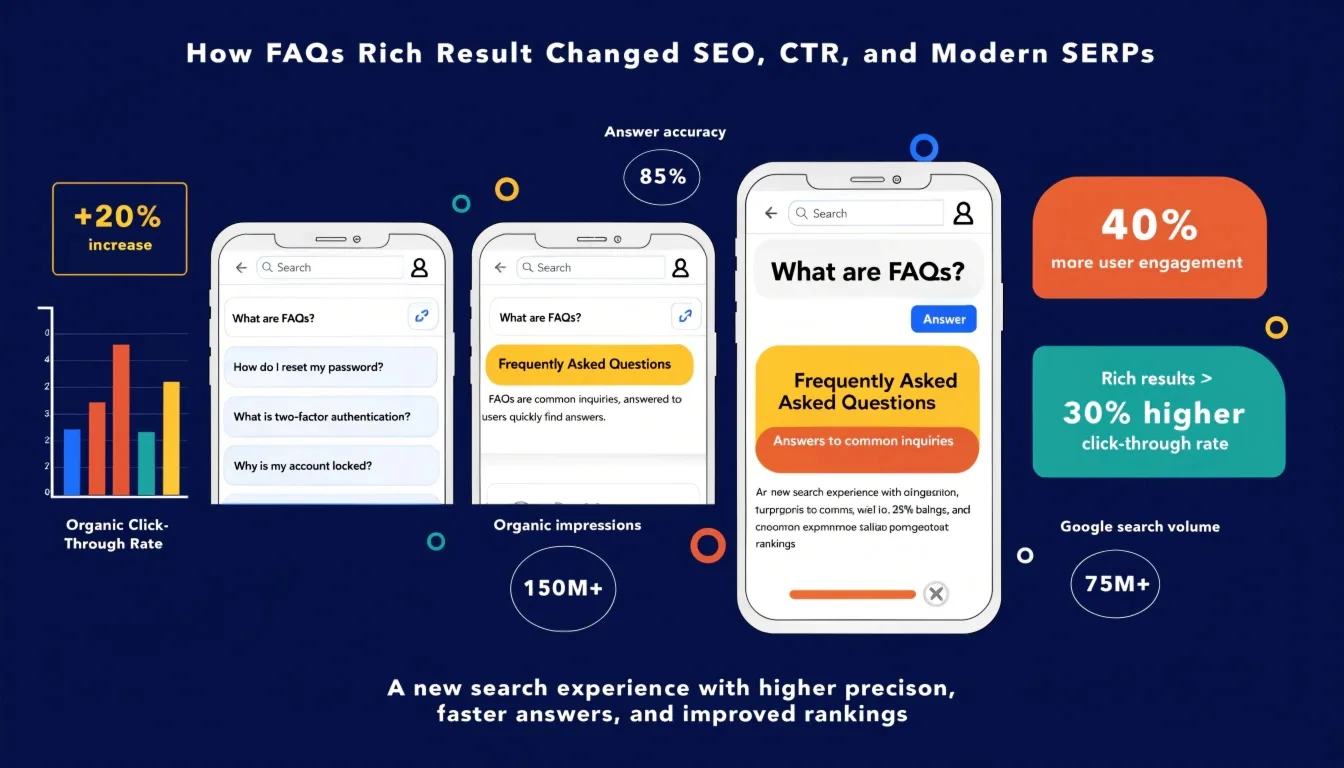
If you’ve been in the digital marketing trenches for a few years, you remember the “Golden Age” of the FAQs Rich Result. Back in 2019, adding a few lines of schema markup could instantly double your SERP real estate. Your listing would expand with beautiful, clickable dropdowns, pushing competitors further down the page and sending your CTR through the roof.
Let’s fast forward now to May 2026. On May 7, Google completely killed off the last remaining FAQs rich result in an event that actually began way back at the end of 2023.
As an experienced SEO consultant, I can say for sure that this triggered a major controversy. Is this a “death blow” to structured data? Not even close. It’s actually a pivot point. We are moving away from “SERP manipulation” and toward a sophisticated era of GEO (Generative Engine Optimization) and AEO (Answer Engine Optimization).
Also Read: Why “Browsy Queries” Are the Future of SEO
The Autopsy: Why Google Killed the FAQ Snippet
For years, the FAQs rich result was the ultimate “growth hack” for SEO Services. But as with all good things in SEO, it was loved to death.
1. The Schema Abuse Pandemic
Marketers began using FAQs schema not to help users, but to “bully” the SERP. Websites were adding 10–15 questions to every single blog post—often irrelevant or redundant—just to take up more vertical space. This over-optimization turned Google’s clean search results into a cluttered mess of dropdown menus.
2. The Rise of “Zero-Click” Search
Google soon found out that the more they gave information directly from the SERPs, the fewer clicks there were to the actual sites. This is ironic since although FAQ snippets made it easy for users to find their answers, it affected the site negatively. Google’s current shift toward AI Overviews (formerly SGE) is a more integrated way of doing the same thing: providing answers without the click.
3. Ranking Loss vs. CTR Loss: A Critical Distinction
It’s important to understand that when Google removed the FAQs rich result, most sites didn’t lose their rankings. They lost their visibility.
- Ranking Loss: Your site moves from position #2 to #10.
- CTR Loss: Your site stays at position #2, but because you no longer have the “accordion” dropdowns, people stop clicking at the same rate.
The SERP Evolution: Before vs. After
The visual transformation of Google Search over the last three years is staggering.
| Feature | The “Old” SERP (2019-2023) | The Modern AI SERP (2026) |
| Visual Focus | Blue links with FAQ/Review snippets | AI Overviews & Interactive Modules |
| Top Real Estate | Google Ads & Featured Snippets | Generative Summaries & People Also Ask |
| Structure | Linear list of results | Contextual “mesh” of sources |
| User Intent | Keyword-based retrieval | Semantic SEO & Entity matching |
Does FAQs Schema Still Matter in 2026?
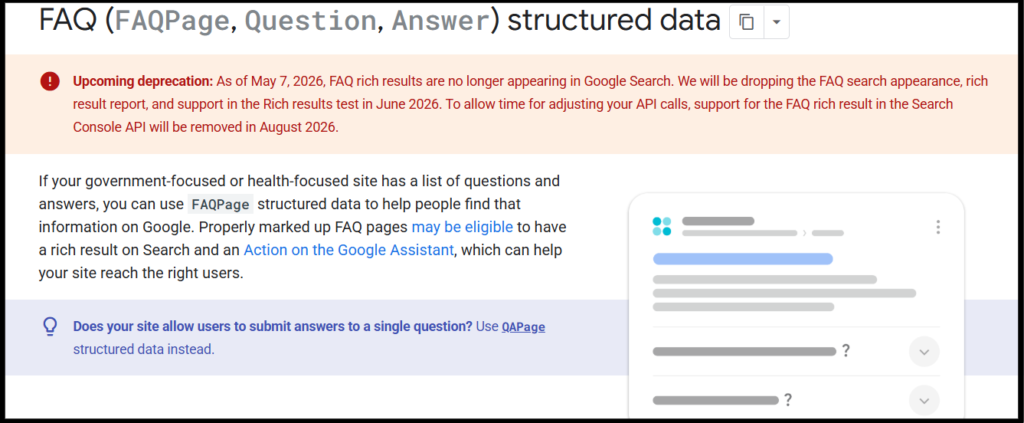
The short answer: Yes, more than ever.
While the visual rich result is gone, the data is still being consumed. In the world of AEO, Google, Perplexity, and ChatGPT use your FAQs schema as a “cheat sheet” to understand your content. Recent data suggests that pages with structured FAQ data are 3x more likely to be cited in an AI Overview.
Expert Insight: Think of FAQs schema as a “clarity layer.” It’s no longer about decorating your search listing; it’s about making your content “extractable” for AI retrieval systems.
The Shift to GEO and AEO: The New Digital Marketing Frontier
We are witnessing the death of “traditional” SEO—the kind where you just pepper keywords and hope for the best. Modern SEO Services now focus on three specific pillars:
1. Semantic SEO & Entity Optimization
Search engines no longer look for strings of text; they look for entities (people, places, things, concepts). By using entity SEO, you’re telling the search engine exactly how your brand relates to a specific topic.
2. Context Optimization over Manipulation
Instead of trying to “trick” the algorithm with schema hacks, we now optimize for context. This means writing in a human-first, conversational tone that matches how people actually talk to AI assistants.
3. The Role of Google Ads
As organic real estate shrinks due to AI summaries, the relationship between Google Ads and organic search has tightened. We’re seeing a “Pay-to-Play” layer at the top, followed by an “AI Synthesis” layer, with organic links buried further down. This makes search visibility a multi-channel effort.
Actionable Strategy: Future-Proofing Your Content
How should you adapt your Digital Marketing strategy in this post-FAQ world? Here is my 2026 checklist:
- Don’t Delete Your FAQs Schema: Keep it. It helps AI Search engines index your facts correctly, even if the “dropdowns” don’t show up.
- Focus on Topical Authority: AI engines prefer citing sources that demonstrate deep, consistent expertise on a subject.
- Target “People Also Ask”: Since FAQ snippets are gone, the People Also Ask (PAA) boxes are the new battleground for informational queries.
- Optimize for “Zero-Click”: Accept that some users won’t click. Optimize your content so your brand name is mentioned inside the AI summary. This is “Assisted Conversion” logic.
- Prioritize E-E-A-T: Google is aggressively filtering out “AI-sounding” fluff. Use real-world examples, unique data, and a distinct brand voice.
The Future: Will Other Structured Data Disappear?
Many in the industry worry that Review Schema or Product Schema might be next on the chopping block. While Google may reduce the visual footprint of these features to keep the SERP “clean,” they will never stop using the underlying structured data.
The future of search is a conversation. Whether it’s a voice query on a mobile device or a complex prompt in an AI engine, your site’s ability to provide a clear, structured answer is what will keep you relevant.
Conclusion: From Links to Answers
The decline of the FAQs Rich Result isn’t a sign that SEO is dying; it’s a sign that search is growing up. We’ve moved from a library of links to an engine of answers. For businesses and SEO Services, the goal is no longer just to “rank #1″—it’s to be the most trusted, most extractable, and most authoritative answer in the entire AI ecosystem.
Are you still optimizing for 2019, or are you ready for the AI-driven search of 2026?
How has your organic traffic shifted since the recent AI Overview rollout in your specific niche?