
It was not just the search environment that changed but the very ground upon which we stood.
For many years, digital marketing firms, as well as their clients, worked within the framework of a straightforward agreement with search engines, whereby if you built a page around a key term, got some backlinks, and made it to the top ten “blue link” ranking position, you won.
That contract has been fundamentally renegotiated. With the widespread integration of generative AI directly into search engine results pages (SERPs), search has evolved from a directory of links into an execution engine. Google’s rapid rollout of AI Overviews and conversational AI Mode means users no longer have to click through multiple websites to piece together an answer. The search engine does the synthesization for them.
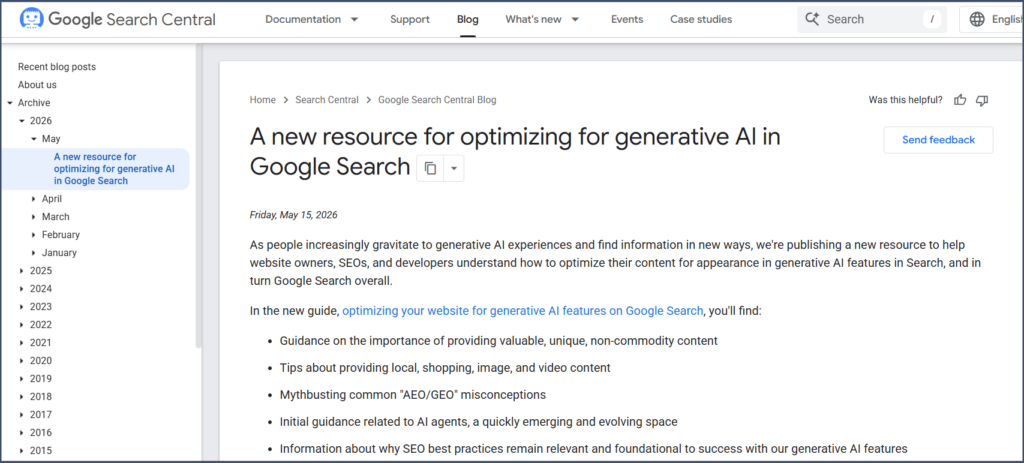
Google’s recently updated official documentation, Optimizing your website for generative AI features on Google Search, serves as the modern playbook for the AI-first era. This update makes one thing clear: you are no longer just competing to rank. You are competing to be the trusted source that grounds Google’s AI.
To survive and thrive, businesses must look beyond traditional mechanics and master GEO (Generative Engine Optimization) and AEO (Answer Engine Optimization). Here is a field-tested analysis of how AI search functions under the hood and what it takes to make your content the chosen citation.
Also Read: GA4 AI Assistant Update: How AI is Redefining SEO, GEO, and Digital Marketing
The Mechanics of the Shift: Traditional SEO vs. AI-First Search
In order to improve a website for Generative AI, it is important that we go beyond the interface and see the technology behind it. Google does not operate on a different index system for its AI components. Rather, it uses two fundamental mechanisms:
- RAG stands for Retrieval-Augmented Generation: “Also referred to as grounding.” LLMs have a well-known issue with generating fictional facts based on the information contained within the pre-trained dataset. In order to avoid that with Search, Google has adopted the use of RAG. Whenever a user inputs a complicated search query, Google’s ranking system selects a number of relevant pages. The AI model then reads only those retrieved documents to synthesize its response, anchoring its answer with clickable citations back to those sources.
- Fan Out of the Query: When the user inputs a multi-faceted and conversational query, the system recognizes its meaning and creates several parallel queries that are related to the input. So, for instance, when one asks “How to grow an agency without burning out,” the queries “frameworks for delegating in an agency setting,” “productization of creative services,” and “retention of clients” are generated in parallel.
This means traditional SEO isn’t dead—it has been recontextualized. If your technical SEO and content depth fail to get you indexed by core quality systems, you have zero chance of being fed into the RAG model.
| Feature / Metric | Traditional SEO Era | AI-First Era (GEO / AEO) |
| Primary Goal | Rank in the top 10 blue links | Become the grounding source/citation in AI responses |
| Query Target | High-volume, short-tail keywords | Long-tail, conversational, multi-layered intent |
| Content Format | Monolithic, keyword-optimized articles | Modular, highly structured, extractable answers |
| Value Metric | Organic Click-Through Rate (CTR) | Information Gain, Entity Trust, Actionable Proof |
| Optimization Lever | On-page keywords, Backlink volume | DOM structure, Clear data tables, E-E-A-T signals |
Debunking the Myths: What Actually Moves the Needle?
Whenever a major industry shift occurs, myths quickly outpace reality. Let’s separate the noise from what actually moves the needle based on Google’s documentation and real-world testing.
The llms.txt Misconception
A common trend among webmasters has been the hasty deployment of an llms.txt file (a Markdown file placed in the root directory intended to provide a clean, shortened version of a site’s content for AI crawlers).
While publishing an llms.txt or an alternate Markdown directory is highly useful for third-party AI platforms, developer documentation hubs, or crawlers from Anthropic and OpenAI, Google explicitly stated that llms.txt is not a ranking factor for Google Search’s generative AI features. Google does not require a secondary text-only file to understand your site. Instead, Google’s automated systems inspect three specific layers of your existing pages:
- Visual Rendering (The Screenshot): How the page looks to a human. The layout, visual hierarchy, and readable text placements.
- DOM Structure: The fully rendered HTML after JavaScript execution. Google looks at clean tag usage, proper heading flows (<h2>, <h3>), and parent-child element relationships.
- The Accessibility Tree: The ARIA roles, labels, and semantic landmarks. If your site’s code is an unmitigated mess of unlabelled <div> tags, Google’s AI agents will struggle to parse your content, hurting your visibility.
Also Read: llms.txt Explained: A New Standard for AI-Friendly Websites
Stop Regurgitating the Giants
One of the most damaging mistakes a content strategist can make is opening Search Engine Journal, Search Engine Land, or Google Search Central, rewriting their articles, and expecting to win topical authority.
AI models are trained on the entire public web. They already know the common knowledge. If your content is just a recycled version of existing industry news, the RAG model will flag it as commodity data with low Information Gain. Google’s AI features look for original data, unique case studies, and distinct professional viewpoints that add something new to the web graph.
Engineering AI-Friendly Content Structures
If you want an AI engine to extract your data and quote it, you must make it effortlessly machine-readable. AI models prefer data that is modular, highly structured, and conversational yet definitive.
1. The “Inverted Pyramid” Answer Block
AI engines are designed to deliver fast results. If the user is asking for an answer to a tough query, you shouldn’t make the person scroll through 800 words of historical context before delivering the actual answer. Instead, you should give them the quick answer right below the header and then explain how it works within the rest of the section.
Example Optimization Strategy:
- Heading (H2): What’s the formula for calculating true ROI on localized Google Ads campaigns?
- Immediate Answer Block (Paragraph): The true ROI on localized Google Ads campaigns is calculated by taking the difference between net revenue from localization and the total cost of the ads and dividing it by the total ad spend multiplied by 100. In cases where there are multiple locations, this will require offline conversions as well.
- Deep-Dive (Bullet Points/Subsections): Unpack the technical steps, required tracking scripts, and attribution models.
2. Conversational, Semantic Context
Keywords are not searched in fragments anymore; people search in complete phrases. It makes no sense to try and cram the keyword phrase SEO services into a paragraph three times when you could be writing about the scenarios in which they apply.
Instead of writing: “This is because we offer the best SEO services for businesses in need of an SEO company,” reframe using semantic techniques: “As the size of the enterprise e-commerce store grows, the need for outsourcing of SEO services to address issues such as faceted navigation and crawl budget.”
Trust, Authority, and the Premium on Human Experience
As AI tools make the production of text virtually free, the web is being flooded with surface-level content. In response, Google has aggressively adjusted its spam and quality systems to heavily favor true E-E-A-T (Experience, Expertise, Authoritativeness, and Trustworthiness).
[Image demonstrating E-E-A-T components: Experience, Expertise, Authoritativeness, Trust]
Commodity vs. Non-Commodity Content
Google’s systems distinguish between text that can be easily synthesized by an LLM and text derived from lived experience.
- Commodity Content (Low AI Value): “5 Tips for Higher Email Open Rates.” (Write a clear subject line, clean your list, segment your audience). An AI model can generate this in three seconds. It adds zero informational value to the search index.
- Non-Commodity Content (High AI Value): “How We Reduced Our Churn by 14% Using Post-Purchase SMS Sequences: A Complete Breakdown of Our A/B Test Data.” This requires an actual human to run an experiment, collect analytics, and capture screenshots of the workflow.
To optimize your content strategy for GEO, ensure every asset includes first-hand observations, real implementation insights, concrete data points, and actual screenshots of results. This data is highly defensible against AI automation because it cannot be fabricated by a predictive text model.
Topical Authority Over Publishing Volume
Brute-forcing your way to the top by publishing 50 shallow articles a day no longer works. AI engines assess topical authority by mapping your brand as an entity within a specific niche.
To build genuine topical authority:
- Map out exhaustive content clusters that answer every semantic facet of a topic.
- Attribute your content to verified subject-matter experts with transparent bios, schema markup, and external links to their professional profiles.
- Ensure your brand is being mentioned and cited across independent, authoritative third-party platforms.
Technical SEO and Tools for the Agentic Era
While content architecture dictates whether you are worthy of being cited, technical SEO determines whether an AI crawler can physically extract your data.
The Emergence of Agentic Protocols
Beyond standard Schema.org structured data, we are seeing the rise of protocols designed explicitly for automated commerce and agent-driven interactions. The most notable development is the Universal Commerce Protocol (UCP), co-developed by Google with major e-commerce platforms like Shopify, Target, and Walmart.
UCP provides a direct, machine-readable standard that allows AI shopping assistants and conversational business agents to instantly check product variants, real-time inventory levels, and transaction mechanics without needing to scrape raw HTML. If you run an e-commerce storefront, integrating UCP-compliant storefront frameworks is a critical priority for future-proofing your brand.
Tools to Evaluate AI-Friendly Content
Because traditional rank tracking doesn’t tell the full story in an AI-driven SERP, workflows must adapt to evaluate how visibility changes across both traditional and generative layers:
- Auditing DOM & Accessibility Trees: Use tools like Google Lighthouse or specialized crawling engines to inspect your accessibility tree. Ensure your heading structures, table layouts, and structural elements are fully machine-readable.
- AI Share-of-Voice Platforms: Utilize modern SEO intelligence platforms (such as Semrush’s AI Overview tracking features or specialized platforms like Verity Score) to monitor your brand’s citation footprint inside generative answer blocks.
- Intent Gap Analysis: Run audits comparing the search queries driving clicks in Google Search Console against the multi-layered questions appearing in Google’s “People Also Ask” and AI Overview modules to find structural gaps in your existing material.
Key Takeaways for Digital Marketers
- RAG is the Foundation: Google’s AI Overviews rely on Retrieval-Augmented Generation. To be cited by the AI, your site must first be indexed and trusted by Google’s core organic ranking systems.
- The Technical Surfaces Have Expanded: Google evaluates your content using visual screenshots, rendered DOM structures, and your site’s accessibility tree. Clean, semantic HTML is no longer optional.
- Information Gain is King: Ditch commodity content. AI features actively look for original data, unique case studies, and lived experience that cannot be replicated by basic prompt engineering.
- Structure for Extraction: Lead your sections with concise, direct answer blocks to satisfy AEO, then expand with deep semantic context and structured data for comprehensive GEO visibility.
Future Outlook: The Intersection of SEO, GEO, and AEO
The future of organic search visibility isn’t an “either/or” scenario. Traditional SEO, GEO, and AEO are merging into a singular, cohesive marketing discipline.
[Traditional SEO] ──> Ensures Indexation & Discoverability
│
▼
[ Generative EO ] ──> Optimizes for RAG Models & Citations
│
▼
[ Answer EO ] ──> Secures Direct Voice & Conversational Answers
Traditional SEO ensures your technical architecture is flawless and your site is discoverable. GEO ensures your content possesses the distinct information gain and entity trust required to be chosen as a primary source by language models. AEO structures that information so elegantly that conversational interfaces can easily extract and read it aloud to a user.
As search tools transition into proactive, agentic assistants capable of booking reservations, comparing product specs, and diagnosing technical issues on the fly, the brands that win will be the ones that focus heavily on entity trust and verified expert insights.
Conclusion: How to Evolve Your Digital Strategy
To stay relevant and keep a robust online presence within the AI economy, businesses need to revamp their strategy when it comes to digital marketing and SEO.
Don’t prioritize the number of searches alone – start investing more of your effort into creating brand authority instead. If you leverage paid search channels such as Google Ads, be sure to connect the dots with offline conversion data and a solid product feed.This ensures Google’s automated bidding and conversational shopping systems fully understand your business capabilities.
Stop treating content creation as a game of volume. Treat your website as a foundational repository of proprietary data, true professional expertise, and definitive answers. By structuring your technical infrastructure for AI agents while tailoring your insights deeply for real human readers, your brand will remain visible, authoritative, and frequently cited—no matter how drastically the search interface evolves.