

Key Takeaways
- llms.txt is an emerging AI web standard
It is designed to help websites provide structured guidance to large language models, focusing on content meaning rather than crawl permissions.- It goes beyond traditional web files
Unlike robots.txt and sitemap.xml, this file is not about access or URL discovery—it’s about helping AI systems understand context, intent, and authority.- Large language models read, not crawl
AI models consume content semantically, which is why machine-readable documentation is becoming essential for AI-friendly websites.- llms.txt does not replace SEO—but complements it
While it doesn’t directly affect rankings, it influences how content appears in AI-generated answers and AI search engines.- Clarity reduces AI misinterpretation
By highlighting preferred sections and explaining site purpose, websites reduce the risk of being misunderstood or misrepresented by AI models.- The file is simple, but intention matters
A plain-text file, placed at the root of a domain, can significantly improve how AI systems prioritize and summarize content.- Developers and content creators both benefit
Developers gain a structured communication layer, while creators retain more control over how their content is interpreted.- Adoption is still early—but momentum is growing
As AI-first discovery becomes the norm, early adopters will shape how their content is surfaced and trusted.- AI-friendly websites are the future
Designing content for both humans and machines is no longer optional—it’s a strategic advantage.
However, as artificial intelligence becomes increasingly integrated into the process of how people search for and find things online, the idea of a website communicating with a human or a search engine has essentially changed. Today, large language models read, interpret, summarize, and use the content of the website as a search engine for AI assistants and other related tools. A new problem has thus been created: the need for a website to explain itself to AI tools.
Traditional web standards were never designed for semantic understanding. They focus on crawling, indexing, and navigation—not meaning. This gap has led to the emergence of llms.txt for websites, an experimental but increasingly discussed approach to providing structured guidance for AI models. Instead of telling machines where they can go, it helps explain what matters and how content should be understood.
In this article, we will learn what exactly llms.txt is, what it means in relation to the current standards, why it is important to the content creator or programmer, and the process of making the correct llms.txt file. As the web standards relating to AI continue to change, learning about this concept now will help you to future-proof your website.
From robots.txt to llms.txt: How Websites Talk to AI Models

For years, websites have been using the robots.txt file to communicate with search engines and crawlers. This file was intended to control the crawl processes via inclusion/exclusion of particular URLs in or out of a website. Although pretty effective for crawl control, it was never designed to carry meaning, intent, and context.
Large language models differ quite radically from classic crawlers. They don’t just scan the pages to index them, but they consume the content of the information on topics, extract insights, and generate responses. This builds a disconnect: while robots.txt might say, “don’t crawl this page,” it can’t say “this section is authoritative” or “this page explains the core concept of my site.”
This is where llms.txt explained as a concept becomes important. It represents a shift from access-based communication to meaning-based communication. Rather than focusing on permissions, it helps websites provide high-level guidance to AI models about how content should be interpreted and prioritized.
As AI search engines increasingly replace traditional search journeys, websites need a way to speak directly to AI systems in a language they understand. llms.txt for AI models is an early attempt at building that communication layer.
llms.txt and SEO: Should Content Creators Care?
At first glance, the file “llms.txt” does not appear to be an SEO tool because it does not directly impact rankings, backlinks, or keywords. But to think in these terms alone is to miss the larger paradigm shift that is already happening. New AI-powered search engines are fundamentally changing the way content is being discovered, summarized, and searched for by users.
In other words, when AI gives answers, answers come from multiple sources, put together, and given as a single answer. If your content is not understood, not used, or taken out of context, then it affects visibility, even if SEO is properly done. This is where an llms.txt file becomes strategically important.
For content creators, llms.txt for websites offers a way to highlight authoritative sections, clarify content purpose, and reduce ambiguity. It supports machine-readable documentation that helps AI systems understand which parts of your site are reliable and intended for reference.
While llms.txt is not an official ranking factor today, it aligns closely with the future of content discovery. As AI search engines grow in influence, creators who adapt early will have more control over how their content is interpreted and represented.
How to Create an llms.txt File for Your Website
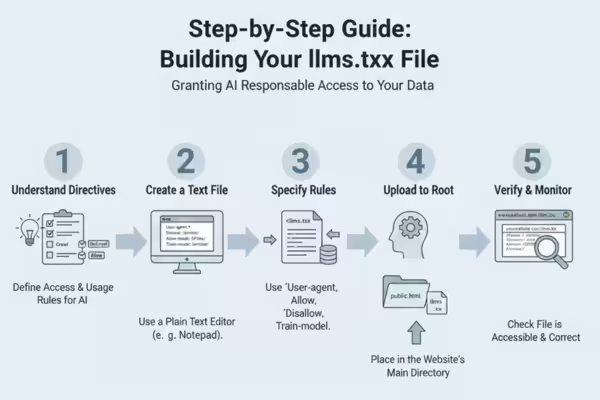
Creating an llms.txt file does not require advanced technical skills, but it does require clarity and intention. Below is a step-by-step, bullet-point breakdown explaining where to create it, how to write it, what each line means, and why every part matters.
Where to Create the File
- Use Notepad (Windows) or TextEdit (Mac) for a simple setup
- Developers can use VS Code, Sublime Text, or Notepad++
- Content teams may use any plain-text editor, as long as it does not add formatting
- Do not use Word, Google Docs, or rich-text editors
File Name and Location
- The file must be named exactly: llms.txt
- Use lowercase letters only
- Place it in the root directory of your website
- Example: https://example.com/llms.txt
- This location makes it easy for AI models to discover
File Format and Encoding
- Save the file as plain text (.txt)
- Use UTF-8 encoding
- Do not include HTML, Markdown, or special characters
- Each instruction should appear on its own line
Example llms.txt File
# llms.txt – Guidance for AI Models
Site-Name: Example Website
Purpose: Educational content about data analytics and AI standards
Preferred-Content:
– /guides/
– /documentation/
– /blog/ai/
Summary: This website provides human-reviewed, authoritative articles intended for learning and reference.
Steps to Understand and Create llms.txt for AI Models
- # llms.txt – Guidance for AI Models
- A comment line for humans
- Helps explain the purpose of the file
- Ignored by machines but useful for maintenance
- Site-Name: Example Website
- Identifies the website clearly
- Helps AI systems associate content with a brand or source
- Useful for attribution and summaries
- Purpose: Educational content about data analytics and AI standards
- Explains why the site exists
- Helps AI models understand intent and domain relevance
- Reduces misclassification of content
- Preferred-Content:
- Signals that the following paths are high-priority
- Tells AI models where the most reliable information lives
- – /guides/
- Highlights in-depth, structured content
- Often ideal for AI summarization
- – /documentation/
- Indicates technical or reference material
- Useful for factual accuracy
- – /blog/ai/
- Narrows topical relevance
- Prevents AI from over-generalizing unrelated blog posts
- Summary:
- Provides a human-written explanation for machines
- Helps AI search engines generate accurate descriptions
- Acts as a semantic anchor for interpretation
Each line contributes to making your website more understandable to AI models. Together, they form lightweight but powerful machine-readable documentation.
Comparison Among llms.txt, Robots.txt, and Sitemap.xml
Although these files are often discussed together, they serve different purposes and should not be confused with one another.
| Basis | llms.txt | Robots.txt | Sitemap.xml |
| Primary Role | AI interpretation guidance | Crawl control | URL discovery |
| Target Systems | Large language models | Search crawlers | Search engines |
| Focus | Meaning and context | Access permissions | Page listing |
| Format | Plain text (semantic) | Plain text (rules) | XML |
| Impact Area | AI summaries and answers | Crawl behavior | Index coverage |
This comparison shows that llms.txt for websites does not replace existing standards. Instead, it complements them by addressing how AI models understand content rather than how bots access it.
Why Machine-Readable Documentation Matters for AI Search Engines
Interpretation plays a vital role in search engines that use AI technology. When the content’s context is not available, assumptions are used to interpret the content. Assumptions often result in errors with search engine results. Human-readable content reduces the probability of such errors since the content owner provides guidelines directly.
Otherwise, the AI will likely focus on outdated content, secondary information, or even incomplete explanations. With precise instruction provided to the AI, the results will be more accurate and based on credible information only. In doing this, the integrity of your content is preserved.
As AI becomes the new norm in interfaces for information discovery, those websites that communicate well with machines will be easily noticed. Using AI web standards may be considered less about having control and more about cooperating with smart machines.
Also Read: Multi-Location (MTLN) Schema for Local SEO Success
Conclusion: Building Websites That AI Can Truly Understand
The internet is on the cusp of a new era in which computers will not only be looking at the content but will also understand it. In an era where clarity is not an option but a necessity, websites would not only need to reach humans but also computers and other machines.
This understanding of what llms.txt is and how it compares to the other two files—robots.txt and robots.xml—is instrumental for website owners to prepare themselves for the next move. Although the term is still in development, it is an important move towards the development of AI-friendly websites.
The future of the web is one that favors those who aim for understanding, rather than simply discovery. By embracing structured documentation now, you’re giving your site an edge in remaining relevant in the future as artificial intelligence search engines and language models further define how information is consumed. The conversation about adoption is not one about following current trends; it is about keeping up with how the web is evolving.
Most Recent Blogs
AI Website Development Platforms
Moltbook: Inside the AI-Only Social Network
Frequently Asked Questions (FAQs)
1. What is llms.txt?
llms.txt is a file with text format, which will be placed in the root directory of a website. The role of the file entails the provision of guidelines specifically to large language models/ AI on the meaning, intent, and key part of a particular website rather than URL crawling.
2. Is llms.txt an official web standard?
No, llms.txt is not yet an officially recognized web standard like robots.txt or sitemap.xml. It is an emerging, community-driven concept that reflects the growing need for AI-friendly websites and machine-readable documentation.
3. How is llms.txt different from robots.txt?
robots.txt governs the access to certain pages by search engine crawlers. On the other hand, “llms.txt” is more concerned with the interpretation of website contents by AI models.
4. Does llms.txt affect SEO rankings?
llms.txt does not directly impact traditional search engine rankings. However, it can influence how content is surfaced, summarized, or cited by AI search engines and AI-powered assistants.
5. Who should use llms.txt?
llms.txt is useful for website owners, developers, content creators, publishers, and businesses that want greater control over how their content is understood and represented by AI models.
6. Where should the llms.txt file be placed?
The file should be placed in the root directory of a website so it is easily discoverable by AI systems. For example: https://example.com/llms.txt.
7. What format should llms.txt be saved in?
llms.txt should be saved as a plain text (.txt) file using UTF-8 encoding. It should not contain HTML, Markdown, or rich formatting.
8. Can llms.txt block AI models from using my content?
No, llms.txt is not a blocking mechanism. It provides guidance, not enforcement. It helps AI systems understand preferred content and context but does not prevent access or usage.
9. Is llms.txt required for all websites?
No, it is not mandatory. However, websites that rely heavily on content authority, education, or thought leadership may benefit more from adopting it early.
10. Will llms.txt replace sitemap.xml in the future?
No, llms.txt is not a replacement for sitemap.xml. Both serve different purposes—sitemaps help search engines discover URLs, while llms.txt helps AI models understand content meaning.