
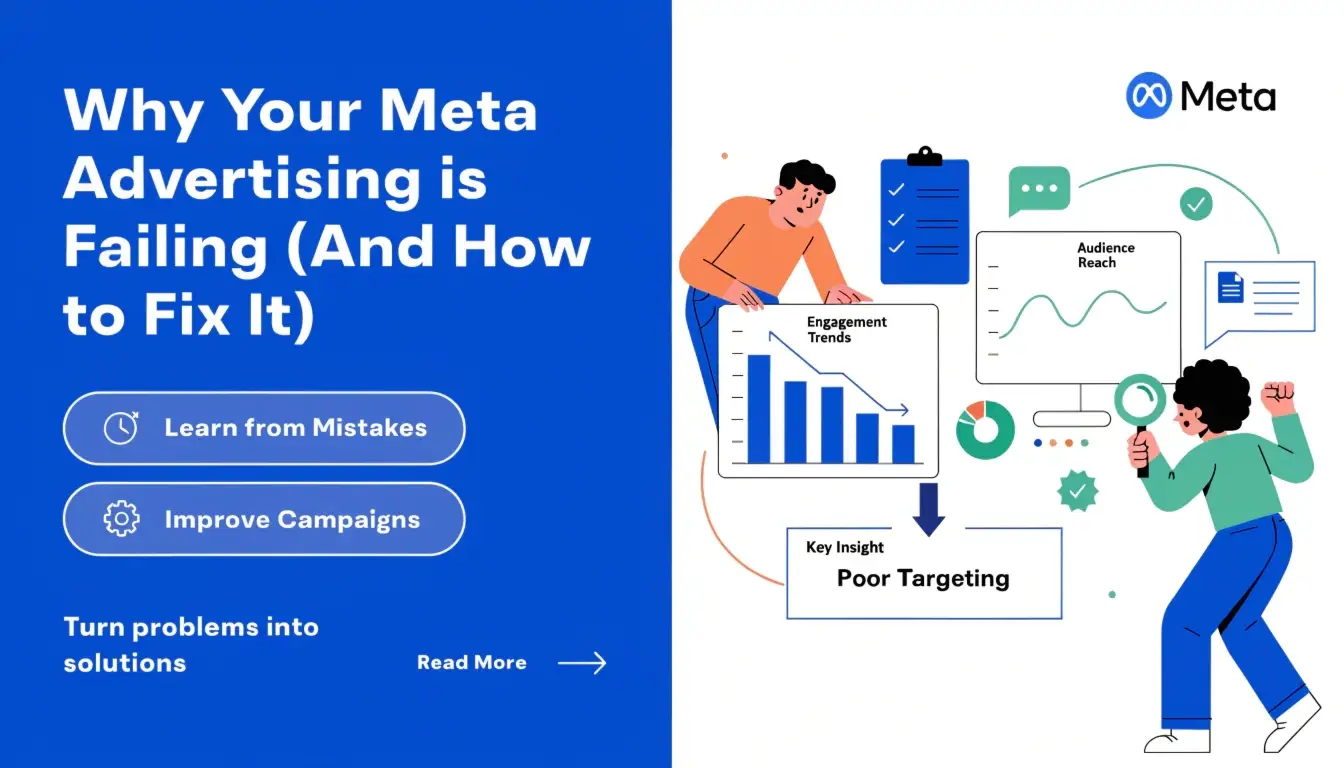
The golden age of “set it and forget it” Meta Advertising is officially in the morgue. If you’ve noticed your ad performance sliding into a ditch while your costs climb like a caffeinated rock climber, you aren’t alone. But here’s the cold truth: it’s not just “the algorithm.”
Most marketers are staring at their dashboards, refreshing the page, and praying to the Zuck for a miracle. They’re treating online marketing like a slot machine rather than a science. If you want to stop burning cash, we need to talk about why your current approach is failing and how a real marketing strategy can actually save your ROI.
Why Ad Performance Is Dropping (And No, It’s Not Just Apple)
Everyone loves to blame iOS 14. Yes, tracking changed. Yes, the data got “fuzzy.” But the real reason your ad performance is tanking is deeper than a software update.
- The Attribution Illusion: Marketers are addicted to “View-Through” conversions. Just because someone saw your ad and bought a week later doesn’t mean the ad caused the sale. Relying on inflated platform metrics is like grading your own homework—you’re always going to look like a genius until the bank account says otherwise.
- Creative Fatigue: Users have developed “ad blindness.” If your creative looks like a generic “Buy Now” banner, it’s invisible.
- The Feedback Loop is Broken: Because tracking is less precise, Meta’s AI is sometimes optimizing for the wrong people. If you feed it garbage data, it gives you garbage leads.
Also Read: Meta Tags in SEO Explained: Title, Description, Viewport, Charset & Robots Guide
Understanding Meta Advertising Today
In the old days, you could target “People who like organic kale and live in a 5-mile radius.” Today, Meta Advertising has evolved into a massive AI black box.
The platform has moved away from hyper-specific manual targeting toward “Broad” targeting. This means the algorithm is now the one doing the heavy lifting. In the modern online marketing landscape, the machine is smarter than you are at finding customers—but only if you give it the right fuel. If your ads optimization doesn’t account for this shift toward AI-driven discovery, you’re fighting a losing battle against a supercomputer.
Where Most Marketers Go Wrong (The “Loosers” Angle)
Most marketers are “Loosers” because they think ads optimization is about clicking buttons in the Ads Manager. It’s not.
The Hot Take: Your technical setup is rarely the problem. Your boring, safe, and “corporate” marketing strategy is.
The biggest mistake? Treating Meta like a sales closer instead of a brand builder. If your online marketing relies on a single touchpoint to get a conversion, you’re asking for a marriage proposal on the first date. It’s desperate, and it’s expensive. Most people “optimize” their ads by changing a button color when they should be changing their entire offer.
Ads Optimization That Actually Works
If you want to revive your ad performance, you need to pivot from technical tweaks to psychological levers.
- Creative-Led Growth: In 2024 and beyond, your creative is your targeting. The hook, the visual, and the vibe of your ad dictate who clicks.
- Dynamic Creative Testing (DCT): Stop guessing. Use DCTs to let the audience tell you which headline and image combo actually resonates.
- Post-Click Experience: You can have the best ads optimization in the world, but if your landing page looks like a scam from 2004, your conversion rate will stay in the gutter.
Why Online Marketing Needs a Bigger Approach
Relying solely on Meta Advertising is like building a house on rented land. If the algorithm hiccups, your business dies. A robust online marketing ecosystem requires diversification. You need to be thinking about how your Meta ads play with your email marketing, your SEO, and your organic social presence. When you have multiple channels working together, your ad performance stabilizes because you aren’t relying on a single platform’s tracking to tell the whole story.
Fixing Your Marketing Strategy
To fix the root cause, you have to stop looking at Meta as an isolated silo. A winning marketing strategy focuses on First-Party Data.
- Own Your Data: Use server-side tracking (like Conversions API) to bypass browser limitations.
- Focus on LTV: Stop obsessing over the first-click ROAS. Focus on the Lifetime Value of the customer.
- Better Offers: If the ad performance is low, the offer is usually weak. Make an offer so good that even a mediocre ad couldn’t mess it up.
Action Plan: The “Stop Losing” Checklist
Ready to turn it around? Follow these steps:
- Audit Your Tracking: Ensure CAPI is set up correctly so Meta actually sees your sales.
- Kill the “Safe” Creative: Produce three ads that feel “edgy” or “contrarian” to grab attention.
- Shift to Broad: Test a campaign with zero interest targeting. Let the creative find your tribe.
- Analyze the Funnel: Look at your click-through rate (CTR) vs. your conversion rate (CVR) to see exactly where the “leak” is.
- Scale Vertically: When you find a winner, don’t just double the budget—increase it by 20% every 48 hours to keep the algorithm stable.
Also Read: The Future of Marketing: Why Marketers Are Turning Into AI-Powered Strategists
Conclusion
The problem isn’t Meta Advertising—the problem is that the “old way” of doing things is dead. Declining ad performance is just a symptom of a stale marketing strategy. If you keep trying to hack the system with technical tricks while ignoring the human element and the data reality, you’ll stay a “Looser.”
Stop blaming the platform. Start optimising for the person on the other side of the screen. That is the only ads optimization that ever truly mattered.
Frequently Asked Questions
Why is my Meta Advertising ROI suddenly dropping?
Your ad performance is likely dropping because of a reliance on outdated tracking and “safe” creative. Between privacy updates like iOS 14/15 and increased competition, the platform can no longer find your customers using just technical settings. High-performing Meta Advertising now requires a marketing strategy that prioritizes high-impact creative and first-party data rather than just pushing buttons in Ads Manager.
How do I fix poor ad performance in 2026?
The fastest way to improve ad performance is to pivot your ads optimization toward creative testing. Stop micro-managing your audiences and start testing different psychological hooks, video formats, and offers. If the machine (Meta’s AI) has the right “bait” (your creative), it will find the right fish even without specific interest targeting.
What is the best marketing strategy for small budgets?
If you have a limited budget, don’t spread yourself thin across every online marketing channel. Focus on one core offer and use Meta Advertising to drive traffic to a high-converting landing page. Focus on “Broad” targeting to keep your CPMs (Cost Per 1,000 Impressions) low, and use your limited funds to test 3–5 wildly different creative concepts to see what sticks.
Does ads optimization still matter if the AI does the targeting?
Absolutely. However, the definition of ads optimization has changed. It’s no longer about tweaking age ranges or zip codes; it’s about optimizing your “Conversion API” (CAPI) events, improving your website load speed, and refining your messaging. You are now optimizing the environment in which the AI operates, rather than the AI itself.
How does online marketing differ from just running Facebook ads?
Relying only on Meta Advertising is a gamble, not a business. A true online marketing approach integrates multiple touchpoints. For example, using Meta for discovery, Google for intent-based searches, and Email/SMS for retention. This creates a holistic marketing strategy where your ad performance isn’t the only thing keeping your business afloat.