
Introduction: Google Just Entered Your Shopping Cart
Disclaimer: This article includes both confirmed information about Google’s AI commerce initiatives and forward-looking strategic analysis. Some sections represent predictions and interpretations, not official Google statements.
Let’s start with a scenario that sounds almost too convenient to be real.
You open Google on your phone. You type: “wireless headphones with noise cancelling, long battery, under 10,000 rupees.” Instead of getting a list of ten blue links sending you to ten different websites — you get something entirely different.
You get a product. A recommendation. A price. A delivery date. An “Add to Cart” button. And when you tap it, the product goes into your Google Universal Cart — sitting comfortably alongside the running shoes you added this morning and the laptop bag you found last night.
No new accounts. No duplicate address forms. No payment details to re-enter. One tap on “Secure Checkout with Google Pay” and it’s done.
That is not a mockup or a future concept. That is what the Google Universal Cart interface — currently live in beta — looks like right now.
And if you are running an ecommerce business, providing SEO services, managing digital marketing campaigns, or building your brand online — this single product update is one of the most consequential things to happen to your industry in the last decade.
Here is the thing though. On the surface, Google Universal Cart looks like a consumer convenience feature. Faster checkout. Less friction. Smarter shopping. And yes, all of that is true. But underneath it, there is a structural shift in who controls the relationship between a buyer and a seller online. A shift in where transactions happen. A shift in what traffic actually means. A shift in whether your website is a destination or just a data source.
That is what this article is really about.
We are going to explain exactly what Google Universal Cart is, how it works technically, why Google built it, and what it genuinely means for ecommerce purchases, website traffic, SEO services, digital marketing, GEO, and the future of how products are discovered and bought online.
By the end of this, you will not just understand Google Universal Cart. You will understand the strategic game being played — and how to position yourself to win inside it.
What Is Google Universal Cart?
Google Universal Cart is a centralized, AI-powered shopping cart system embedded directly inside Google’s search and commerce ecosystem.
In plain language: it is one single cart, managed by Google, that lets users add products from multiple different stores and complete their entire purchase — without ever leaving Google.
Traditionally, online shopping looked like this. You search on Google. You click a result. You land on an ecommerce website. You browse. You add to cart. You create an account. You fill in your address. You enter card details. You submit. You get a confirmation email. That entire process — repeated across every merchant, every platform, every purchase — is full of friction. And friction kills conversions.
Google Universal Cart is designed to collapse that entire process into a single, seamless experience managed by one trusted interface.
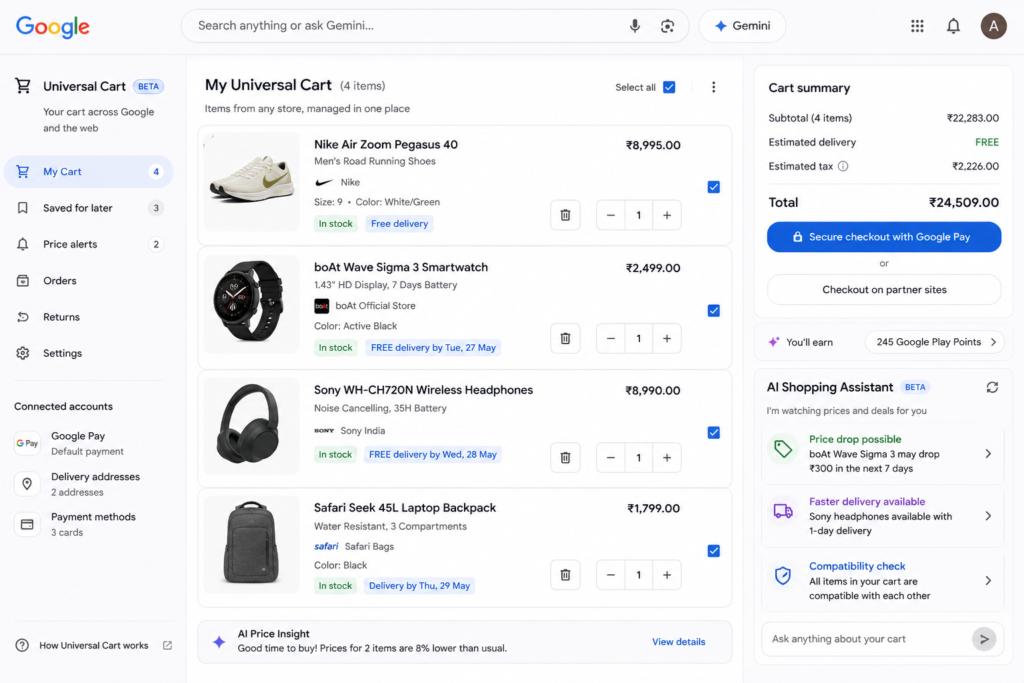
Look at the interface screenshot that has been making rounds across the SEO and ecommerce community. “My Universal Cart” shows four products from four completely separate brands — Nike Air Zoom Pegasus 40 running shoes, a boAt Wave Sigma 3 Smartwatch, Sony WH-CH720N wireless headphones, and a Safari Seek 45L Laptop Backpack — all sitting together in one cart. The cart summary shows the subtotal, a free delivery badge, estimated tax, and a total of ₹24,509. One button: “Secure checkout with Google Pay.”
On the right panel, an AI Shopping Assistant is actively monitoring the cart: flagging a potential ₹300 price drop on the boAt smartwatch, notifying that Sony headphones have faster 1-day delivery available, and confirming that all four products in the cart are compatible with each other.
This is not just a checkout tool. This is Google operating as a full-stack commerce platform — handling discovery, comparison, curation, AI advisory, payment, and fulfillment orchestration, all from within its own interface.
Google Universal Cart is the moment Google stopped being a search engine for shopping and became the shopping experience itself.
Why Google Built Universal Cart: The Real Story
To understand why Google built this, you need to understand the competitive landscape Google is fighting in.
For two decades, Amazon has owned the end-to-end commerce funnel. People search on Amazon. They find on Amazon. They buy on Amazon. The transaction — and all the data that comes with it — stays inside Amazon. Google has historically owned discovery: people search on Google, find a product, and then leave Google to buy it elsewhere.
Google made advertising revenue from that handoff. But it never owned the purchase. And in an AI-driven world, the platform that owns the purchase owns the most valuable data: what people actually buy, not just what they search for.
That is the strategic gap Google Universal Cart is designed to close.
The Friction Problem
There is also a genuine consumer problem being solved. Online cart abandonment rates average between 70% and 80% globally. The primary reasons are almost always the same: forced account creation, too many checkout steps, payment security concerns, and unexpected costs at checkout. Every ecommerce website that forces users through a five-step checkout flow is leaking conversions every hour of every day.
Google Universal Cart eliminates the most friction-generating moments in online shopping. Saved payment methods through Google Pay. Pre-saved delivery addresses. One-tap purchase confirmation. The consumer experience genuinely improves.
The AI Commerce Ambition
But the deepest reason Google built Universal Cart is AI.
Google has invested enormous resources into Gemini AI — its large language model and AI assistant platform. The long-term vision for Gemini is not just answering questions. It is completing tasks. And one of the most commercially valuable tasks an AI can complete on a user’s behalf is buying things.
For AI-assisted or AI-autonomous purchasing to work, there needs to be a commerce layer that AI can interact with programmatically. A standardized checkout infrastructure. A trusted payment system. A centralized cart that AI can manage across sessions and devices.
Google Universal Cart is that infrastructure. It is the foundation layer that makes AI-powered ecommerce purchases possible at scale. Without it, Gemini AI could recommend a product but could not close the transaction. With it, the entire loop closes.
How Google Universal Cart Works: The Complete Flow
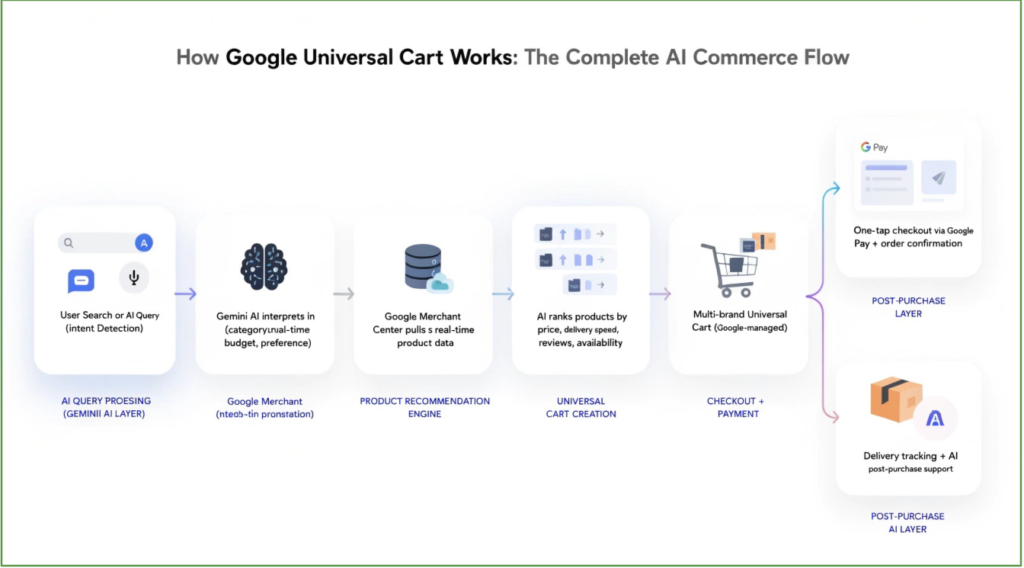
Let’s walk through the full operational flow, because understanding each step will show you exactly where the opportunities and risks sit for your business.
Step 1: User Intent and AI Query Processing
A user searches Google — through text, voice, or Gemini AI’s conversational interface. The AI does not just match keywords. It interprets intent. “Running shoes for long-distance road running, size 9, white, under 10K” is parsed simultaneously for category, use case, size, color, and price constraint. The AI understands what the user wants, not just what they typed.
Step 2: AI Recommendations via Merchant Center
Gemini AI queries Google Merchant Center in real time — pulling product listings from merchants who have integrated their catalogs. Products are ranked not just by relevance but by a combination of factors: price competitiveness, delivery speed, review scores, stock availability, and AI trust signals derived from structured data quality.
This is a critical point that most ecommerce businesses have not fully internalized yet: the quality of your structured data in Google Merchant Center directly determines whether your products appear in AI-driven recommendations. It is not just about SEO anymore. It is about machine readability.
Step 3: Product Discovery and Cart Addition
Products surface inside Google’s interface with all key information visible — price, delivery date, color/size variants, seller details, and availability status. Users can add directly to Universal Cart without visiting the merchant’s website. The cart persists across devices, across sessions, and across different merchants.
Step 4: AI Shopping Assistant Monitoring
Once items are in the cart, Google’s AI Shopping Assistant actively monitors them. Price movements. Better delivery options. Product compatibility checks. Stock alerts. This is not passive. The AI is working on the user’s behalf continuously — a feature that traditional ecommerce websites simply cannot match individually, but Google can offer systematically across all merchants simultaneously.
Step 5: Checkout via Google Pay
When the user is ready, checkout happens through Google Pay. Saved addresses, saved payment methods, and a single confirmation tap. The merchant receives the order through Google’s commerce APIs. Fulfillment happens on the merchant’s side. Google handles the front-end transaction layer.
Step 6: Post-Purchase AI Management
After purchase, the AI can track delivery status, surface return windows, suggest complementary products, and re-engage users at the right moment. The post-purchase relationship — traditionally one of the most valuable phases of ecommerce for building loyalty — now sits inside Google’s ecosystem.
Will Your Website Cart Disappear? The Honest Answer
This is the question that has been generating anxiety in ecommerce circles — and the answer is nuanced but important.
In the short term, no. Website carts are not disappearing. Google Universal Cart is launching as an additional layer, not a replacement. Merchants will still have their own websites. Their own checkout flows. Their own cart systems. The Universal Cart coexists with all of that — at least initially.
Google is positioning Universal Cart as a convenience option: “You can buy here on our platform, or continue to the merchant’s site if you prefer.” That “checkout on partner sites” button visible in the interface confirms this dual-path approach.
But here is the strategic reality that every ecommerce operator should sit with honestly: when one option is frictionless and the other requires multiple steps, which one will most users choose?
Cart abandonment research has shown consistently that every additional step in a checkout flow reduces conversions. Google’s one-tap checkout through Google Pay is, by design, the lower-friction option. Over time, as user behavior normalizes around Universal Cart, the expectation gap between Google’s checkout experience and a typical ecommerce website’s checkout will grow.
The trajectory is clear even if the timeline is not. Initially, website carts and Universal Cart coexist. Over the next few years, the proportion of transactions flowing through Universal Cart grows. And eventually, for many product categories and consumer segments, the website cart becomes secondary — a fallback for users with specific preferences or for purchases involving complex customization that AI cannot handle.
It is not that website carts will disappear. It is that they may gradually become less relevant as the default commerce experience shifts to Google’s layer.
The strategic question for ecommerce businesses is not “will my cart survive?” but “what am I building that creates value regardless of where the transaction happens?”
Merchant Integration: What You Actually Need to Set Up
To have your products appear in Google Universal Cart and AI-powered recommendations, there is a technical infrastructure you need to build — and if you have not started already, now is the time.
Google Merchant Center (The Foundation)
Google Merchant Center is the backend platform where merchants submit their product catalogs to Google. For Universal Cart, having a well-maintained Merchant Center account is table stakes. Your product feed needs to include accurate titles, descriptions, images, pricing, availability, shipping information, and return policies — all kept current in real time.
Stale data, inaccurate prices, or incorrect stock availability will not just result in poor AI recommendations — they will erode Google’s trust in your feed, reducing your overall visibility in AI-powered shopping experiences.
Structured Data and Schema Markup
On your ecommerce website itself, implementing structured data using Schema.org formats is critical. Product schema, Offer schema, Review and AggregateRating schema, BreadcrumbList, and ShippingDeliveryTime markup all provide the machine-readable signals that AI systems use to understand, compare, and recommend your products.
Think of structured data as the language your website speaks to AI. If your website cannot communicate in that language clearly, AI systems will work with incomplete or inferred information about your products — which means less accurate recommendations and reduced visibility.
Universal Commerce Protocol and APIs
As Google’s commerce ecosystem matures, the Universal Commerce Protocol — the standardized API layer that enables real-time inventory, pricing, and order management communication between Google and merchants — will become increasingly central.
Merchants will need to provide API access that allows Google to check stock levels, confirm pricing, process orders, and retrieve tracking information in real time. This is not optional if you want full integration. It is the infrastructure that makes Universal Cart function accurately.
For merchants using major ecommerce platforms like Shopify, WooCommerce, or Magento, this integration will increasingly be handled through certified plugins and partner integrations. For custom-built ecommerce systems, dedicated API development will be required.
Review and Trust Signal Infrastructure
AI recommendation systems weight social proof heavily. Google’s AI Shopping Assistant draws on review data, return rate signals, merchant reliability scores, and customer satisfaction metrics when determining which products to surface in recommendations. Building a systematic review collection strategy is not just good for SEO anymore — it is fundamental infrastructure for AI recommendation eligibility.
The Big Revenue Question: Will Ecommerce Make More or Less Money?
Here is where the conversation gets genuinely interesting — and where the answer is more complex than most people expect.
The headline answer is: in the short to medium term, many ecommerce businesses — especially smaller ones — may actually make more money because of Google Universal Cart. Not less.
Let that sink in for a moment, because it runs counter to the fear narrative that dominates most discussions about Google’s expansion into commerce.
Why Ecommerce Revenue May Initially Increase
The math of cart abandonment is devastating for ecommerce. If your store converts 2% of visitors and 78% of cart adds are abandoned, you are leaving enormous revenue on the table. Any systemic reduction in checkout friction translates directly into increased conversion rates.
Google Universal Cart’s one-tap checkout eliminates the single biggest source of abandonment: the checkout process itself. For products already in a user’s Universal Cart, the barrier to completing the purchase drops dramatically. That means more completed transactions for the same amount of product interest.
For smaller ecommerce businesses that currently struggle to compete on checkout experience against Amazon and Flipkart — brands that have invested years and millions into optimizing their checkout flows — Universal Cart is a massive equalizer. Suddenly, a 50-employee online store can offer the same frictionless checkout experience as a retail giant. Not because they built it themselves, but because they plugged into Google’s infrastructure.
The Opportunity for Newer Ecommerce Brands
This is particularly significant for emerging and newer ecommerce websites. Brands that have struggled with high cart abandonment rates due to less polished checkout experiences can now compete on product quality, pricing, and structured data quality — not on checkout UX budget.
A well-optimized product feed combined with competitive pricing and strong reviews could get a brand-new ecommerce store into Universal Cart recommendations against incumbents with massive marketing budgets. That is genuinely exciting for the long tail of ecommerce.
The Hidden Twist Behind the Growth: Dependency, Control, and the Long Game
Now we need to talk about what happens after the growth.
Because here is the strategic trap that many ecommerce businesses will walk into without realizing it — until it is too late to reverse course easily.
The same infrastructure that gives you growth also gives Google control over your customer relationships.
The Platform Dependency Risk
Every transaction that flows through Google Universal Cart is a transaction where Google, not you, owns the checkout experience. And increasingly, the customer relationship.
When a customer buys through Google Pay inside Universal Cart, their loyalty is to the convenience of the platform — not to your brand. Their next purchase recommendation is served by Google’s AI — which may or may not surface your products again, depending on a hundred algorithm factors you do not fully control.
You fulfilled the order. You shipped the product. You bear the return risk. But Google owns the relationship touchpoint where the next purchase decision gets made.
This is not dissimilar to what happened with Amazon Marketplace. Thousands of brands grew rapidly by listing on Amazon, only to find themselves competing on price against Amazon’s own private label products, stripped of their brand identity, and entirely dependent on a platform that could change fees, rank algorithms, or policies at any time.
Google Universal Cart may follow a similar arc. Initial enthusiasm. Rapid growth. Increasing dependency. Then, potentially, terms changing, fees emerging, or competitive pressures from Google’s own commerce initiatives.
The Brand Visibility Reduction
When a customer experiences your product through Google’s interface — with Google’s design language, Google’s checkout flow, Google’s AI assistant providing the product advice — how much of that experience reinforces your brand?
Not much.
Brand-building has always been partly about the experience of interacting with a company’s owned digital space — the website design, the product page storytelling, the email confirmation that reflects brand voice, the unboxing experience connected to a direct relationship. When the transaction layer moves to Google, much of that brand-building surface area disappears from the customer journey.
Over time, products that primarily sell through Google’s commerce ecosystem risk becoming commodities. Chosen by price and AI recommendation score. Not by brand affinity or loyalty.
AI-Driven Price Wars
The AI Shopping Assistant in Universal Cart is, among other things, a price comparison engine. It surfaces price drop alerts. It compares options. It optimizes for value on the user’s behalf.
This is great for consumers. But for merchants, it creates systematic downward pressure on prices. If your AI recommendation score is partly determined by price competitiveness, and competitors are competing on the same metric, the result is a race to the bottom on margins.
This has happened in every marketplace that made price comparison frictionless. Google Universal Cart, with AI-powered price monitoring at scale, will accelerate this dynamic significantly in categories where products are commoditized.
What Happens to Your Ecommerce Website?
Let’s be specific about the impacts on ecommerce websites themselves, because “things will change” is not a strategy.
Direct Traffic May Decline for Transactional Queries
If a user discovers and purchases your product entirely within Google’s interface, they never visit your website. Your analytics will show that traffic — which previously landed on product pages — has reduced. But simultaneously, your order volume through Google’s commerce channel may have increased.
This creates a metrics paradox that many ecommerce businesses will find genuinely disorienting. Less website traffic. More orders. What does that mean for the metrics you use to make decisions?
It means ecommerce businesses need to evolve their success metrics. Revenue, customer lifetime value, and repeat purchase rates become more important. Raw website session counts become less important as a standalone metric.
Affiliate and Review Content Faces Existential Pressure
Here is a downstream impact that deserves its own spotlight: if Google’s AI Shopping Assistant synthesizes product comparisons and recommendations directly inside the search interface, what happens to the “best wireless headphones under 10,000” listicle articles that affiliate blogs and review websites publish?
They lose traffic. Significantly.
Gemini AI can already synthesize a product comparison from structured data across multiple merchant feeds in real time. It does not need a human-written listicle to do this. As AI Shopping becomes more sophisticated, the information that comparison blogs and review sites package into articles becomes directly available inside Google’s interface — with actionable purchase options attached.
This is one of the most underappreciated disruptions that Google Universal Cart represents for content-driven SEO and affiliate marketing models.
Also Read: How AI and Google UCP Update Are Rewriting the Rules of Ecommerce
Content Websites Still Have a Role — But a Different One
That said, content and context are not dying. They are changing shape.
AI systems still need high-quality source content to train on, to cite, and to draw authority signals from. Brand storytelling, detailed use-case articles, expert reviews, and in-depth buyer’s guides still generate the trust signals that AI recommendation systems need to evaluate products.
The model shifts from “attract traffic with content, convert with checkout” to “build AI credibility with content, transact through Google’s layer.” Content strategy remains relevant — but its role in the funnel changes fundamentally.
The Transformation of SEO Services and Digital Marketing
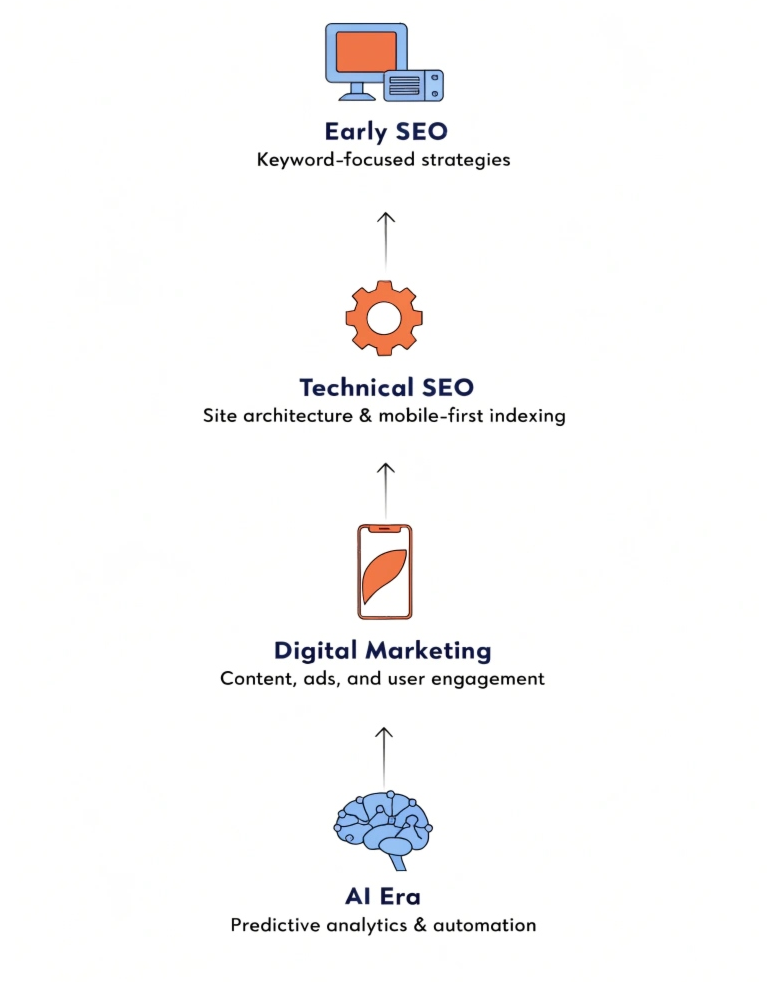
If you provide SEO services to ecommerce clients, or manage digital marketing campaigns for online brands, you are looking at the most significant strategic evolution in your discipline since mobile optimization became mandatory.
Traditional Keyword SEO Is Necessary But No Longer Sufficient
Ranking on page one for high-volume transactional keywords will still drive value. It is not irrelevant. But for ecommerce specifically, the decision about which products appear in AI-powered recommendations is made by systems that operate on entirely different logic than traditional keyword ranking algorithms.
Google’s AI recommendation engine weighs feed data quality, pricing competitiveness, structured data richness, review credibility, delivery reliability, and AI trust signals. It does not rank based primarily on keyword density, domain authority, or backlink profiles.
This means that SEO services for ecommerce clients need to expand. Not replace traditional SEO, but expand dramatically to include commerce-specific optimization that most SEO agencies currently do not offer.
The New Ecommerce SEO Stack
In an AI commerce world, ecommerce SEO services need to encompass:
-
- Google Merchant Center feed optimization and ongoing quality management
-
- Structured data implementation and validation across all product, offer, and review schemas
-
- AI-readability audits — ensuring product information is machine-parseable and accurate
-
- Review acquisition and response strategy as a ranking signal
-
- Competitive pricing intelligence and monitoring frameworks
-
- Delivery and inventory data accuracy management
-
- E-E-A-T optimization — building brand authority signals that AI systems recognize
-
- GEO content strategy — creating content that AI engines cite in product recommendations
-
- AEO optimization — formatting information so AI answers surface your products first
Digital Marketing and Google Ads Evolution
Google Ads is being reengineered around AI-driven commerce. Performance Max campaigns, which already use AI to optimize across all of Google’s ad inventory, are becoming the central vehicle for ecommerce advertising. Shopping campaigns feed directly into Universal Cart product visibility.
The future of Google Ads in an AI commerce context involves what we might call “AI recommendation ads” — paid placements inside Google’s AI-driven shopping interface, where brands can bid for enhanced visibility in Universal Cart recommendations. This is not confirmed in full detail yet, but the commercial logic is inevitable. Google will monetize its commerce layer with advertising, and understanding that infrastructure early will give brands and agencies a significant head start.
The Rise of GEO and AEO: Optimizing for AI, Not Just Search
Two concepts that have been gaining momentum in advanced SEO circles deserve a deep, clear explanation here, because they are about to become central to every serious digital marketing conversation.
What Is GEO — Generative Engine Optimization?
Generative Engine Optimization is the practice of optimizing your digital presence — content, product data, brand signals, and technical infrastructure — so that AI-powered generative engines favor your brand when synthesizing recommendations, summaries, and answers.
Traditional SEO is about earning a position in a list of links that a human then chooses from. GEO is about earning selection by an AI system that synthesizes information and makes a direct recommendation — without showing a traditional results list at all.
In the context of Google Universal Cart, GEO means ensuring that when Gemini AI processes a shopping query, your product is the one it selects as the best match. It means building the technical and content infrastructure that makes your products legible, trustworthy, and recommendable to AI systems.
GEO for ecommerce specifically involves:
-
- Comprehensive, AI-readable product descriptions that answer the questions shoppers actually ask
-
- Rich structured data that gives AI systems complete product context without interpretation gaps
-
- Brand entity optimization — ensuring your brand is clearly understood and trusted by AI knowledge graphs
-
- Content that AI engines cite when generating shopping recommendations in your category
-
- Pricing, availability, and specification accuracy that AI systems can verify and trust
What Is AEO — Answer Engine Optimization?
Answer Engine Optimization focuses on getting your content, products, or brand selected as the direct answer to a user’s query — in AI Overviews, featured snippets, voice responses, and conversational AI interactions.
The difference between SEO and AEO is this: SEO aims for position one in a list of options. AEO aims to be the option — the single, authoritative answer that the AI surfaces without presenting alternatives.
For ecommerce, AEO means that when a user asks “What is the best laptop bag for a 15-inch laptop under 2000 rupees?” — your product is what appears as the direct answer in Google’s AI interface, with an option to add it immediately to Universal Cart.
Achieving AEO requires:
-
- FAQ sections on product pages using natural, question-formatted language
-
- Clear, concise product summaries that answer common buying questions in the first paragraph
-
- Comparison tables and specification data that AI can use to evaluate your product against alternatives
-
- Use-case-specific content targeting the exact scenarios where your product excels
-
- Review and social proof signals that make your product the credible, low-risk choice an AI would confidently recommend
Why GEO and AEO May Become More Important Than Traditional SEO
Here is the uncomfortable but strategic truth: as AI-powered shopping interfaces become the default for a growing proportion of ecommerce queries, the value of a traditional page-one keyword ranking for transactional searches declines relative to the value of being the AI’s preferred recommendation.
A #3 organic ranking on a traditional search results page gets a certain click-through rate. An AI recommendation inside Google Universal Cart, surfaced to a high-intent shopper with a one-tap purchase option, converts at a fundamentally different rate.
Businesses that invest in GEO and AEO now — while most competitors are still thinking purely in traditional SEO terms — will build a visibility advantage in AI-driven commerce that will compound over the next several years.
Google Ads in the AI Commerce Era
Let’s talk about what happens to paid advertising in a world shaped by Google Universal Cart.
Performance Max campaigns are already Google’s primary AI-driven advertising product — using machine learning to optimize ad delivery across Search, Shopping, Display, YouTube, Gmail, and Maps simultaneously. These campaigns feed directly into Google’s shopping ecosystem, and their integration with Universal Cart will deepen significantly over time.
The most important evolution to watch is what we might call sponsored AI recommendations — a paid layer within Google’s AI-driven product discovery experience. When Gemini AI surfaces product recommendations in response to a shopping query, the commercial reality is that some of those recommendations will carry paid placement components, similar to how traditional shopping ads work today but integrated far more natively into conversational AI responses.
This creates a new form of digital marketing competition. The question will not just be “who ranks highest organically?” but “who is most effective at combining organic recommendation quality with strategic paid amplification inside Google’s AI commerce interface?”
Brands and agencies that understand both the organic optimization layer (GEO, structured data, Merchant Center quality) and the paid amplification layer (Performance Max, Shopping campaigns, AI-native ad formats) will have a decisive advantage.
What Happens to Affiliate Marketing and Review Websites?
This is a conversation that deserves honesty, because the impact here is significant and not widely discussed.
Affiliate marketing and product review content publishing have thrived for years on the back of a simple model: write comprehensive “best of” lists, rank for high-intent shopping queries, insert affiliate links, earn commissions on purchases made through those links.
Google Universal Cart, combined with Gemini AI’s ability to synthesize product comparisons directly inside search results, threatens this model structurally.
If a user searching for “best noise-cancelling headphones” gets a Gemini AI-synthesized comparison with product recommendations, price information, delivery details, and a direct add-to-Universal-Cart option — all inside Google’s interface — the incentive to click through to a third-party review article diminishes dramatically.
Traffic to comparison and affiliate content sites targeting transactional shopping queries is likely to decline. This is not speculative — we have already seen early versions of this with AI Overviews reducing clicks to informational content. The commerce version of this is coming for affiliate sites next.
The businesses that will survive this shift are those building genuinely differentiated content value: in-depth testing, original research, authentic community-driven recommendations, and expert analysis that AI cannot synthesize from product feed data alone. The middle tier of thin affiliate content — aggregating information that is already available in structured data — is the most exposed.
The Future of Ecommerce Purchases: What AI Will Change Next
We are currently at the early stages of a much larger transformation in how ecommerce purchases happen. Let’s look at where the trajectory leads.
AI-Assisted Purchases (Present)
This is where we are now. AI helps users discover products, compare options, understand specifications, and navigate pricing. The user still makes the final purchase decision and completes the transaction with a tap. The AI is an advisor.
AI-Agentic Purchases (Near Future — 2026-2027)
The next stage is agentic commerce — where AI systems complete purchases on behalf of users based on pre-set preferences, budgets, and goals. “Reorder my usual supplements when they run low” becomes a fully automated instruction that AI executes without user involvement at the transaction moment.
Google’s development of Gemini as an AI agent capable of taking actions (not just providing information) is directly pointed at this capability. Universal Cart is the commerce infrastructure that makes agentic purchasing technically possible at Google’s scale.
Predictive and Subscription Commerce (2027-2029)
AI systems that learn your consumption patterns, lifestyle needs, and seasonal behaviors will begin predicting purchases before you initiate a search. Running low on household essentials? Your AI knows. Seasonal wardrobe update time? The AI has learned your pattern.
The consumer’s role in ecommerce gradually shifts from active searcher to approver — reviewing AI-suggested purchases rather than initiating them. For certain product categories (consumables, recurring needs, highly habitual purchases), this may become the dominant mode of commerce.
Voice and Screen-Free Commerce
As voice interfaces mature, a growing proportion of ecommerce purchases will happen through voice-activated AI assistants with no visual interface at all. “Hey Google, add my usual protein powder to cart and complete checkout” becomes a standard interaction.
For this to work, products need to be so deeply integrated into Google’s commerce infrastructure — perfectly structured, fully trusted, and available for one-command purchase — that the AI can complete the transaction with confidence without visual confirmation.
Predictions: 2026 to 2030 — What the Ecommerce Landscape Will Look Like
2026 — Universal Cart Mainstream Adoption
Google Universal Cart exits beta, rolls out across major markets. Merchant Center integration becomes table stakes for ecommerce visibility. First wave of SEO agencies begins offering GEO and AEO services. Traditional product review blogs begin seeing traffic declines in high-competition shopping categories.
2027 — AI Recommendation Advertising Emerges
Google launches a sponsored AI recommendations product — paid placement within Universal Cart and Gemini AI shopping responses. Performance Max campaigns deeply integrate with Universal Cart conversion data. Ecommerce businesses begin measuring “AI recommendation share” alongside traditional metrics like organic rankings and paid impression share.
2028 — Agentic Commerce Reaches Scale
Gemini AI agents complete purchases autonomously for a growing segment of high-intent, habitual shopping. Subscription and replenishment commerce sees significant disruption. Voice and ambient commerce accelerates. Ecommerce website traffic for transactional queries declines measurably while order volumes through Google’s commerce layer increase.
2029 — Merchant Dependency Reaches Critical Mass
A significant proportion of ecommerce transactions for commoditized product categories flows through Google’s commerce ecosystem. Merchants begin experiencing platform risk — dependency on a single infrastructure layer controlled by Google. Regulatory scrutiny of Google’s commerce practices increases in key markets. Savvy brands double down on direct-to-consumer channels to maintain customer relationship ownership.
2030 — Google as Commerce Infrastructure
Google operates, effectively, as the operating system for a large portion of online commerce. Merchant Center is as critical as a physical store lease. AI recommendation algorithms are the new storefront traffic. Brands that built AI-readable product infrastructure early, diversified their customer relationship channels, and developed strong GEO and AEO positioning hold significant competitive advantages.
Final Conclusion: The New Ecommerce Imperative
Let’s come back to the core strategic insight that should shape every decision you make about your ecommerce business and digital marketing strategy in the years ahead.
The future of online commerce is not just about being searchable. It is about being AI-recommendable.
These are fundamentally different things. Being searchable means ranking for keywords that humans type into a search box and then choose from a list of results. Being AI-recommendable means being the product, brand, or answer that an AI system selects as the best match when it is making or facilitating a purchase decision on a user’s behalf.
Google Universal Cart is the clearest, most tangible evidence yet of this shift. It is not a theoretical future. It is live, in beta, with real products, real merchants, and real transactions happening inside Google’s interface right now.
The businesses that will struggle are those treating this as just another Google feature to monitor. The businesses that will thrive are those who recognize it as a structural change and adapt their entire commerce infrastructure accordingly.
That means building excellent Merchant Center data today. Implementing rich structured data today. Developing a GEO content strategy today. Optimizing for AEO today. Building the review and trust signal infrastructure today. Not because these are nice-to-haves, but because they are the foundational requirements for AI recommendation eligibility — and AI recommendation eligibility is increasingly what drives ecommerce revenue.
At the same time — and this is equally important — you cannot abandon brand ownership. You cannot let the entirety of your customer relationship migrate into Google’s ecosystem without building parallel channels that you control directly. Email lists. Loyalty programs. Direct-to-consumer content. Community building. These are not legacy marketing tactics. They are the insurance policy against platform dependency.
Google Universal Cart will give many ecommerce businesses their best growth opportunity in years. It will also, gradually, reshape the terms on which that growth happens. The businesses that navigate this successfully will be those who play the growth game intelligently while protecting their brand equity, their customer relationships, and their long-term independence.
Be AI-recommendable. Be Google-integrated. But never stop being yourself — because your brand is the one thing Google cannot put in a cart.
The future of ecommerce is being written right now. The question is whether your business is the one writing it — or the one being written out of the story.