
Quick Reference: Key Terms
| Term | Definition |
| Google Core Update | A broad algorithm change that re-evaluates content quality across the entire web |
| E-E-A-T | Experience, Expertise, Authoritativeness, Trustworthiness — Google’s content credibility framework |
| Information Gain | The net new value your content adds beyond what existing top results already cover |
| Topical Authority | Google’s assessment of how comprehensively a site covers a specific subject area |
| Helpful Content | Google’s system for identifying content made primarily for people, not for rankings |
| SERP Reality Check | Pre-writing analysis of top-ranking pages to identify gaps and differentiation opportunities |
Also Read: Structured Data in SEO – A Beginner-Friendly, Practical Schema Markup Guide
Introduction: Why Rankings Vanish Overnight
You wake up one morning, open Google Search Console, and your traffic has dropped by 40%. No manual penalty. No technical errors. Just a Google core update that quietly reshuffled the rankings — and your content landed on page three.
This has happened to thousands of websites since 2018. It happened with the Medic update. It happened with BERT. It happened with the Helpful Content system rollout in 2022–2023, and it is still happening in 2026 with Google’s increasingly AI-powered ranking infrastructure.
The frustrating part? Most site owners don’t know why. They chase symptoms — tweaking title tags, adding more words, refreshing old posts — without fixing the actual cause.
This guide cuts through the noise. You’ll learn exactly what makes content vulnerable to core updates, what Google is actually rewarding in 2026, and a practical framework for building content that doesn’t just survive updates — it gains from them.
What Is a Google Core Update?
A Google core update is a broad change to Google’s search ranking algorithm that affects how all pages across the web are evaluated and ranked. Unlike spam updates (which penalize rule-breaking) or page experience updates (which reward technical performance), core updates are fundamentally about content quality re-evaluation.
| KEY DEFINITION A Google core update is not a penalty. It is a recalibration of what Google considers ‘the best answer’ for a given query. Sites that drop in rankings haven’t been punished — they’ve been re-evaluated against a higher standard. |
Google runs thousands of quality rater assessments before each update. Human raters evaluate pages using the Search Quality Evaluator Guidelines — a document that runs to nearly 200 pages and is built around one core concept: does this page genuinely help the person who found it?
In 2026, Google’s algorithm is increasingly reinforced by large language models that can assess semantic quality, experiential depth, and topical coherence — not just keywords and backlinks.
The One Common Factor in Every Core Update
Here is the thread that runs through every single core update Google has ever shipped: Google is always moving toward rewarding genuine value and away from rewarding manufactured signals.
| Then (Pre-2015) | Now (2026) |
| Keyword density & exact match | Topical relevance & semantic depth |
| Backlink quantity | Backlink quality + brand authority |
| Word count | Completeness + information gain |
| Domain age | Demonstrated expertise over time |
| On-page SEO tricks | Real user experience signals |
The ranking logic has evolved through three distinct eras. First came keyword relevance: rank for the words on your page. Then came usefulness: rank for answering the question well. Now we’re in the experience era: rank for content that only a genuine expert could produce.
That last shift is what makes most generic AI-generated content structurally vulnerable. It can pass keyword relevance. It can approximate usefulness. But it cannot demonstrate real experience — and that’s increasingly what separates durable rankings from volatile ones.
Why Most Content Gets Hit by Core Updates
Most content that loses rankings after a core update shares one or more of the following characteristics:
Thin or Generic Content
Thin content doesn’t mean short. A 4,000-word article can be completely thin if it only restates what every other article already says. Generic content is the SEO equivalent of a product that technically works but offers nothing distinctive. Google’s raters are trained to identify ‘low value-added’ pages, and their assessments feed the algorithm.
AI-Generated Content Without Human Value
This is the defining content quality issue of 2025-2026. AI tools can produce fluent, structured, grammatically perfect text — and Google can increasingly recognize it as surface-level pattern completion rather than genuine knowledge. The issue isn’t AI; it’s AI without editorial intelligence, personal experience, or original perspective layered on top.
Missing E-E-A-T Signals
Experience, Expertise, Authoritativeness, and Trustworthiness — abbreviated E-E-A-T — are the four dimensions Google uses to evaluate content credibility. The extra ‘E’ (Experience) was added in late 2022 and is now arguably the most differentiating signal. If your content could have been written by anyone, it scores poorly on experience.
Weak Topical Authority
Publishing one article on a topic doesn’t make you an authority. Google evaluates your entire site’s topical depth. A site that covers 30 loosely related topics at shallow depth will consistently underperform a site that covers 5 topics comprehensively.
Volume Over Value
Publishing 50 blog posts per month might seem like a strong strategy. But if 40 of them are thin rewrites of existing content, you’re diluting your site’s overall quality score. Post-2023 Google is clearly deprioritizing sites that flood the index with low-quality content, regardless of how well-optimized the individual pages are.
The Core Update Alignment Framework
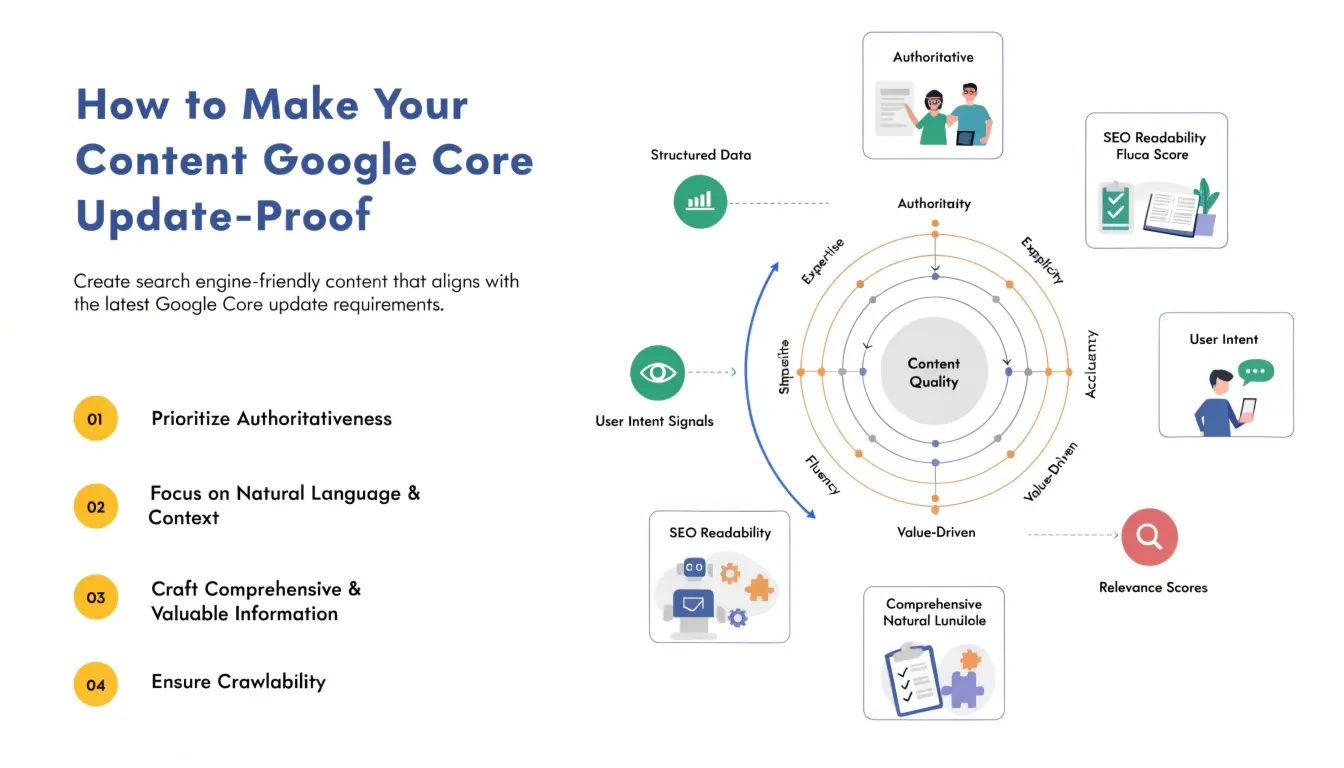
This is the practical system for building content that aligns with what Google consistently rewards. It has five components, each addressing a distinct dimension of content quality.
SERP Reality Check
Before writing a single word, study the current top 10 results for your target query. This is not about copying — it’s about understanding the competitive baseline and finding the gap.
Ask these questions about each top-ranking page:
- What specific angle or perspective does this page take?
- What does it cover thoroughly? What does it miss or gloss over?
- Who is the author and what is their evident expertise?
- What format does it use — listicle, how-to, opinion, research roundup?
- How old is it, and does it show signs of stagnation?
Your goal is not to produce a better version of what exists. Your goal is to produce something different enough that a user who has read the top three results would still find value in yours.
Information Gain Strategy
Information gain is the concept that your content should add net new information to what the user already encounters in search results. It’s the answer to the question: why would someone need to read my article if they’ve already read the top results?
| CORE PRINCIPLE ‘Better’ is not enough. ‘Different’ is required. A more polished version of the same information has minimal information gain. An article that adds original data, a contrarian perspective, a new framework, or first-hand experience has high information gain — and that’s what Google’s systems are increasingly trained to reward. |
Practical sources of information gain in 2026:
- Original research, surveys, or data you collected
- Case studies from your direct work or clients
- Contrarian analysis: what everyone else gets wrong about this topic
- Practical frameworks you developed through real experience
- Specific failure stories: what didn’t work and why
- Updated information that makes existing top results outdated
E-E-A-T Optimization
E-E-A-T is not a technical checklist. It’s a credibility signal that Google infers from multiple content-level and site-level factors. Here’s how to build it into your content directly:
- Experience: Write in first person about what you’ve actually done, seen, or tested. ‘In my experience working with 40+ e-commerce clients’ signals experience. ‘According to experts’ does not.
- Expertise: Demonstrate depth, not breadth. A cardiologist discussing heart health will outscore a general wellness blogger even on the same keyword — because the content signals domain-specific knowledge through language, detail, and nuance.
- Authority: Get cited by authoritative sources. Earn mentions in industry publications. Be the origin of a concept or data point that others reference.
- Trust: Keep your information accurate and current. Disclose affiliations. Provide clear author bios with verifiable credentials. Have a transparent About page.
Content Depth & Structure
Depth means covering a topic completely enough that the user has no lingering questions. It does not mean exhaustive length — it means comprehensive coverage of what matters for that specific query.
Structure helps both users and Google’s crawlers understand your content. A well-structured article with clear H2s and H3s, logical flow, and internal linking between related content signals topical competence. It also makes your content more extractable for Google AI Overviews and AI search engines like Perplexity.
Practical structural guidelines:
- Answer the primary query in the first 150 words
- Use H2s that map to distinct sub-questions the user likely has
- Include a ‘quick answer’ or summary box at the top for AI extraction
- Link internally to your other content on related sub-topics
- Use examples for every abstract claim you make
User Behavior Signals
Google has always maintained that it doesn’t use analytics data — but the reality is that user behavior shapes rankings through Chrome data, click behavior in SERPs, and the overall pattern of how people interact with content over time.
The signals that matter most for content quality are:
- Time on page: Are users reading the full article, or leaving after the first paragraph?
- Scroll depth: Does your content structure hold attention all the way through?
- Return rate: Does your site build repeat visitors, indicating genuine value?
- Click-through rate: Does your title and meta description make a specific promise that your content delivers on?
The Brutal Truth Test
| THE QUESTION EVERY CONTENT CREATOR NEEDS TO ASK “If this content disappeared from the internet tomorrow, would anyone notice? Would anyone miss it?” |
This is the editorial filter that separates durable content from disposable content. If the honest answer is ‘no — it’s just another guide that says what every other guide says,’ then it will not perform consistently through core updates.
Replaceable content is content that could be produced by anyone with a few hours and an AI tool. Irreplaceable content is content that carries your direct experience, your specific data, your developed perspective, or your particular way of explaining a complex thing simply.
The test isn’t about writing style or production quality. It’s about the fundamental value proposition of the content. Does it exist because you have something unique to say — or because you want to rank for a keyword?
Harsh as it sounds, Google’s systems are increasingly good at detecting the difference.
What Real Experience Actually Looks Like in Content
I want to be direct about this, because ‘add personal experience’ is advice that gets tossed around without anyone showing what it actually means in practice.
Early in my content work, I published a comprehensive guide on technical SEO audits. It covered all the standard categories — crawlability, indexation, page speed, structured data. It was thorough, well-structured, and completely generic. It ranked briefly then drifted to page two after a core update. No manual issues. No technical problems. Just insufficient reason for Google to rank it above better-credentialed sources.
I rewrote it with three specific changes:
- I added a section on the five most common audit mistakes I personally made with clients, with real consequences described
- I included a custom prioritization framework I’d developed after running over 60 audits — something no other article offered
- I wrote a section on what audit findings actually lead to ranking improvements vs. which ones are rabbit holes
The result? Rankings recovered within three months and held through two subsequent core updates. The content had become irreplaceable because it carried knowledge that only someone who had actually done the work could possess.
That’s the pattern. First-person experience sections work not because Google detects the word ‘I’ — but because the specificity, the nuance, and the honest acknowledgment of failure are signals that trained quality raters (and increasingly, AI evaluators) consistently associate with genuine expertise.
Common Mistakes That Make Content Vulnerable
- Writing for a keyword, not a person: If your entire content strategy begins with ‘what keyword do I want to rank for,’ you’ll consistently produce content optimized for machines rather than readers. Keywords are a navigation tool, not a purpose.
- Publishing volume without editorial filters: Fifty articles that nobody needs is not an SEO strategy. It’s a technical liability. Low-quality content dilutes your site’s overall authority signal and can drag down strong pages through association.
- Copying competitors with minor rewrites: If your competitive research process involves reading the top three articles and synthesizing them into a fourth article, you’re producing a derivative work. Derivative content can rank in the short term but consistently gets demoted when Google recalibrates quality benchmarks.
- Using AI without editorial intelligence: AI-assisted content is fine. AI-only content that goes live without a subject matter expert reviewing and enriching it is a long-term ranking risk. The distinction is whether the human is adding value or just approving output.
- Treating E-E-A-T as a checklist: Adding an author bio and a few links to external sources doesn’t build E-E-A-T. Building E-E-A-T is a multi-month effort of consistently publishing expert content, earning mentions, building a verifiable author track record, and demonstrating topical authority at scale.
Actionable Checklist: Before You Hit Publish
Run every piece of content through this filter before publishing. If you can’t answer ‘yes’ to most of these, the content is not ready.
| Content Quality Checklist | |
| ✓ | Does this content solve a real, specific problem — not just describe a topic? |
| ✓ | Does it add information the reader cannot easily find in the top 5 search results? |
| ✓ | Does it include personal experience, original data, or a distinctive framework? |
| ✓ | Is it more useful than the current top-ranking content for this query? |
| ✓ | Is the author’s expertise evident from the language, depth, and specificity? |
| ✓ | Is it easy to scan? (Clear H2s, short paragraphs, concrete examples) |
| ✓ | Does it answer the query directly in the first 100-150 words? |
| ✓ | Have you checked all factual claims for accuracy and currency? |
| ✓ | Is there a clear next step or action for the reader after finishing? |
| ✓ | Would a subject matter expert endorse this content as accurate? |
Final Thoughts: Create Content That Only You Can Create
Long-term SEO success in 2026 is not a technical problem. It hasn’t been a technical problem since at least 2018. It’s an editorial problem — a question of whether you are genuinely contributing to the information ecosystem or just occupying space in it.
Google core updates will keep coming. The algorithm will keep improving at recognizing genuine quality and deprioritizing manufactured quality. The sites that consistently gain from updates rather than losing to them share one trait: they produce content that exists because someone with real expertise had something real to say.
That means building topical authority slowly and deliberately rather than publishing at scale with no depth. It means making every article demonstrably better and different from what already exists. It means showing your work — your experience, your data, your mistakes, your reasoning.
It means thinking like a reader who has a real problem, not like an algorithm that needs to be satisfied.
| THE FINAL PRINCIPLE The most defensible content strategy in 2026 is also the simplest to state and the hardest to execute: create content that only you can create. Not content that AI can generate in your place. Not content that your competitors have already published. Content that carries your specific experience, your developed perspective, and your honest engagement with the reader’s actual problem. |
Do that consistently, over time, across a clearly defined topical area — and core updates become something you look forward to, not something you fear.