
There’s a quiet revolution happening every time someone types a question into Google. Most people don’t notice it. They just see a cleaner answer, faster. But underneath that experience, something fundamental has shifted — something that is already changing the way businesses get found online, how advertisers spend their money, and what it even means to rank on the world’s most powerful search engine.
Google’s AI Powered Search Box isn’t a minor update. It isn’t another algorithm tweak that SEO professionals can adjust to with a new checklist. It is, genuinely, the most significant transformation in how search works since Google first launched over two decades ago. And if you work in Digital Marketing, run a business that depends on organic traffic, manage Google Ads campaigns, or care about where your brand shows up when someone goes looking — you need to understand this deeply, not just superficially.
So let’s talk about it like real people. Not jargon. Not buzzwords. Just an honest, deep, and practical conversation about what is happening, why it matters, and what you should do about it.
First, Let’s Understand Where We’re Coming From
To appreciate how dramatic this shift really is, you have to go back to how Google search worked for most of its history. The mental model was simple: you type something in, Google shows you ten blue links, you click one, you read it, you go back, maybe click another. That’s it. That was the entire paradigm for twenty-plus years.
Behind the scenes, Google was doing something genuinely impressive. It was crawling billions of web pages, indexing their content, and then ranking them based on hundreds of signals — things like how many other sites linked to a page (backlinks), how relevant the words on the page were to what you typed (keyword matching), how fast the page loaded, how mobile-friendly it was, and so on. Search Engine Optimization, as a discipline, grew up entirely around understanding and gaming these signals. If you wanted to rank for “best running shoes,” you wrote an article about best running shoes, got other websites to link to it, and made sure Google could crawl it without trouble.
It worked. It worked remarkably well for a long time. Entire industries were built on top of it. SEO Services became a multi-billion dollar business precisely because the ability to appear at the top of those blue links translated directly into visibility, traffic, leads, and revenue.
But here’s the thing about that model: it was fundamentally built around documents. Google was essentially a really smart library catalog. You asked a question, it pointed you to the books — the web pages — that were most likely to have the answer. You still had to go read the book yourself.
That model is ending.
Also Read: How GEO and AI Are Reshaping the Future of Google Ads Dashboard
What the AI Powered Search Box Actually Is
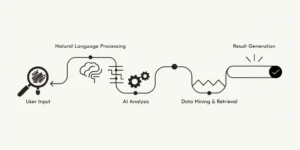
When people talk about the AI Powered Search Box, they’re referring to a suite of Google features — most visibly the AI Overviews that now appear at the top of many search results pages, but also the deeper conversational search experiences being rolled out through Search Labs and integrated increasingly into the main Google search interface.
The fundamental difference is this: instead of pointing you to pages that might contain an answer, the AI is now generating the answer for you, right there in the search results. It synthesizes information from multiple sources, applies language understanding to figure out what you actually meant, and delivers a direct, often comprehensive response — sometimes with citations, sometimes without, and sometimes in a conversational format where you can ask follow-up questions without starting a new search.
Think about what that means in practice. Someone searches “what’s the best way to treat a mild ankle sprain at home?” In the old model, they’d get links to WebMD, Mayo Clinic, a sports medicine blog, maybe a Reddit thread. They’d click through, read, come back, click another. Now? Google’s AI synthesizes those sources and gives them the RICE method — Rest, Ice, Compression, Elevation — along with timelines and warnings about when to see a doctor. All in one clean, readable summary. Right at the top.
The AI Powered Search Box isn’t just a search engine anymore. It’s starting to function like a knowledgeable friend who’s already read everything on the internet and can give you a straight answer. That is a profound change.
The Shift from Blue Links to AI-First Search
This transition didn’t happen overnight, and it’s not complete — not by a long shot. Blue links still exist. Traditional organic results still matter enormously. But the direction of travel is unmistakable, and anyone paying close attention has watched the writing appear on the wall over several years.
It started with Featured Snippets — those boxes that pulled a direct answer from a web page and displayed it above the regular results. SEOs called it “position zero” and scrambled to optimize for it. Then came Knowledge Panels, which pulled structured information about entities — people, companies, places — directly from Google’s knowledge graph. Then People Also Ask boxes, which started anticipating follow-up questions. Then Local Packs, Shopping results, News carousels. Each one of these was Google doing more of the answering itself, pushing the blue links further down the page.
AI Overviews are the culmination of that trajectory, now supercharged by large language models. Google isn’t just pulling a snippet from one page anymore; it’s synthesizing across multiple sources and generating new text. The AI Powered Search Box represents Google’s clearest statement yet: we want to be the destination, not just the directory.
This is, to put it bluntly, both the most exciting and most terrifying development in the history of Search Engine Optimization.
How Conversational AI Changed the Way We Search
Here’s something subtle but important: AI search isn’t just changing how Google delivers results. It’s changing how people ask questions in the first place.
When everyone knew that search engines were essentially keyword-matching machines, people learned to type like robots. “Best Italian Restaurant.” “iPhone 15 price.” “Symptoms of back pain.” Truncated, telegraphic, stripped of the natural language we’d actually use if we were asking another person. We optimized our searches for the machine.
Now that the machine understands natural language — really understands it, not just pattern-matches against it — people are unlearning that behavior. Increasingly, they search the way they’d actually ask a question. “What’s a good Italian place in River North that’s not too loud and has outdoor seating?” “How much should I expect to pay for an iPhone 15 if I’m switching from Android?” “I’ve had this dull ache in my lower left back for about three days, what could it be?”
These are conversational queries. They’re longer, richer, more nuanced, and they contain so much more information than a two-word keyword. They include context, preferences, constraints, and implied intent. And this is exactly where conversational AI in search becomes a genuine breakthrough — because the AI Powered Search Box is built to understand all of that context simultaneously.
This shift toward longer, more natural queries is reshaping the landscape of user intent entirely. When someone types “back pain lower left,” their intent is ambiguous. When they describe a symptom with duration and location and context, their intent becomes clear. The AI can match responses to actual needs rather than just keyword patterns.
User Intent Over Keywords: The Most Important Shift in SEO
If there is one concept that defines the difference between old-school SEO and modern AI SEO, it’s this: the shift from keyword matching to intent understanding.
Traditional SEO was, at its core, about putting the right words in the right places. Title tags, meta descriptions, H1 headers, body copy — you made sure your target keyword appeared in all of them, at the right density, with the right variations. That’s an oversimplification, but it’s not wrong as a description of the mentality.
The problem is that keywords are a proxy for intent. When someone searches “buy running shoes,” the keyword is “buy running shoes” but the intent is to find and purchase footwear for running that meets their needs. Those are related but not identical. A page stuffed with the phrase “buy running shoes” might rank, but it doesn’t necessarily serve the actual human on the other side of the search.
Google’s AI — powered by the same underlying technology as large language models like the ones behind ChatGPT — has gotten dramatically better at inferring intent. It looks at the whole query, yes, but it also looks at the context of the conversation, the user’s apparent level of expertise, the type of answer that would actually be useful, and — this is where it gets sophisticated — the likely follow-up questions the user will have.
This is why keyword stuffing is not just outdated — it’s actively counterproductive now. If you write a page that mechanically repeats “SEO Services” forty times but doesn’t actually explain what those services entail, why they matter, how they work, and who they’re for, the AI will recognize the shallowness of that content and rank it accordingly. The AI rewards depth of understanding, not density of keywords.
And yet — and this is crucial — keywords haven’t disappeared from the equation. They’ve changed their role.
Why Keywords Still Matter (Just Not the Way You Think)
Let me be direct here because there’s a lot of overcorrection happening in the SEO industry. Some people have started saying “keywords don’t matter anymore, just write naturally.” That’s only half true, and the half that’s false is important.
Keywords still matter because they are how humans express intent. The words people actually use in their searches are signals. They tell you what vocabulary your audience uses, what concepts they’re trying to understand, what problems they’re trying to solve. If every single person asking about relieving knee pain uses the word “knee pain” rather than “patellofemoral syndrome,” you should know that. Not to stuff your article with it, but to use the right language to connect with the right people.
Keywords also still matter for semantic clustering. Google’s AI has a sophisticated understanding of which concepts are related — which topics, entities, and ideas belong together. Writing about “running shoes” without mentioning related concepts like pronation, cushioning, trail versus road, or specific brands would seem thin and incomplete to the AI. The presence of semantically related terms signals genuine topical depth.
What’s changed is the relationship between keywords and ranking. It’s no longer about hitting a keyword frequency target. It’s about demonstrating genuine expertise and comprehensive coverage of a topic. The keywords are evidence of that coverage, not the coverage itself. That’s a subtle but enormously important distinction.
Semantic Search and Entity-Based SEO: The New Architecture
To understand where SEO is heading, you have to understand how Google’s AI actually “thinks” about content — and that means understanding two concepts: semantic search and entity-based SEO.
Semantic search means Google understands the meaning behind words, not just the words themselves. It knows that “automobile,” “car,” and “vehicle” are related. It knows that “best” and “top-rated” and “recommended” are functionally similar. It understands that a question about “how to train for a 5K” belongs to a cluster of related concepts including running, cardiovascular fitness, training plans, beginner athletics, and race preparation. This semantic understanding allows Google to surface relevant content even when the exact query words don’t appear on the page.
Entity-based search takes this further. Google has built a massive knowledge graph — essentially a database of real-world things (entities) and the relationships between them. People, places, organizations, products, concepts, events — these are all entities. When you search for “Tesla,” Google doesn’t just look for pages with “Tesla” on them; it draws on everything it knows about Tesla as an entity: it’s a car company, founded by Elon Musk, known for electric vehicles, publicly traded, headquartered in Austin, and so on. The search results reflect that rich understanding.
For businesses, this means something practical: Google’s AI is evaluating your brand and your content as entities with attributes, not just as documents with keywords. Do you have a consistent presence across the web — your website, Google Business Profile, Wikipedia, industry directories, social media? Are you mentioned in authoritative publications? Do expert sources reference you? These entity signals help Google understand who you are and whether you’re trustworthy, which feeds directly into how AI Overviews represent (or ignore) you.
Semantic SEO — building content that demonstrates deep topical expertise rather than just targeting individual keywords — is now the foundation of effective Search Engine Optimization. And if you’re not already thinking this way, this is the moment to start.
Also Read: How to Optimize Your Website for Generative AI in Google Search
GEO: The New Discipline Nobody Taught You in Marketing School
Alright, here’s where things get genuinely new. You’ve probably heard of SEO. You might have heard of AEO. But Generative Engine Optimization — GEO — is the emergent discipline that didn’t exist in its current form until generative AI search became mainstream, and it’s something every Digital Marketing professional needs to understand now.
GEO is the practice of optimizing your content to be cited, referenced, and synthesized by AI-generated search responses. It’s not just about ranking — it’s about being included in the AI’s answer. Think about the difference: traditional SEO gets you a link someone might click. GEO gets your brand, your data, or your perspective woven into the AI’s actual response.
When Google’s AI generates an overview answering a question, it draws on multiple sources. It might pull a statistic from one site, an explanation from another, a quote from a third. Businesses that practice GEO are specifically optimizing to be among those sources. That means several things practically.
It means writing content that directly answers questions — not dancing around topics or burying the lede in paragraphs of preamble. AI systems reward clarity and directness. It means using structured data markup to help AI systems understand what your content contains. It means building genuine authority on specific topics so that when AI needs to synthesize an answer about your area of expertise, your content is considered credible enough to draw from.
GEO is closely related to what I think of as “reference-worthy content” — material that experts, journalists, and now AI systems reach for when they need to explain or substantiate something. This is a higher bar than “content that ranks,” but it’s increasingly the bar that matters.
Here’s a practical example. Imagine you run a financial advisory firm. Under traditional SEO, you’d optimize a page for “what is a Roth IRA.” Under GEO, you’d go further: you’d make sure that page contains authoritative, precise, uniquely useful information that an AI would want to cite when answering that question. You’d include specific figures, clear comparisons, expert perspective, and data that isn’t just regurgitated from government websites. You’d make your content the primary reference — not just a result.
That’s GEO. And it’s becoming a core component of modern AI SEO strategy.
AEO: Answering Before They Even Ask
Answer Engine Optimization, or AEO, is a related but distinct discipline. Where GEO is specifically about generative AI systems, AEO is broader — it’s about optimizing content for any system that generates direct answers rather than lists of links. This includes voice assistants like Siri, Alexa, and Google Assistant; featured snippets; Google’s AI Overviews; Bing Copilot; and any other interface where the user gets an answer rather than a list.
The core principle of AEO Services is deceptively simple: structure your content to directly answer questions. But doing this well is genuinely nuanced.
Think about how people phrase questions in voice search or conversational AI. They don’t say “Roth IRA rules.” They ask “Am I eligible for a Roth IRA?” or “What happens to my Roth IRA when I retire?” or “Can I contribute to a Roth IRA and a 401k at the same time?” Each of these is a specific question with a specific answer format. AEO involves anticipating these questions, structuring content around them (FAQ sections help enormously here), and providing answers that are the right length and format for the delivery mechanism.
For voice search, a good answer is typically one to three sentences — conversational, direct, and complete without requiring follow-up. For AI Overviews, a good answer might be more comprehensive, with structure that helps the AI identify the key points. The underlying principle is the same: be genuinely, usefully answerable.
One more critical aspect of AEO Services: you have to answer not just the obvious question but the adjacent questions — the ones a thoughtful person would ask next. If someone asks “how often should I change my oil,” a great AEO-optimized page doesn’t just answer that question; it also addresses “what happens if I wait too long,” “how do I know what oil to use,” and “how much should an oil change cost.” This depth of question coverage signals to answer engines that your content serves the full intent journey, not just the initial query.
How AI Overviews Are Changing User Behavior — And What That Means for Traffic
Let’s talk numbers for a moment, because this is where things get uncomfortable for a lot of publishers and business owners.
When Google’s AI Overviews first rolled out broadly, the immediate concern among SEO professionals and content creators was what the industry started calling “zero-click searches” — searches where the user gets their answer directly from the AI summary and never clicks through to any website. Traffic observations following AI Overview rollouts showed declines for informational content in many categories.
Now, the data here is genuinely mixed. Some types of searches — particularly navigational queries (people looking for a specific website), transactional queries (people ready to buy something), and complex research queries (where the AI summary prompts deeper exploration) — have not seen dramatic declines in click-through behavior. But for purely informational queries — “what is photosynthesis,” “what’s the capital of Portugal,” “how long does a passport application take” — the AI answers so completely that there’s often no reason to click.
This is the “search without clicks” phenomenon, and it’s reshaping how we think about the value of information content. If you’ve built an SEO strategy heavily around ranking for informational keywords with the expectation that ranking means traffic, you need to rethink that assumption in the age of AI search.
That said, there are important nuances here. AI-generated summaries often include citations — links to the sources the AI drew from. Being cited in an AI Overview still provides brand visibility and can drive traffic for users who want to read more. And the psychological shift is interesting: when an AI tells a user something and attributes it to your brand, that’s a form of brand recognition that can build trust over time, even without an immediate click.
The behavior shift is real though. Users are becoming comfortable getting answers from AI without needing to visit a website. Conversational search is training people to expect complete answers in the search interface itself. This is a fundamental change in user behavior that marketers and publishers need to account for in their strategy.
Personalized AI Search: The Engine That Learns You
One of the most fascinating and, frankly, under-discussed aspects of the AI Powered Search Box is personalization. Not the relatively crude personalization of traditional search — “we see you search for a lot of sports content so here are sports-adjacent results” — but something potentially much more sophisticated.
Google has enormous data about how individuals search: their history, their preferences, the content they’ve engaged with, their location, their device patterns, the searches that led them to click versus bounce versus refine. Now pair that with a generative AI that can adapt its outputs based on what it knows about the user, and you have the potential for genuinely personalized search experiences.
Imagine a medical professional searching “metformin side effects” getting a response calibrated to their clinical expertise level, while a newly diagnosed diabetic patient asking the same question gets a response pitched at patient education level. Or a beginner photographer asking “aperture settings for portraits” getting foundational explanations, while someone whose search history shows extensive photography knowledge gets straight to the technical specifics.
Google has been cautious about how explicitly it talks about this level of personalization — both because of the technical complexity and because of privacy concerns. But the trajectory is clear. The AI that powers search has the capability to serve more personally relevant answers, and Google has both the incentive and the data to make that happen.
For Digital Marketing, the implications are profound. It means the “average user” is becoming less useful as a planning unit. It means you might need to think about how your content serves different segments of your audience at different levels of familiarity, because the same query might land on your content via very different versions of the search response.
The Privacy Elephant in the Room
We can’t talk about personalized AI search without talking about what it costs. And what it costs is data. A lot of it. Extremely personal data.
To personalize your search experience meaningfully, Google needs to know things about you. Your search history, obviously. But increasingly also your browsing behavior across sites that use Google’s tracking infrastructure, your location data, your purchase history if you use Google Pay, your email content if you use Gmail, your calendar if you use Google Calendar. The more an AI knows about you, the more personally relevant it can make your search experience.
This creates a genuine tension that I don’t think the industry has fully grappled with. The same capability that makes AI search feel magically helpful — “it’s like Google just knows what I mean” — is built on a level of data collection and behavioral modeling that many users would find uncomfortable if they thought about it explicitly.
GDPR, CCPA, and other privacy regulations have added legal scaffolding around some of this. Google has made various commitments about how it uses data. But the reality is that an AI-powered search experience that learns from you is, by definition, building a model of you. And that model resides on Google’s servers, not yours.
For businesses, there’s a related concern: the more Google knows about your potential customers through their search and browsing behavior, the more Google can serve them directly — potentially cutting out the intermediary of your website entirely. It’s a structural dynamic worth thinking carefully about, because it affects the long-term sustainability of the “get found on Google” model that so much of digital marketing has been built around.
Why Publishers and SEO Professionals Are Genuinely Worried
Let me be honest about something. There is a significant contingent of SEO professionals, content creators, publishers, and digital marketers who are deeply concerned about the direction of AI search — and not without reason.
The worry isn’t that AI search is bad for users. In many ways, it’s excellent for users. Faster answers, better synthesized information, more conversational interaction. The concern is structural: Google’s AI search creates a model where Google extracts value from the web’s content — using it to train its models and generate its answers — while potentially reducing the traffic that content creators receive in return.
This was the explicit concern behind several high-profile publisher lawsuits and the ongoing debates about AI training data and copyright. When Google’s AI generates an answer that synthesizes an article I spent hours researching and writing, and the user never visits my site, the economic model that supported creating that content starts to break down. If creating high-quality content no longer drives the traffic that justified the investment in that content, why would anyone continue creating it?
This isn’t a trivial concern. The open web — the ecosystem of independently published, high-quality, human-researched content — is what made Google search valuable in the first place. If AI search reduces the incentive to create that content, it could gradually degrade the very resource it depends on. It’s a long-term structural tension that Google is aware of and doesn’t have a fully satisfying answer to yet.
For businesses heavily invested in content marketing as an SEO strategy, this is the central strategic question of the next few years: how do you continue to justify the investment in content when the returns in terms of organic traffic may be declining?
But Here’s Why Websites Are Still Deeply Important
Before the doom and gloom gets too overwhelming, let me make the case for why websites remain essential — and why this isn’t going away even as AI search grows.
First, Google’s AI needs sources. It needs high-quality, accurate, up-to-date content to synthesize answers from. It cannot generate reliable information from nothing; it needs the web as its substrate. This means that businesses and publishers who create genuinely authoritative content on specific topics will remain important — not necessarily as traffic destinations in every case, but as the foundational sources that the AI draws from and cites. Being that source is valuable.
Second, transactional intent still requires a destination. When someone is ready to buy something, book something, hire someone, or take a specific action, they need to go somewhere to complete that transaction. Google’s AI can help them identify where to go and what to look for, but it cannot actually close the sale for a local restaurant, a custom software agency, or an e-commerce brand. The role of websites in the purchase journey remains strong even as the discovery phase shifts toward AI-mediated answers.
Third, trust is built through presence. Even in a world where AI answers questions, brand recognition matters. If your company is consistently cited in AI Overviews, appearing in Knowledge Panels, referenced by authoritative sources — that visibility builds the kind of brand trust that drives direct navigation, word-of-mouth, and conversion when people do reach you. Your website is still where that trust gets validated and transactions happen.
Fourth, AI search is still imperfect. Anyone who’s used AI Overviews extensively has seen them make mistakes, hallucinate facts, or miss the specific nuance of a niche query. Users have learned, reasonably quickly, to click through to sources for anything where they actually need to be sure. For complex, high-stakes decisions, the blue link model isn’t going away — it’s just no longer the universal first step.
How Google Ads Is Evolving — and What Advertisers Need to Know
Now let’s talk about paid search, because the changes in AI search are reshaping Google Ads just as dramatically as they’re reshaping organic SEO — just in different ways.
The traditional Google Ads model was, in many ways, even more keyword-dependent than organic SEO. You bid on keywords. When someone searches that keyword, your ad shows if your bid and quality score are high enough. You pay per click. Simple, transparent, controllable.
That model is changing rapidly, and the direction of change is toward AI-driven, intent-based targeting that gives advertisers more scale but less direct control. This is creating a complicated mix of opportunity and anxiety among PPC professionals.
Let’s start with match types, because this is where the philosophical shift is most visible. Google Ads has three core match types — exact match, phrase match, and broad match — and understanding how AI is transforming each of them is essential.
Exact match used to mean exactly what it said: your ad only showed when someone searched precisely the keyword you specified. Over time, Google expanded it to include “close variants” — plurals, misspellings, reordered words. Now, exact match is substantially broader than the name suggests, using AI to determine when a search is semantically equivalent to your keyword even if the words are different.
Phrase match sits in the middle. Historically, it required the keywords to appear in order within the query. Now, AI-driven phrase match allows for much more flexible interpretation, matching queries that contain the meaning of your phrase even without the exact word sequence.
Broad match is where the AI transformation is most dramatic. Broad match in its modern, AI-driven form doesn’t just match your keyword with variations — it tries to match your entire campaign and landing page context against what Google’s AI determines to be relevant user intent. Google essentially says: trust us, we know when someone’s search intent aligns with what you’re offering. The AI brings together signals from your ad creative, your landing page content, your historical performance data, and the user’s intent model to decide when to show your ad.
This is simultaneously powerful and disconcerting. Powerful because well-run broad match campaigns can reach audiences you’d never have thought to target with specific keywords. Disconcerting because you’re ceding keyword-level control to an algorithm that, however sophisticated, doesn’t always understand the nuances of your business the way you do.
AI-Based Audience Targeting: Intent Prediction Changes Everything
Beyond match types, Google’s AI is transforming how audience targeting works in paid search. Performance Max campaigns — Google’s most aggressively AI-driven campaign type — are the clearest example. You provide assets: headlines, descriptions, images, videos, your landing page URL. You tell Google your conversion goals. The AI handles everything else: which queries trigger your ads, which audiences see them, what time of day, on what device, in what combination of channels across Search, Display, YouTube, Gmail, and Discover.
The underlying capability here is intent prediction at scale. Google’s AI is modeling what signals — across all the data it has about users — best predict that someone is about to convert for businesses like yours. It’s not just looking at what someone searched today; it’s looking at their full intent journey: what they’ve searched previously, what content they’ve consumed, what their behavioral patterns suggest about where they are in the purchase funnel.
This is genuinely remarkable technology. And for advertisers who give the AI enough conversion data to learn from and enough creative assets to work with, Performance Max can drive results that would be difficult to achieve through manual, keyword-based campaign management.
But here’s the tension: Google wants advertisers to “focus on outcomes, not keywords.” Feed us your conversion goals, give us your budget and creative, and let the AI optimize toward the outcomes you care about. Stop managing bids and keywords and placements and start thinking about the inputs the AI needs to succeed.
Many advertisers, understandably, find this uncomfortable. It requires a significant amount of trust in a system that isn’t fully transparent about what it’s doing with your money. And it shifts the advertiser’s role from hands-on campaign management to a more strategic function: defining clear goals, building great creative, ensuring your landing pages convert, feeding the machine quality data. That’s a real skill shift for many PPC professionals.
The Future of PPC in the AI Search Era
Where does paid advertising go from here? My honest take is that it becomes simultaneously more powerful and more consolidated.
More powerful because AI-driven audience targeting, intent prediction, and automated bidding genuinely work better than manual keyword management in many situations — particularly for businesses with enough conversion data and budget for the AI to learn effectively. The ceiling for what great PPC performance looks like gets higher.
More consolidated because the complexity of navigating AI-driven advertising systems creates an expertise premium. Small businesses running their own campaigns with limited data will increasingly struggle against sophisticated advertisers who understand how to brief the AI, how to structure their data feeds, how to build creative that the AI can optimize effectively. The gap between well-run and poorly-run campaigns will grow.
For the Digital Marketing industry more broadly, this means Google Ads expertise is shifting away from keyword research and bid management toward creative strategy, conversion optimization, data architecture, and the ability to interpret AI-driven performance data. These are different skills from traditional PPC management, and agencies that don’t adapt will find themselves obsolete.
One more thing worth noting: AI Overviews in search results are creating new real estate that paid ads need to compete with or appear alongside. Google has been experimenting with sponsored content within or adjacent to AI Overviews. This is an emerging battleground, and the advertisers who figure out how to appear in and alongside AI-generated responses — not just below them — will have a significant advantage.
Topical Authority and Trust Signals: The New Currency of Search
If AI search rewards anything above all else, it’s authority. Not the cheap manufactured authority of bought backlinks and keyword density, but genuine topical authority — the kind that comes from having more useful, accurate, comprehensive, and consistently maintained content about a specific subject than almost anyone else online.
Google’s concept of E-E-A-T — Experience, Expertise, Authoritativeness, and Trustworthiness — has been part of its quality rating guidelines for years. AI search amplifies its importance dramatically. The AI needs to determine not just whether a piece of content answers a question, but whether it can be trusted to answer accurately. That determination is made based on signals about who created the content, where it was published, who else cites it, how consistent its quality is over time, and whether the entity behind it has a demonstrated track record of expertise.
For businesses, building topical authority means making a commitment. You can’t be credible about fifty topics. You need to identify the subjects where you have genuine expertise, create comprehensive content that covers them deeply, maintain that content over time as information changes, and build an ecosystem of related content that demonstrates the breadth and depth of your knowledge.
A good example: imagine two financial advice websites. One publishes broad, shallow articles about everything from mortgages to cryptocurrency to budgeting tips to retirement planning, each article covering the basics without particular depth. The other publishes exclusively about small business financial planning — taxes, cash flow, financing, insurance, retirement plans for business owners — and does it comprehensively, accurately, and with genuine practitioner insight. In AI search, the second site wins on its topics every time. That’s what topical authority looks like.
Trust signals matter too. Does your website have clear authorship? Do those authors have verifiable credentials? Do other authoritative sources link to and cite your content? Is your business properly structured with a real physical address, consistent NAP (Name, Address, Phone) information, and a genuine track record? These signals help Google’s AI determine whether your content is a credible source to draw from when generating answers.
Structured and Conversational Content: Both Matter Now
Here’s a practical content strategy insight that often gets lost in the theoretical discussions about AI search: the formats that work best in AI-era SEO are a combination of structured and conversational.
Structured content means using schema markup to explicitly tell search engines what type of content you have and what it contains. FAQ schema that structures your question-and-answer content. Article schema that identifies your author, publication date, and key topics. Product schema that details specifications, prices, and availability. Review schema. How-to schema with step-by-step instructions. These structured formats make it dramatically easier for AI systems to parse, understand, and cite your content correctly.
Conversational content means writing in a way that naturally mirrors how people ask questions — anticipating the actual phrasing of voice queries and conversational searches, using natural language rather than terse keyword-packed sentences, and addressing the human behind the search rather than the algorithm in front of them.
The ideal is content that is both — structured enough for AI systems to parse precisely and conversational enough to feel genuinely helpful and human when the AI cites or surfaces it. This is actually how the best content has always been written; AI search is just making it more explicitly valuable.
Long-form, comprehensive content that covers a topic from multiple angles, anticipates follow-up questions, includes real examples, and demonstrates genuine expertise — that has been the gold standard of good content marketing for years. AI search doesn’t change that; it intensifies it.
How Businesses Need to Adapt Their Strategy Right Now
Let me get specific, because abstract advice about “building topical authority” and “optimizing for user intent” doesn’t pay the bills. What should businesses actually do differently?
First, audit your content for depth. Go through your highest-traffic pages and ask honestly: if Google’s AI were to synthesize an answer to the question this page addresses, would it use my content as a source? If the answer is “probably not because my content is too thin/generic/outdated,” that’s your starting point. Don’t create more content — improve what you have.
Second, identify your genuine areas of expertise and concentrate your content investment there. You cannot be authoritative across fifty topics with limited resources. Three topics covered brilliantly will outperform thirty topics covered superficially in an AI-first search environment.
Third, think about your content from the answer-first perspective. What questions are your ideal customers asking at different stages of their research and buying process? Make sure you have content that directly, specifically, and thoroughly answers each of those questions. Use FAQ sections, clear headers framed as questions, and concise direct answers before elaborating.
Fourth, invest in structured data markup. It’s not glamorous, but schema markup is increasingly important for helping AI systems understand and cite your content accurately. If you’re not using it, you’re leaving potential AI visibility on the table.
Fifth, build genuine external authority. Not just backlinks for SEO purposes, but actual recognition from credible sources — industry publications, professional associations, academic citations, expert roundups. These are the signals that make AI systems treat you as a trustworthy source.
And sixth — don’t abandon Google Ads in the uncertainty about organic traffic. Paid search remains more controllable and predictable than organic in the short term, and a well-run Google Ads strategy can supplement the organic traffic uncertainty while you adapt your SEO Services approach to the new reality.
Digital Marketing in the AI Era: The Big Picture Shift
Zoom out for a moment. All of these specific changes to SEO, Google Ads, content strategy, and user behavior are symptoms of something larger: a fundamental restructuring of how Digital Marketing works in an AI-mediated world.
For two decades, the dominant model was: create content, optimize it for search engines, drive traffic to your website, convert visitors into customers. AI search is breaking the link between “rank on Google” and “drive traffic to website” that underpinned that model. It doesn’t make Google irrelevant — if anything, Google’s AI becomes more central to discovery than ever. But the path from Google to your business is being rerouted.
The new model is less about traffic and more about presence. Being the authoritative voice in your space that AI systems refer to, cite, and recommend. Being visible in AI Overviews. Being the brand that users recognize when they do click through. Building direct relationships with customers that don’t depend entirely on continued Google traffic.
Email marketing — long overshadowed by SEO in budget and attention — becomes more valuable when you can’t rely on organic traffic the way you used to. Community building, direct-to-audience channels, referral programs, offline relationship building — these diversification strategies have always been smart, but they become strategically essential in a world where AI search can reduce your organic visibility.
Digital Marketing is also becoming more about brand than many practitioners are comfortable with. In a world where AI answers the informational queries and transactional queries are increasingly served by e-commerce giants, differentiation comes from brand trust, customer experience, and the distinctiveness of what you offer. These are harder to measure but ultimately more defensible than search rankings.
Search Agents and the Future of AI Search
Here’s where we get genuinely speculative, but in an informed way. The current AI Powered Search Box — impressive as it is — is probably not the final form of AI search. What’s coming next is something more radical: search agents.
A search agent isn’t just a system that answers questions. It’s a system that takes actions on your behalf based on your goals. “Find me a reliable plumber in my area who can come this week, check their reviews, verify they’re licensed, and book an appointment on Tuesday at 2pm.” A search agent doesn’t just return a list of plumbers; it completes the task.
Google has been building toward this with features like Google Assistant, Google Lens, and the integration of various Google services. Microsoft is doing it with Copilot and its deep integration with Office and Windows. OpenAI is doing it with its agent-focused products. The AI that handles your search query is increasingly capable of — and likely to be — an agent that orchestrates a series of actions to complete a goal, not just retrieve information.
For Digital Marketing, this changes the conversation entirely. If an AI agent is making purchasing decisions or booking appointments on behalf of users, the entire funnel looks different. The AI itself becomes a customer in some sense — you need to optimize not just for human decision-makers but for AI agents who are evaluating your business on behalf of human principals.
This is speculative, but it’s near-term speculation. Agent-based AI search is being built right now. Businesses that think about how to serve AI agents — through structured data, APIs, clear machine-readable information about their products and services, reliable fulfillment systems — will have a significant advantage as this technology matures.
Both Exciting and Dangerous: An Honest Assessment
I want to be honest about something that polished marketing content often glosses over: the era of AI search is genuinely double-edged, and pretending it’s purely an opportunity or purely a threat doesn’t serve anyone.
It’s exciting because AI search is genuinely making the internet more useful. The ability to get a synthesized, accurate, comprehensive answer to a complex question without clicking through eight different pages is a real improvement in human experience. The ability for a small business to be surfaced in AI results based on genuine quality rather than just budget for link building is potentially democratizing. The increasingly conversational, natural nature of search interaction is lowering barriers for people who aren’t skilled at keyword-based query formulation. These are real benefits.
It’s dangerous because the concentration of power it represents is unprecedented. Google’s AI doesn’t just index the web anymore — it intermediates it. Every answer it generates is filtered through Google’s AI models, which have their own biases, limitations, and potential for error. The companies whose content gets cited thrive; those who get overlooked lose visibility regardless of the quality of their work. And a single company — one of the most powerful corporations in human history — sits at the center of all of it.
It’s dangerous for publishers and content creators who built their businesses around a traffic model that AI search is systematically eroding. It’s dangerous for the quality of information over time if the economics that support rigorous, expensive, expert content creation deteriorate. And it’s dangerous for competition in the advertising market if Google’s AI increasingly recommends Google’s own products and services in AI Overviews.
None of this means AI search is bad. It means it’s complicated. And the people best positioned to navigate it are those who understand both sides clearly.
The Conclusion: Where SEO, GEO, AEO, and AI Search Are Going
Let me wrap this up with what I actually believe, based on watching this industry evolve for years and tracking these developments closely.
Search Engine Optimization is not dead. Reports of its death are dramatically overstated. But it has graduated — permanently — from a primarily technical discipline focused on keywords and backlinks into something more like a combination of brand building, expert content creation, technical infrastructure, and data strategy. The practitioners who thrive will be those who can operate across all of those dimensions.
GEO and AEO Services are not temporary buzzwords. They represent real disciplines that address real changes in how AI systems discover and surface content. Any business that communicates online needs to understand how AI systems interpret and represent their information, and actively optimize for that. This is now core Digital Marketing infrastructure, not an optional advanced technique.
Google Ads will survive and likely thrive in the AI search era, but it will look different. Less keyword management, more AI collaboration. Less micro-control, more strategic vision and creative investment. The skill floor goes up; so does the ceiling for what great performance looks like.
User behavior has shifted. Conversational search is the norm for a growing segment of queries. Voice search, AI chat interfaces, and conversational AI in search are training the next generation of internet users to interact with information in completely different ways than previous generations. Marketing that doesn’t adapt to this behavioral shift will become progressively less effective.
And underneath all of it — all the algorithm updates, AI Overviews, personalized search experiences, and agent-based search futures — the fundamental principle hasn’t changed. Genuinely useful, honest, expert content that serves real human needs will always have a place in a world where people are trying to find reliable information and make good decisions. AI makes that content more important, not less. It just changes who needs to read it first.
The AI Powered Search Box is not the end of the internet as a marketplace of ideas and commerce. It’s a transformation of how that marketplace operates. The businesses, marketers, and SEO professionals who understand that transformation clearly — and adapt intelligently — aren’t just going to survive this shift. They’re going to thrive in it.
The question is whether you’re ready to do the work.
This article covers developments in AI Powered Search Box technology, GEO, AEO Services, and Digital Marketing strategy through May 2026. The landscape continues to evolve rapidly; specific features and policies referenced may have been updated since publication.