
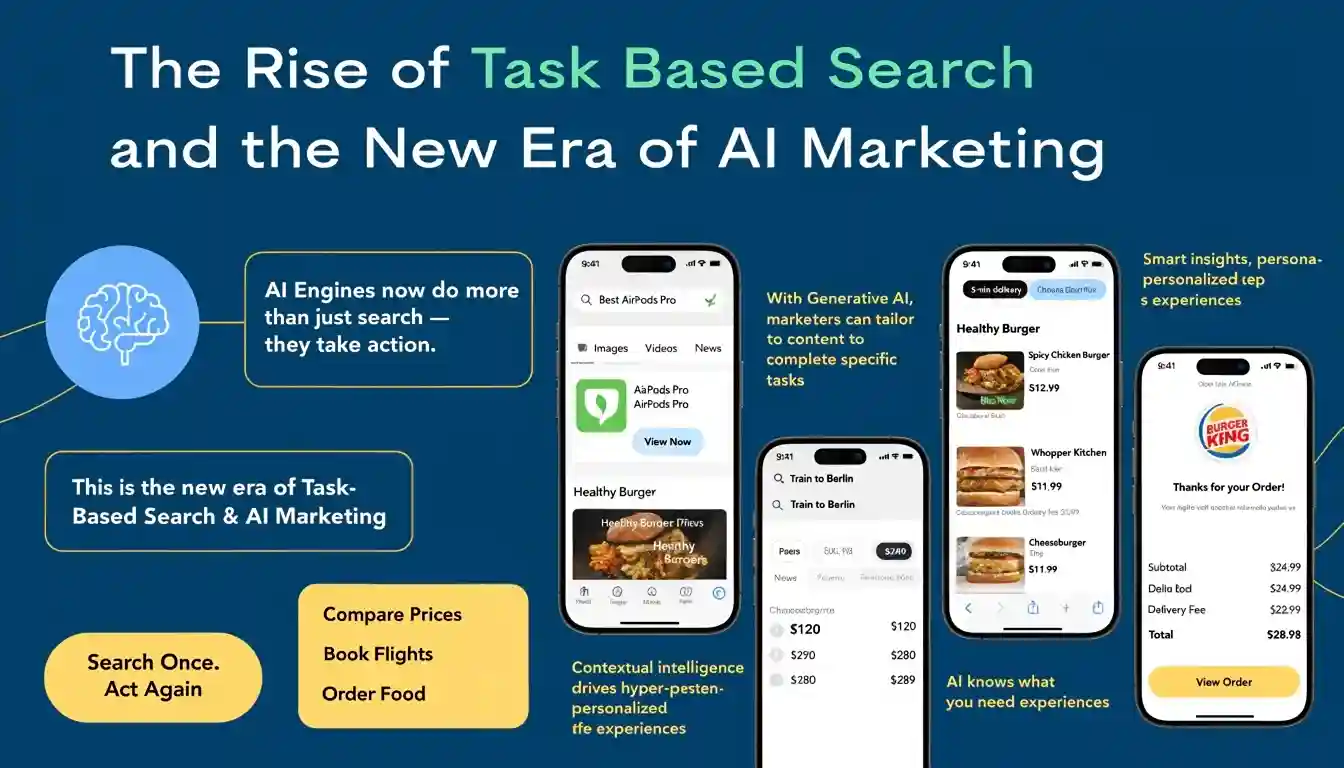
For two decades, the formula for digital growth was simple: find a high-volume keyword, write a 1,500-word blog post, build some backlinks, and watch the traffic roll in.
Today, that formula is breaking. With the integration of AI Overviews (SGE), the rise of “Zero-Click” searches, and the pivot toward task based search, a collective panic has set in among digital marketers. The question on everyone’s lips: Is SEO dying?
The short answer is no. But the SEO you knew—the one built on chasing blue links and gaming algorithms—is effectively on life support. We are witnessing the birth of the Task Engine, and if your strategy doesn’t evolve, your visibility will vanish.
The Great Evolution: From Search to Action
To understand the SEO future, we must look at the trajectory of how humans interact with information. We are moving through three distinct eras:
- The Search Engine Era (1998–2010): Users typed keywords; Google provided a list of potential destinations.
- The Answer Engine Era (2011–2023): Users asked questions; Google provided snippets and “People Also Ask” boxes.
- The Task Engine Era (2024+): Users have goals; AI search tools provide the workflows, tools, and execution to achieve them.
In the Task Engine era, the goal isn’t to “read about” a topic. It’s to do the topic. Whether it’s planning a 7-day itinerary for Tokyo or building a financial model for a startup, AI is moving from being a librarian to being a personal assistant.
Also Read: SEO vs AI: Will AI Replace Search Engines and Websites?
AI Overviews vs. Task-Based Search: Know the Difference
Many marketers conflate AI search with AI Overviews. While related, they represent two different psychological shifts in user behavior.
AI Overviews (Informational)
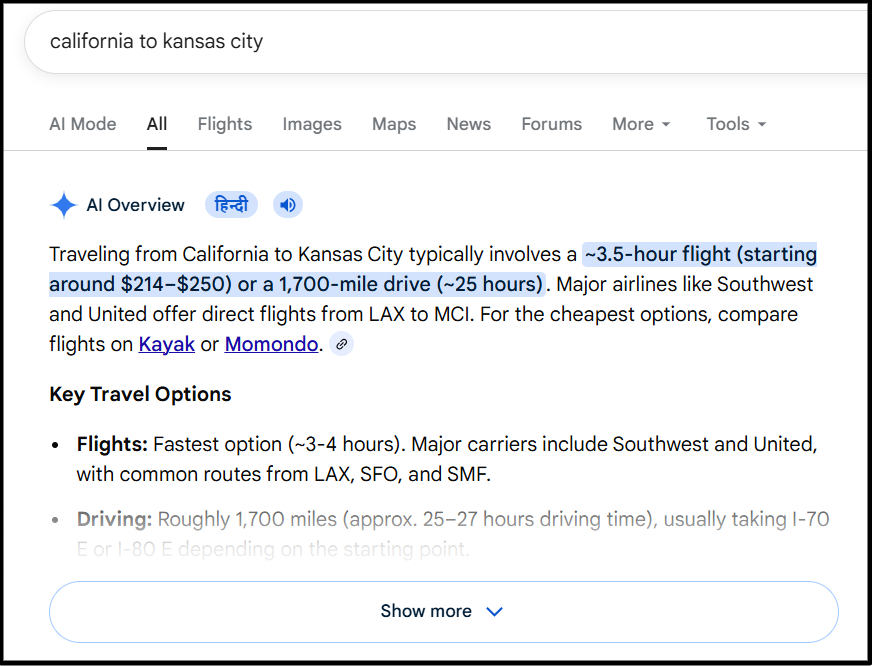
AI Overviews (formerly SGE) focus on synthesis. If a user asks, “What are the benefits of magnesium?”, Google’s AI synthesizes five articles into one cohesive paragraph. This is the “Answer Engine” at its peak. It satisfies the user’s curiosity without them ever needing to click a link.
Task Based Search (Functional)
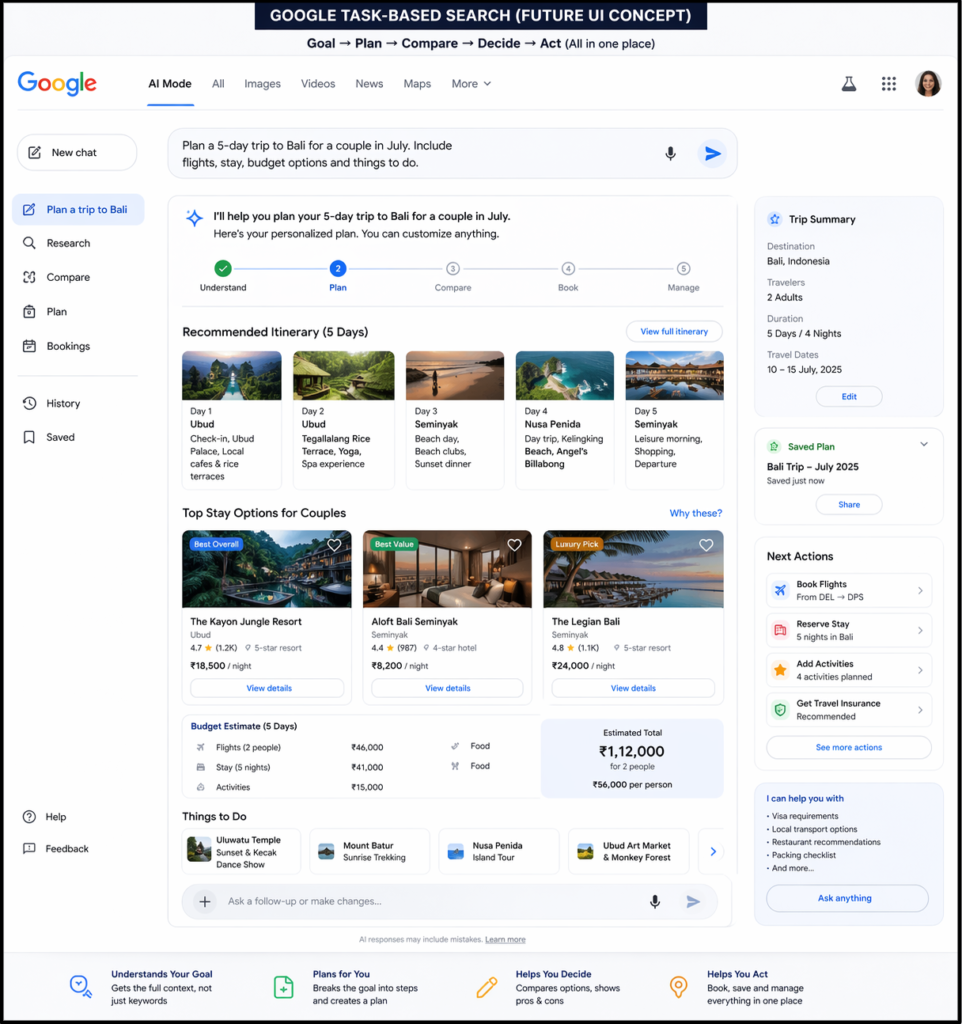
Task based search is deeper. If a user asks, “Help me set up a keto meal plan for a family of four on a $200 weekly budget,” the AI isn’t just answering a question. It is:
- Calculating caloric needs.
- Checking current grocery prices.
- Generating a shopping list.
- Organizing recipes by cooking time.
The Distinction: AI Overviews provide knowledge; task based search provides utility. For marketers, this means your content must transition from being “educational” to being “functional.”
The Harsh Reality: What’s Actually Dying
We need to be honest: some parts of SEO are dying, and they deserve to. If your strategy relies on the following, your traffic is at extreme risk:
- Low-Value “Skyscraper” Content: Writing the “ultimate guide” to something that has already been explained 1,000 times. AI can summarize those 1,000 articles better than you can.
- Keyword Stuffing & Semantic Gaming: Trying to trick an LLM (Large Language Model) is a losing battle. These models understand intent, not just word frequency.
- Basic Informational Queries: If your business model relies on “top-of-funnel” traffic from simple questions (e.g., “What is a CRM?”), expect that traffic to drop by 60-80% as AI Overviews take over the top of the SERP.
The New Winning Playbook: What Thrives in an AI World
If “answering questions” is no longer enough to win, what is? The winners in the age of AI in digital marketing will be those who provide things AI cannot easily replicate:
Experience-Driven Insights (EEAT on Steroids)
AI can aggregate facts, but it cannot have experiences. A blog post titled “How to Hike the Appalachian Trail” is replaceable. A post titled “What I Learned Hiking the Appalachian Trail with a Broken Boot and Two Gallons of Water” is irreplaceable.
Tools, Templates, and Frameworks
Task based searchers want shortcuts. If you provide a downloadable calculator, a Notion template, or a proprietary framework, you become the utility the AI recommends to help the user finish their task.
Brand Authority and “Selection”
In a world of infinite AI-generated content, humans (and AI filters) will gravitate toward brands they trust. We are moving from a world of “Ranking” to a world of “Selection.” The AI will select the most trusted source to fulfill the user’s task.
How SEO Will Evolve: The 7 Core Shifts
To survive the transition to task based search, marketers must rethink every fundamental pillar of SEO.
| Traditional SEO | Task-Based SEO | The Strategic Shift |
| Keywords | User Goals | Stop targeting “mortgage rates”; target “buying a first home.” |
| Articles | Workflows | Don’t just explain; provide a step-by-step interactive path. |
| Pages | Modular Content | Structure data so AI can extract and use it in different contexts. |
| Traffic | AI Inclusion | Success is defined by being the “Source” the AI cites. |
| Content | Content + Tools | Pair your advice with a widget or template. |
| Backlinks | Trust Ecosystem | Focus on mentions in niche communities and expert directories. |
| Blogs | Content Ecosystems | Interconnect your YouTube, Podcasts, and Web content. |
Practical Strategies for AI Optimization
You cannot “optimize” for an AI the same way you do for a crawler. You must optimize for clarity and utility.
Step 1: Use Modular Content Architecture
AI models process information in chunks. Instead of long, rambling paragraphs, use:
- Clear H2s and H3s that represent sub-tasks.
- Bulleted lists for “Steps to Complete.”
- Tables for comparison data.
Step 2: Implement Advanced Structured Data
Schema markup is no longer optional. Use HowTo schema, FAQ schema, and SoftwareApplication schema to tell the AI exactly what task your page helps the user perform.
Step 3: Create “Task Clusters”
Instead of “Keyword Clusters,” build content around a specific objective.
- Core Task: Starting a Podcast.
- Sub-tasks: Choosing a mic, hosting platforms, interview scripts, editing workflows.
- Your site should be a “one-stop shop” for the entire workflow.
Step 4: Formatting for Extraction
AI “scrapes” to fulfill a user’s request. Make it easy. Use “TL;DR” summaries at the top of your articles and provide clear, declarative statements (e.g., “The best way to [Task] is [Method] because [Reason]”).
The Metric Shift: Will Google Create a Task-Tracker?
In the future, “Rank #1” will be a vanity metric. If Google provides the answer in an AI Overview, being #1 might yield zero clicks.
We expect the evolution of Google Search Console to include new metrics:
- AI Inclusion Rate: How often your brand is cited as a source in AI-generated answers.
- Assisted Conversions: Users who interacted with your brand via AI and eventually landed on your site to finalize a transaction.
- Brand Sentiment Index: How the AI “describes” your brand when asked for recommendations.
The Future of SEO: From Ranking to Influence
The “death” of SEO is actually the “death of the middleman.” Users no longer want to browse through ten websites to find a solution; they want the solution immediately.
As a marketer, your job is no longer to build a “destination” but to build an influence system. You want your data, your tools, and your insights to be the “fuel” that powers the AI’s response.
The New SEO Mantra: Don’t just build a page that ranks; build an asset that is essential to the user’s workflow.
Conclusion: Adapt or Fade
SEO isn’t dying; it’s finally growing up. We are leaving the era of “tricking the bot” and entering the era of “powering the assistant.”
The rise of task based search is a threat to those who produce generic, thin content. But for the forward-thinking marketer, it is an unprecedented opportunity. By shifting your focus from keywords to goals, and from pages to workflows, you ensure your brand remains the “Selected” authority in an AI-driven world.The future of search isn’t about being found—it’s about being useful. Stop optimizing for the click; start optimizing for the completion of the task.