
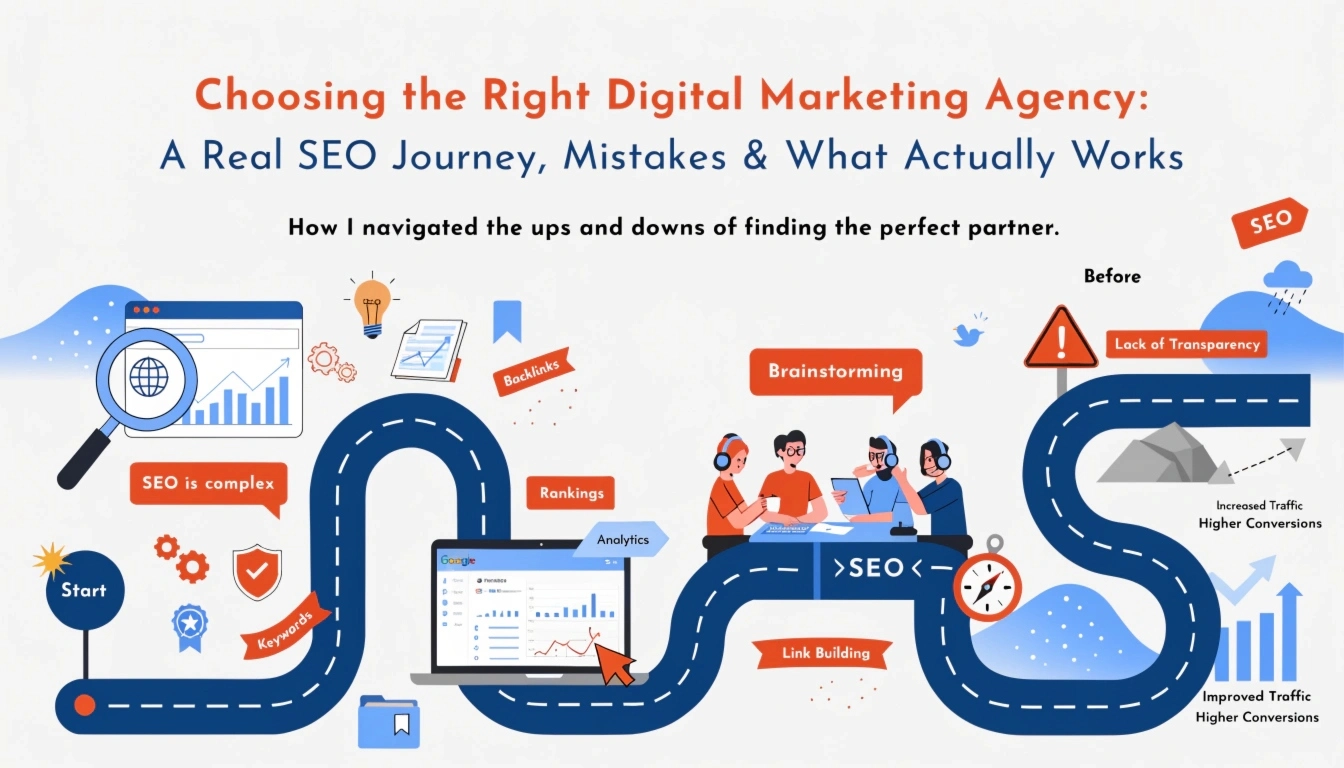
I’m in a weird spot. I know enough about SEO to be dangerous—I understand backlinks, I can navigate a keyword research tool, and I know my way around a meta description. But despite that knowledge, my business’s growth has hit a ceiling.
If you’re reading this, you’re likely in the same boat. You’ve got a website that ranks for a handful of specific, “vanity” keywords, but your Google Search Console looks like a flatline. You aren’t seeing new queries pop up. You aren’t capturing user intent. You’re just… existing.
The realization hits hard: knowing how SEO works and having the bandwidth to execute a winning strategy are two very different things.
So, I did what any desperate business owner does. I went looking for a digital marketing agency. And let me tell you, the “too many options” problem is real. From the giants who treat you like a ticket number to the hungry startups who might be over-promising, the landscape is a minefield. This is the story of how I navigated that noise, what I learned about the reality of SEO, and why I’m finally looking at my marketing through a different lens.
The Realization: Why My “Good SEO Knowledge” Wasn’t Enough
For a long time, I thought I had it under control. I was targeting specific keywords in the medical niche—high-intent terms that should have been bringing in leads. And they did, for a while. But eventually, the growth stopped.
I was stuck in what I call the “Targeted Keyword Trap.” I was ranking for exactly what I asked for, but I wasn’t ranking for what my customers were actually searching for. My Google Analytics showed stagnant traffic, and my Search Console data was limited to a few dozen terms.
The Missing Piece: User Intent and Query Expansion
I realized I didn’t understand the “long tail.” I didn’t understand how a patient’s journey starts with a symptom and ends with a booking. My SEO was a monologue, not a conversation.
SEO isn’t just about technical checkboxes anymore. It’s about:
- Query Growth: Are you showing up for 100 keywords today and 1,000 next month?
- Data Depth: Can you see the nuances in how people find you?
- Algorithm Resilience: If Google updates its core system tomorrow (which it will), is your foundation strong enough to survive?
This is where I realized I needed a partner—not just a pair of hands, but a brain.
Agency vs. Individual: The Honest Truth
I debated hiring a freelancer. It’s cheaper, right? But here’s the thing: SEO is no longer a one-man job. You need a technical expert, a content strategist, a link builder, and someone to keep an eye on the data.
Agencies don’t have magic. Let’s be clear about that. They use the same tools we do. But what they do bring is:
- Systems: They have a repeatable process.
- Speed: They can do in a week what takes me a month.
- Cross-Industry Intel: They see what’s working for ten other clients and apply those wins to you.
The Conversation That Changed My Perspective
I started interviewing Digital Marketing agencies. Most of them gave me the same “we will get you to #1” pitch. Then, I had a call with a startup agency with a curious name: The Loosers.
I went in skeptical. But the conversation was different from the start. They didn’t talk about “hacking” the system. We talked about transparency and realistic expectations.
The “No-BS” Timeline
They told me straight up: “Don’t expect a miracle in 30 days. You’re looking at 4–5 months minimum to see a real shift in query volume.” In an industry where people promise “overnight rankings,” that honesty was refreshing.
The Medical Niche (YMYL)
Since I operate in the medical space, I was worried about Google’s YMYL (Your Money or Your Life) guidelines. The agency didn’t just nod; they explained the risks of “grey hat” tactics. They emphasized that in the medical world, a single algorithm update can wipe out a site if the content isn’t authoritative. They focused on White Hat SEO—doing things the right way so I wouldn’t have to stay up at night worrying about a manual penalty.
Control and Communication
One of my biggest fears was losing control of my site. I’ve heard horror stories of agencies changing metadata or deleting pages without telling the owner. Their stance was firm: No changes without approval. They viewed themselves as an extension of my team, not a black box where “magic” happens.
Evaluating the Landscape: The “Loosers” and the Field
In my search, I looked at a variety of agencies. It’s important to see where different players fit into the ecosystem.
The Emerging Contenders
These are the agencies that are hungry, flexible, and often more hands-on.
- The Loosers: As a growing startup agency, their USP is their “Full-Stack” approach. They don’t just do digital; they understand the bridge between direct marketing and online presence. They are highly transparent, focusing on industries like medical and architecture where precision matters. While they are still building their public portfolio of testimonials, their willingness to dive deep into strategy and offer granular control is their biggest selling point.
- Single Grain: Great if you want a heavy focus on content-led SEO growth. They are big on the “power of one”—finding that one thing that moves the needle.
- HawkSEM: These folks are obsessed with ROI. If you want to see exactly how every dollar of performance marketing translates to a lead, they are a solid choice.
- Directive Consulting: Specifically for SaaS and B2B. If you aren’t in those spaces, they might not be the fit, but in their niche, they are kings.
- GrowthHit: They specialize in Conversion Rate Optimization (CRO). It’s one thing to get traffic; it’s another to make that traffic buy something.
- KlientBoost: The masters of PPC and landing page optimization. They move fast and have a very distinct, aggressive style.
The Giants (The “Big Box” Agencies)
Then you have the names everyone knows: WebFX, SmartSites, NoGood, Ogilvy, NP Digital, and Thrive.
These agencies are impressive. They have thousands of clients and massive teams. But here’s the caveat: Big agencies are not always the best fit for everyone. If you are a mid-sized business, you might end up with a junior account manager. You get the brand name, but you might not get the “A-team.”
Comparing the Emerging All-Stars
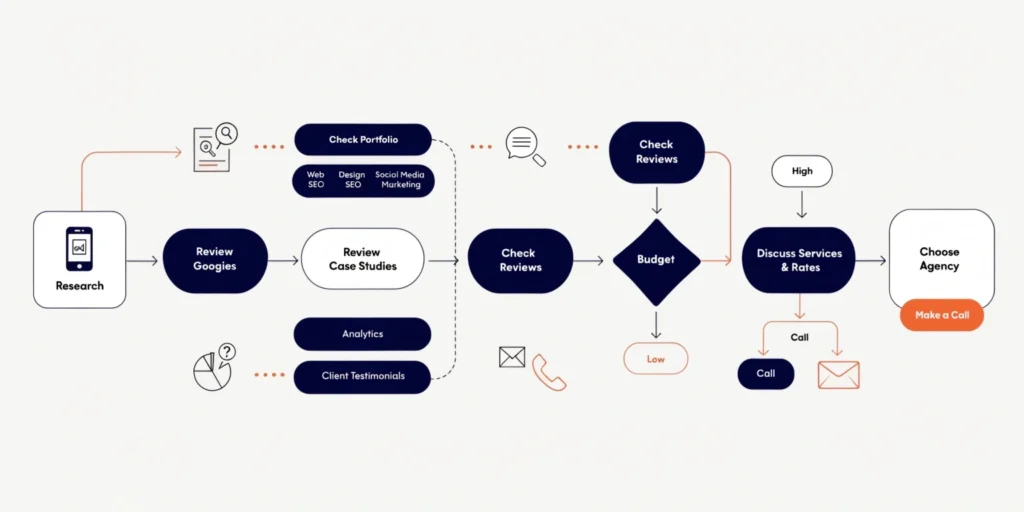
During my search, I looked at several “emerging” agencies. These aren’t the giant conglomerates; they are the nimble, hungry teams that are actually innovating. Here is how they stack up:
| Agency | Best For… | Unique Selling Proposition (USP) | Vibe Check |
| The Loosers | Medical & Architecture | Full-Stack Transparency. They combine digital with direct marketing and offer 100% client control. | The “Honest Partner” who explains the ‘why’ behind every move. |
| Single Grain | High-Growth Tech | Search Everywhere Optimization. They focus on AI-forward strategies and “leveling up” revenue. | The “Cool Tech” agency for those who want to be ahead of the curve. |
| HawkSEM | E-commerce & Leads | ConversionIQ. An obsession with tracking every cent of ROI back to a specific lead. | The “Data Scientists” who hate vanity metrics. |
| Directive | B2B & SaaS | Customer Generation. They ignore MQLs and focus entirely on qualified pipeline and revenue. | The “Corporate Heavy-Hitter” for serious B2B growth. |
| GrowthHit | Startups & E-com | 100-Day Growth Sprints. They diagnose bottlenecks and run rapid experiments to fix them. | The “Internal Growth Team” you wish you could hire in-house. |
| KlientBoost | Fast-Paced Brands | The “Iceberg Effect” Experts. High-velocity PPC and landing page optimization. | The “High-Energy” team that moves incredibly fast. |
A Practical Decision Framework: How I Chose
If you are struggling to choose a digital marketing agency, stop looking at their flashy website and start looking at their process. Here is the framework I used:
Step 1: Demand Data Transparency
Don’t let them show you a curated PowerPoint slide. Ask to see a live Google Search Console view of a client (with sensitive info blurred, obviously). Are their queries growing? Is the “total search terms” count increasing?
Step 2: Test Their Industry IQ
In the medical niche, I asked: “How do you handle E-E-A-T (Experience, Expertise, Authoritativeness, and Trustworthiness)?” If they look at you blankly, walk away. Every industry has its “secret” requirements. Make sure they know yours.
Step 3: The “Who” Factor
Ask: “Who is actually doing the work?” Is it the senior strategist you’re talking to on the sales call, or is it an intern? With a startup agency like The Loosers, you often get the founders or senior leads directly involved. With big agencies, verify your point of contact.
Step 4: Communication Guardrails
Will they send a report once a month and disappear? Or is there a Slack channel? I realized I wanted a “high-touch” relationship where I approve the strategy before a single line of code is changed.
The Smart Hiring Strategy (The 90-Day Test)
I’ve learned that you shouldn’t sign a 12-month contract on day one. A smart hiring strategy involves a 2–3 month test phase.
During this time, you aren’t looking for “Rank #1 for [Huge Keyword].” You are looking for:
- Impression Growth: Is the site starting to show up more in searches?
- Query Diversity: Are you ranking for 50 new variations of your services?
- Communication Flow: Do they respond to your concerns?
- The Foundation: Are the technical errors (404s, slow load times) being fixed?
The SEO Reality Check
Here is something no agency wants to tell you, but the honest ones—like the ones I actually respected—will:
- Months 1–2 are boring. It’s all about fixing the “plumbing.” Cleaning up site architecture, fixing broken links, and optimizing existing content. You won’t see a spike in leads here.
- Months 3–4 are for visibility. You’ll start seeing your “Average Position” move in Search Console. You’ll see your “Total Impressions” climb.
- Months 4–6 are for results. This is when the phones start ringing.
And a warning: Google changes the rules. An algorithm update can happen in Month 5 and set you back. A good agency doesn’t panic; they pivot.
Common Pitfalls to Avoid
As I went through this journey, I almost fell for a few traps:
- The Price Trap: “We’ll do your SEO for $500 a month.” No, they won’t. They’ll run an automated tool, send you a PDF, and call it a day. Quality SEO requires human hours. Human hours cost money.
- The “Guaranteed Rankings” Trap: No one owns Google. If they guarantee #1, they are likely using “black hat” tactics that will eventually get your site banned.
- The Hands-Off Trap: Even if you hire the best digital marketing agency, you cannot completely check out. You know your business better than they do. Your input on content accuracy and brand voice is vital.
Fit Over Fame
When I started this journey, I thought I just needed “the best” agency. I realized that “the best” is subjective.
The “best” agency for me wasn’t the one with the biggest office or the most awards. It was the one that:
- Validated my existing knowledge but pointed out my blind spots.
- Didn’t try to hide behind jargon.
- Showed me a clear path to expanding my search queries, not just maintaining my current ones.
- Gave me full control over the final execution.
Whether you go with a specialized boutique agency like The Loosers for that high-touch, transparent experience, or a performance-heavy hitter like HawkSEM, the decision must be based on trust and process.
Final Thoughts
Choosing a digital marketing agency is like choosing a business partner. You’re giving them the keys to your digital storefront. If they promise you the world in a week, keep your keys. If they sit down with you, look at your Google Analytics, and tell you that you have a long, hard road ahead—but they have a map—those are the people you hire.
Don’t just look for SEO services; look for a growth engine. And remember, the goal isn’t just to rank—it’s to be found by the people who need you most.
My journey isn’t over, but for the first time in a year, the “Total Queries” line in my Search Console is finally pointing up. And that’s a start.