
Let’s be honest — the moment Google started answering questions directly at the top of the page, every SEO professional felt a small earthquake under their feet. The Gemini Sparx update didn’t just shake the ground. It rewrote the map.
If you’ve been in the Digital Marketing world for any amount of time, you already know that Google never stands still. But what’s happening right now is different. It’s not another core algorithm update or a penalty wave. It’s something far more fundamental: the way people search, and the way Google responds, is being rebuilt from the ground up around artificial intelligence.
So let’s talk about it properly. What exactly is the Gemini Sparx update? What does it mean for your SEO strategy? And the big question everyone’s asking — is GEO (Generative Engine Optimization) actually replacing traditional SEO, or are we just dealing with another round of industry hype?
Grab a coffee. This one’s worth reading slowly.
What Is the Google Gemini Sparx Update, Really?
The Gemini Sparx update is Google’s most aggressive push yet to integrate its Gemini AI model directly into the search experience. Think of it as Google graduating from a librarian who points you to the right shelf, to a highly intelligent research assistant who reads the books, synthesizes the key ideas, and hands you a custom answer — instantly.
Under Sparx, Google’s AI doesn’t just retrieve links. It interprets intent, understands context, compares multiple sources, and generates an AI-powered summary right at the top of your search results — what Google calls an AI Overview. Below that, you still get traditional blue links, but most users are already reading the AI answer before they ever scroll down.
This is a massive behavioral shift. And it’s one that every business relying on organic traffic needs to deeply understand.
What makes Sparx different from earlier AI features is the depth of conversational capability. You can now search for something, follow up with a clarifying question, narrow your request further, and Google’s AI will maintain context across the entire session — like a conversation, not a series of disconnected queries. This is what’s driving the conversation around Conversational Search and why how we think about SEO Services needs to evolve.
Also Read: Google May Core Update 2026: What You Should Know
The Rise of AI-Powered Search — And Why It Changes Everything
Here’s a simple way to think about the shift. Traditional search was fundamentally a matching game. You type in a keyword. Google scans its index. It ranks pages based on relevance and authority. You click a link and find your answer.
AI-powered search is a generation game. Google’s AI reads, reasons, and writes. It synthesizes information from multiple trusted sources, understands what you’re really trying to accomplish, and responds with structured, direct answers. The need to click ten different links to piece together information? It’s rapidly shrinking.
| “The search engine has stopped being a pointer and started being a participant in your research process.” — A shift that defines the post-Sparx search era |
For businesses, this is both a threat and an enormous opportunity. The threat is obvious — if Google is answering questions directly, will anyone click through to your website? The opportunity, which most people aren’t fully grasping yet, is this: if your content is cited by Google’s AI, you become part of the answer itself. That’s a level of visibility that no traditional ranking could guarantee.
This is the heart of what Generative Engine Optimization (GEO) is all about.
Traditional SEO vs GEO — What’s Actually Different?
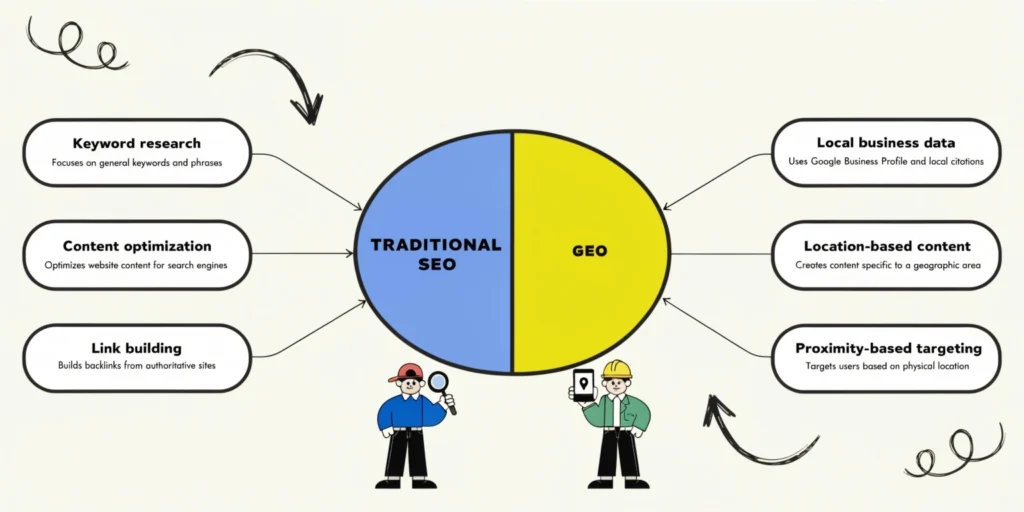
Let’s clear something up before we go further. GEO is not the death of SEO. It’s the evolution of it. But the difference in approach is significant enough that treating them identically will hurt you.
| Focus Area | Traditional SEO | GEO (Generative Engine Optimization) |
|---|---|---|
| Primary Goal | Rank on page one for target keywords | Be cited in AI-generated answers and overviews |
| Content Strategy | Keyword-dense pages targeting search volume | Authoritative, conversational, entity-rich content |
| Success Metric | Rankings, CTR, organic traffic volume | AI citations, brand mentions, trust signals |
| Link Building | Volume of backlinks matters significantly | Quality, context-relevant links as authority signals |
| Search Logic | Pattern matching on keywords | Semantic understanding + entity recognition |
| User Experience | Drive the user to your page | Serve user intent — on-page or off |
Notice that the differences aren’t about abandoning what you know — they’re about upgrading it. Keywords still matter. Links still matter. But the why behind them has fundamentally changed, and that changes the how.
Let’s Talk About Keywords — Are They Dead?
No. But Keyword Stuffing? That’s Very Much Dead.
One of the most common misconceptions after any major Google update is that keywords have been killed off. People hear “AI understands intent” and immediately leap to “so I don’t need to worry about what words I use.” That’s not what it means.
Keywords still tell Google — and more importantly, your audience — what your content is about. They’re still the vocabulary of search. The difference now is that Google’s AI doesn’t just look for the presence of a keyword. It looks at the entire semantic context around it. Are you covering the topic comprehensively? Are you addressing related sub-topics and questions? Does your content demonstrate real expertise?
Under the Gemini Sparx update, stuffing a page with the phrase “best running shoes” forty-seven times won’t get you anywhere. But writing a genuinely useful, well-structured guide about running shoe selection — one that covers terrain types, gait analysis, brand differences, injury prevention — will signal to Google’s AI that you are a trustworthy source on that topic. That’s semantic SEO, and it’s at the heart of modern optimization.
| PRACTICAL TAKEAWAY: Stop targeting single keywords. Start building topical authority. Cover a subject from every meaningful angle, answer the questions your audience actually asks, and structure your content so AI systems can easily extract clear, useful information from it. |
What About Backlinks? Are They Still Worth Pursuing?
Yes — but the calculus has changed significantly.
In the old world of SEO, getting five hundred backlinks from low-quality directories and article spinning sites could move your rankings. Many of those tactics still technically worked as recently as a few years ago, even if Google always said they didn’t. The Gemini Sparx era has closed that gap almost entirely.
Here’s why backlinks still matter: Google’s AI needs to establish trust. When it synthesizes an answer from multiple sources, it’s not going to pull from a random blog that nobody has ever cited. It gravitates toward sources that other credible entities reference. A backlink from a respected industry publication isn’t just a ranking signal anymore — it’s a trust certificate.
Quality over quantity has never been more true. Ten contextually relevant, editorially earned backlinks from credible sources are worth exponentially more than a hundred links from sites that exist purely to sell link placements.
The businesses that will win in the Gemini Sparx era are the ones being talked about, cited, and referenced across their industry — not just on their own website, but in trade publications, expert roundups, authoritative blogs, and even in other AI-generated content that references them as a source.
Understanding AEO — The Other Piece Most Marketers Are Missing
If GEO is about being included in AI-generated search answers, then Answer Engine Optimization (AEO) is about being the definitive source for specific, direct questions — particularly the kind that voice assistants, chatbots, and AI search interfaces handle.
Think about how someone uses a voice search: “What’s the best time to post on Instagram?” or “How long does it take to recover from a sprained ankle?” These aren’t navigational queries — they’re direct question-answer pairs. AEO is the discipline of structuring your content to be the most precise, trustworthy, and easily extractable answer to those questions.
Where GEO focuses on broad topical authority and being cited in generative answers, AEO focuses on featured snippets, direct answers, structured data (schema markup), FAQ sections, and the kind of clear, concise Q&A content that AI engines can pull and present with confidence.
Key AEO Tactics:
- FAQ Schema Markup
- How-To Structured Data
- Clear Definition Paragraphs
- Conversational Q&A Sections
- Voice-Optimized Phrasing
- Concise Direct Answers + In-Depth Supporting Content
The smartest Digital Marketing strategies in the post-Sparx world aren’t choosing between GEO and AEO. They’re building content that serves both — answering specific questions with precision while also establishing deep topical authority that AI systems recognize and trust.
Myths, Fears, and the Reality of GEO Replacing SEO
| The Myth | The Reality |
|---|---|
| MYTH AI Overviews will kill organic traffic entirely. If Google answers the question, nobody clicks through anymore. |
REALITY AI Overviews drive curiosity and discovery. Users who see authoritative mentions often click to learn more. Being cited is a new visibility channel — not a replacement for traffic, but an addition to it. |
| MYTH GEO is just a rebrand of SEO. Nothing has fundamentally changed — it’s just new terminology for the same tactics. |
REALITY The tactics overlap, but the logic is different. Traditional SEO optimizes for a ranking algorithm. GEO optimizes for an AI that must trust and cite you — requiring genuine expertise, not just technical signals. |
| MYTH Small businesses can’t compete in the AI search era. Only massive brands with millions of backlinks will get cited by Gemini. |
REALITY Hyper-specific niche authority is one of the most powerful positions in AI search. A focused, deeply knowledgeable site on a narrow topic can absolutely earn AI citations that broad generalist sites cannot. |
The Deeper Fear: Are SEO Professionals Becoming Obsolete?
This is the one that keeps agency owners and freelancers up at night, so let’s address it head-on. The honest answer is: not if they evolve.
What is becoming obsolete is a very specific type of SEO work — the mechanical, low-quality, checklist-driven kind. If your SEO strategy has primarily consisted of finding keywords with high volume and low competition, stuffing them into thin content, and buying bulk links, then yes, you have a very serious problem.
But genuine strategic SEO work — the kind that involves understanding an audience deeply, building comprehensive content ecosystems, earning real authority, optimizing technical infrastructure, and now calibrating content for AI interpretation — that expertise is more valuable than ever. The SEO professionals who will thrive are those who can bridge the old discipline with the new landscape.
How AI Engines Actually Decide What to Cite
Understanding this is probably the most commercially useful thing in this entire article, so pay attention.
When Google’s Gemini AI generates an answer, it’s not randomly selecting websites. It’s making a judgment about trust, relevance, and completeness. The factors that influence that judgment include:
Entity Recognition: Google’s Knowledge Graph maps entities — real-world things like people, organizations, products, places, and concepts. If your website and its content are clearly associated with specific, well-defined entities, you become part of Google’s semantic understanding of a topic. This is why structured data, clear author attribution, brand mentions across the web, and consistent topical focus all matter so much now.
Expertise Signals: The AI looks for signs that content is created by someone who genuinely knows their subject. First-hand experience, original research, expert quotes, professional credentials, and specific detail that only a real practitioner would know — these all register as expertise signals. Generic overview content registers as the opposite.
Topical Depth and Authority: A website that covers a single subject comprehensively — every angle, every related question, every sub-topic — tells the AI that this is a destination for that topic. Topical authority is built through consistent, interconnected coverage of a defined subject area.
Conversational Relevance: As Conversational Search becomes the norm, content that mirrors how real humans discuss and ask about topics performs better. This means writing in natural language, structuring content around questions, and anticipating follow-up questions.
User Satisfaction Signals: Google has always monitored engagement — time on page, bounce rates, pogo-sticking back to search results. Under the Gemini Sparx framework, these satisfaction signals feed directly into the AI’s understanding of whether your content genuinely helps users.
Also Read: Google’s AI Powered Search Box Is Rewriting the Rules of Digital Marketing
What Businesses Should Actually Do Right Now
Enough theory. Let’s get practical. If you’re running a business or managing SEO Services for clients, here’s where to direct your energy in the Gemini Sparx era:
| 1. AUDIT YOUR CONTENT DEPTH: Identify your most important topics. Are you covering them end-to-end? Do you have supporting articles that address every meaningful sub-question? Build content clusters, not isolated pages. |
| 2. IMPLEMENT SCHEMA MARKUP: FAQ, Article, HowTo, and Organization schema are not optional anymore. Structured data is how AI engines parse and extract information from your pages reliably. |
| 3. BUILD REAL AUTHOR PROFILES: Every major piece of content should have a named, credentialed author with a bio, profile photo, and linked credentials. Anonymous content is a trust signal going in the wrong direction. |
| 4. EARN MENTIONS, NOT JUST LINKS: Pursue PR, expert contributions, and editorial features in respected publications. Being referenced by name — even without a hyperlink — builds entity authority in Google’s AI model. |
FOR SEO SERVICES AGENCIES: Your service offerings need to expand beyond traditional keyword research and link building. Clients in the Gemini Sparx era need help with content architecture for AI systems, structured data implementation, entity optimization, AEO-focused FAQ development, and conversational content strategy. The agencies that will lead the next five years of Digital Marketing are the ones building GEO and AEO competencies today, not waiting until clients start asking for them. |
The Future of Digital Marketing in the AI Search Era
Let’s zoom out and look at where this is all heading, because the Gemini Sparx update is not the destination. It’s an early chapter in a much longer story.
AI agents — autonomous systems that can research, plan, and execute tasks on a user’s behalf — are becoming a real part of how people interact with information. When you ask an AI agent to “find me the best cloud accounting software for a small manufacturing business,” that agent isn’t browsing ten pages and comparing them the way a human would. It’s querying trusted data, synthesizing structured information, and making a recommendation.
The businesses that will be found by those agents are the ones that have made themselves legible to AI: structured data, clear entity associations, consistent reputation signals across the web, and content that directly answers the kinds of comparative, decision-making questions that AI agents handle.
This means the future of Digital Marketing involves thinking about your brand not just as a website to rank, but as a trusted source in an AI-mediated information ecosystem. Your content needs to work for humans reading it. It also needs to work for AI systems interpreting it. These goals are actually more aligned than they sound — both require clarity, accuracy, depth, and genuine usefulness.
What this future does not have room for is content farms, keyword-stuffed fluff, spun articles, purchased link schemes, and the dozens of other shortcuts that have historically gamed ranking algorithms. In the AI search era, those games have essentially no shelf life at all.
The Bottom Line: SEO Isn’t Dead — But It Has to Grow Up
● Low-quality SEO is dying ● GEO is an evolution, not a replacement ● Human + AI optimization = the future
SEO is not dead. The principles that have always defined great SEO — understanding your audience, creating genuinely useful content, building real authority — are not just still relevant, they are more important than ever. What the Gemini Sparx update has accelerated is the death of a particular style of SEO: the mechanical, the shortcut-heavy, the fundamentally user-unfriendly kind.
GEO, AEO, and traditional SEO are not competing disciplines. They are layers of the same optimization philosophy, each addressing a different dimension of how modern search works. Traditional SEO builds the technical and authority foundation. AEO ensures you answer specific questions with precision and structure. GEO positions you as a trusted, citable source within AI-generated answers. You need all three working together.
The businesses and Digital Marketing teams that will win in the next few years are the ones willing to make this mental shift: from optimizing for algorithms to optimizing for trust. Because that’s ultimately what Gemini Sparx is rewarding. Not the cleverest technical hacks. Not the most backlinks. Not the highest keyword density. Trust. Expertise. Relevance. And a genuine commitment to giving users — and the AI systems that serve them — something worth citing.
The future of search is conversational, contextual, and AI-mediated. The future of great Digital Marketing is making sure your brand, your expertise, and your content are part of that conversation. Not shouting over it. Being included in it.That’s the Gemini Sparx era. And for businesses willing to invest in doing things properly? It’s a tremendous opportunity.