
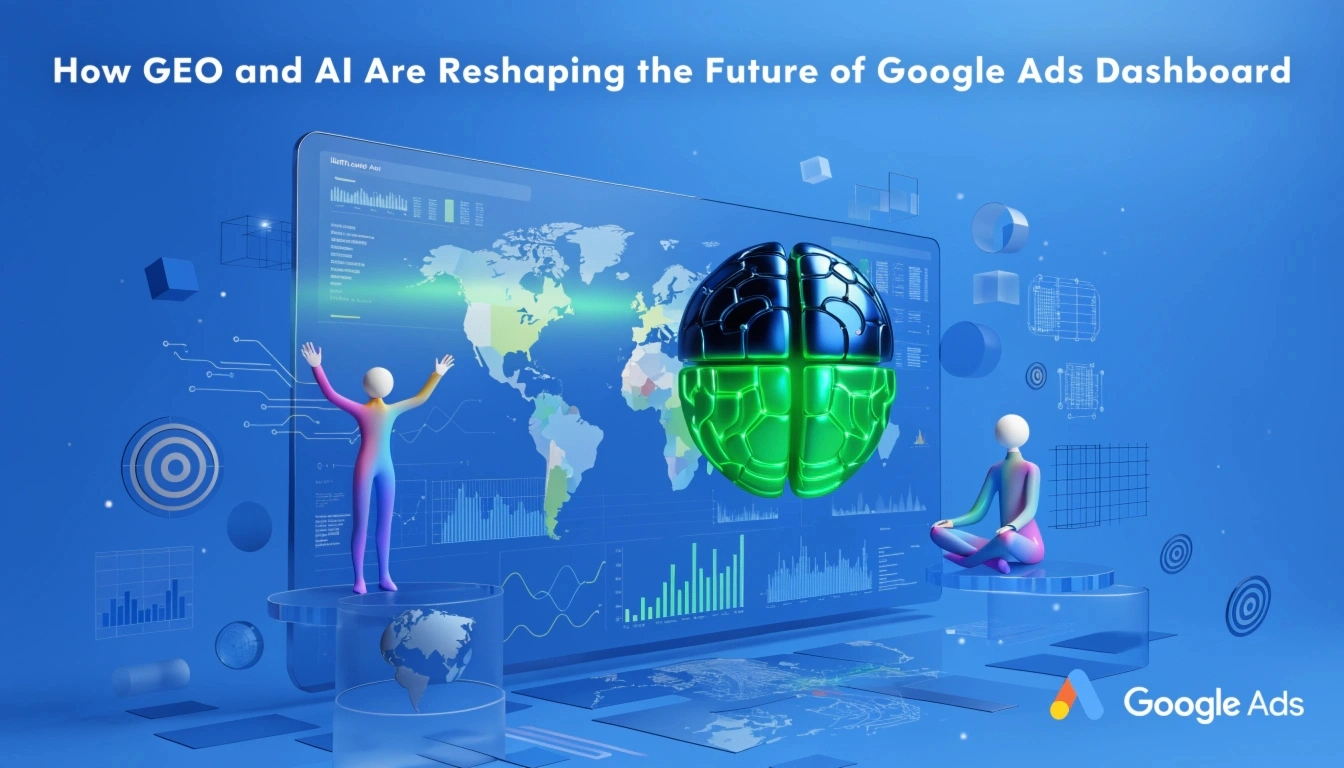
Let’s be frank about it. Google Ads has never been easy from the start, not even for the most experienced PPC marketers who’ve had their share of dealing with a complex web of campaigns, bidding strategies, ad targeting and segmentation, quality scores, and match types. But now that artificial intelligence is at the core of it all, even inside Google Ads’ very interface, thanks to Gemini, things have started getting interesting indeed.
The use by Google of their Gemini AI in its ad service platform cannot be taken lightly. This is not just an improvement in their product offerings. This is a message that things will definitely be different in digital marketing going forward. As a businessman or an entrepreneur, as well as someone in digital marketing or performance marketing, the question to ask is not really whether this technology affects you. It is how fast you can adapt to it.
It is all explained in this article – what the latest updates of Google Ads Dashboard mean, to whom they benefit and where they fail. But the truth is that your strategy, customer’s mindset and creativity will always be your trump cards in the world dominated by AI.
What Is the New Gemini-Powered Google Ads Dashboard?
Starting from early 2024 through 2025, Google rolled out an enhanced version of Google Ads, one powered by the capabilities of its Gemini AI-based models. Specifically, at the heart of the innovation is the introduction of a new concept of the Google Ads dashboard that is not only supposed to be used for managing campaigns but also acting as an intelligent agent helping in creating and optimizing the advertising strategy.
This means that the way of setting up ads has undergone some major changes — instead of going through a number of drop-down menus to specify the desired campaign type (such as search), users are allowed to state their goal directly in plain English such as “Create campaigns in search for booking dental clinic in Chicago aimed at customers aged between 30-55 years.”
Also Read: What Google Ads Data Access Limits Mean for Your Business
Conversational Reporting: Insights Without the Spreadsheet Headaches
Another great benefit offered by AI-driven insights is conversational reporting. Previously, gathering performance information about your Google Ad campaigns involved learning how to use the platform yourself or engaging an expert analyst. Now, you can just type in questions such as “What campaigns performed best in terms of cost per acquisition last month?” and “Why did my click-through rate decrease last week?,” getting a response in the form of machine-generated analysis.
It can be a great solution for entrepreneurs who would like to get some quick answers without having to become proficient in data analysis techniques themselves. However, being able to interpret those answers is another matter altogether.
AI-Generated Ad Copy and Creative Suggestions
Gemini can also create ad headlines, descriptions, and extensions using your landing page content and ad goals. Gemini analyzes your website, picks up your value propositions, and creates ad copy that complies with Google’s standards. This will be especially useful for agencies that have to manage many different accounts. For entrepreneurs who are handling their own ads, this makes things much easier.
The downside? The AI-generated ads will be good from a technical perspective but might not necessarily be good from a strategic one. There’s a huge difference between writing ad copy that adheres to Google standards and creating compelling copy that attracts a particular kind of customer.
Can a Complete Beginner Now Run Ads Just by Typing Prompts?
And that is the million-dollar question. And the truth of the matter is – yes and no.
For sure, an absolute novice will be able to set up a campaign faster than ever before. Gemini will take you through all of the steps involved, recommend your bidding approach, select appropriate keywords, and even create your ad copy. From a purely technical perspective, there’s never been an easier time to start a campaign. That much is true.
What Gemini cannot do for you, however, is to comprehend your customer’s emotional story. It cannot tell you if your prospective customers will respond better to scarcity-driven communication or aspiration-driven communication. It cannot tell you that your offer is inherently flawed and nothing in the world will save it from its fate. Gemini does not know about your market positioning, your competitive edge, or the objection your perfect customer will have before clicking ‘Buy’.
Running ads and running profitable ads are two completely different things. AI can help you do the former. The latter still requires strategic thinking.
An appropriate analogy would be: handing a person a professional quality camera does not mean they have become a photographer. The technical aspect has been taken care of, but the eye, the timing, the knowledge about light and composition – all of which require experience, training, and understanding of how the human eye perceives things – is missing. This is true of digital advertising as well.
While what Gemini accomplishes is democratizing execution, it certainly does not democratize strategy. This one-line separation will be the single most critical point in the next three to five years of performance marketing.
Also Read: Stop Blaming the Algorithm: Why Your Meta Advertising are Tanking
AI-Assisted Marketers vs. Strategic Marketers: A Real-World Comparison
Think about two different advertisers using Google Ads for their competing online fitness coaching services. They both have access to the same Gemini-powered tools. They both have similar budgets. They both have campaigns set up within minutes.
Advertiser A leaves everything to Gemini: suggestion of keywords, ad copy, bidding strategies. The campaigns are quickly launched. The results are mediocre at best. Some clicks happen, but conversions do not seem promising. Cost-per-acquisition starts growing, and eventually, after a couple of weeks, the campaign gets shut down as it does not make any sense.
Advertiser B sees Gemini as the first step in a campaign process. He has done some actual customer research and knows that what his target audience really fears is not becoming overweight – it’s starting a new program and failing for the fourth time. He writes an ad that speaks to this fear and presents his coaching service as the only program he will ever need to take off. His conversion rate is three times higher.
Same technology, different results. This difference is a product of strategy, psychology and positioning – all of which cannot be conjured by a machine.
Why Strategy Still Matters More Than Automation
Google Ads AI — no matter how advanced — works on signals and patterns. It optimizes within the boundaries of what you give it. If your offer is weak, your landing page is confusing, or your messaging misses the mark, Gemini will efficiently drive traffic to a broken funnel. Automation amplifies what’s already there. It doesn’t fix what’s fundamentally wrong.
This is why the best digital marketing agencies aren’t worried about Gemini replacing them. They’re focused on becoming better strategists, sharper copywriters, and deeper students of consumer psychology — because those are the skills that AI cannot replicate by processing historical data patterns.
If Everyone Uses the Same AI, Who Actually Wins?
This is perhaps the most strategically important question of the decade for anyone in digital marketing. And it doesn’t have a comfortable answer.
When every advertiser has access to the same AI tools, the same automated bidding, the same creative generation, and the same optimization recommendations, execution becomes a commodity. Everyone’s ads start looking more or less the same. Everyone’s bidding strategy starts converging toward the same Google-recommended approach. The platform-level advantages flatten out.
What this means is that differentiation moves upstream. It moves away from “who can set up campaigns better” and toward “who has the more compelling offer,” “who understands their customer more deeply,” “who has the stronger brand,” and “who has built enough trust that they convert at a higher rate before the click even happens.”
The New Competitive Advantage: Pre-Click Trust and Positioning
In a world where AI manages execution, your competitive advantage lives in things that don’t happen inside the Google Ads dashboard. It lives in your brand perception, your content ecosystem, your customer testimonials, your thought leadership, and the reputation your business has built in your market. These are things Google’s algorithm rewards and Gemini cannot manufacture.
Businesses that win in this environment will be those that invest in brand alongside performance. They’ll treat SEO Services and content marketing not as optional add-ons but as the foundation that makes their paid campaigns more effective. They’ll understand that omnichannel presence — being discoverable on Search, visible in AI-generated answers, trusted by a community — creates a compound advantage that purely transactional advertisers simply can’t match.
What Google Actually Measures — And Why It Still Rewards Quality
A common misconception that has resurfaced with the rise of AI-powered advertising is the idea that using more automation means better results. Google favors AI-optimized campaigns. But this confuses correlation with causation.
What Google actually measures hasn’t fundamentally changed. Quality Score still matters. Ad relevance — how closely your ad matches search intent — still matters. Landing page experience still matters. Expected click-through rate still matters. And perhaps most importantly, actual conversion quality matters.
Google’s systems are built to show ads that users respond to positively. This means that an AI-generated ad that doesn’t connect emotionally with the searcher will still underperform a carefully crafted human-written ad that does. Automation decides when and where to show your ad. Relevance and resonance determine whether that exposure produces a return.
The Quality Score Equation in the Age of Gemini
Quality Score has always been Google’s way of rewarding advertisers who truly serve user intent. In the Gemini era, this becomes even more consequential. As automation handles more of the execution layer, the differentiation between high and low Quality Scores becomes a function of strategic alignment — how well your entire advertising ecosystem, from keyword to ad to landing page to conversion path, aligns with what your customer actually needs.
This is not something Gemini optimizes automatically. It requires an advertiser who understands their customer well enough to create end-to-end coherence. That’s a human skill. And it directly translates to lower costs and higher returns within the Google Ads ecosystem.
How This Changes the Future of Digital Marketing for Agencies and Businesses
The implications for agencies are significant — and in some ways liberating. For years, a large portion of agency value was derived from platform expertise: knowing how to navigate Google Ads, how to set up campaigns correctly, how to interpret data. As Gemini automates more of that operational layer, agencies that derived most of their value from execution will feel the squeeze.
But agencies that have always positioned themselves around strategic thinking, creative direction, and business outcome accountability will find this era incredibly validating. Their clients don’t want someone to set up campaigns anymore — they want someone who understands their business, their market, and their customers well enough to make decisions that Gemini can’t make for them.
The Growing Importance of SEO Services in a Gemini World
Here’s something that often gets overlooked in the AI Ads conversation: as Google’s paid advertising becomes more accessible through AI, the importance of organic presence through SEO Services actually increases. Why? Because AI-driven paid campaigns will intensify auction competition. More advertisers entering the market with Gemini-assisted campaigns means higher CPCs in many industries.
Businesses that have invested in SEO — building topical authority, earning quality backlinks, creating genuinely helpful content — will have a structural cost advantage that no amount of ad spend can easily replicate. Organic traffic, earned through strategic SEO Services, becomes a moat in an environment where paid media is increasingly crowded and expensive.
First-Party Data Becomes a Core Strategic Asset
As automation takes over more targeting decisions, advertisers who have rich first-party data — email lists, CRM data, purchase histories, customer behavior data — will have a significant advantage. Gemini can optimize better when it has more signal. Businesses that have prioritized customer data collection, consent-based email marketing, and CRM hygiene will feed the AI better inputs and get better outputs.
This shifts the strategic imperative for businesses: stop thinking about advertising in isolation and start thinking about your entire data ecosystem. Every customer interaction is a data point. Every email subscriber is a targeting signal. Every purchase history is a lookalike audience seed. The companies that understand this will compound their AI advantages while others remain at the platform’s default settings.
The Rise of GEO: Why Generative Engine Optimization Is the New Frontier
If you’ve spent years building your digital marketing strategy around traditional search, you need to add a new discipline to your thinking: Generative Engine Optimization, or GEO.
GEO refers to the practice of optimizing your content and digital presence to appear prominently in AI-generated answers — not just in traditional blue-link search results. As tools like Google’s AI Overviews, Gemini in Search, ChatGPT, Perplexity, and other AI answer engines become primary information sources for consumers, the question of whether your business appears in those answers becomes a central marketing challenge.
How GEO Differs From Traditional SEO
Traditional SEO is largely about ranking signals: domain authority, backlinks, on-page optimization, technical health. GEO requires something more nuanced. AI answer engines don’t just look for the most authoritative page — they look for the most clear, accurate, and contextually relevant information that answers a specific question in a way that an AI can easily synthesize and cite.
This means your content strategy needs to think in terms of question-answer structures, clear explanations, entity-rich writing, and authoritative sourcing. Pages that read like genuine expert-written resources — comprehensive, clearly structured, factually grounded — are the ones AI systems tend to surface in generated answers.
GEO and Google Ads: The Convergence
Here’s where it gets strategically interesting. As Google continues to integrate Gemini across its products, the line between organic GEO and paid AI-powered advertising will blur. Ads may begin appearing more prominently within AI-generated responses. Brands that have strong organic GEO presence may receive preferential placement or lower costs in AI-adjacent advertising formats. The advertisers who understand both the paid and organic sides of this AI ecosystem will have a meaningful edge.
For businesses that want to remain competitive across this entire landscape, the strategy is clear: invest simultaneously in strong SEO Services for traditional and generative search, while building Gemini-assisted Google Ads campaigns grounded in genuine strategic thinking rather than default automation.
The Skills That Will Matter Most in the AI Era of Advertising
Let’s be specific about what actually creates value in a world where Gemini handles the execution layer. The following competencies are not just nice-to-haves — they will be the defining characteristics of the marketers and businesses that outperform everyone else over the next decade.
1. Strategic Thinking and Business Acumen
The ability to connect advertising decisions to actual business outcomes — margin, customer lifetime value, market share — will become more valuable as campaign setup becomes more accessible. Strategy is the context within which AI optimization operates. Without it, you’re just optimizing a function that shouldn’t exist.
2. Customer Psychology and Behavioral Understanding
Why do people buy? What makes them hesitate? What triggers action versus indecision? These questions live at the heart of conversion optimization, and they’re not answered by data alone. They require empathy, market research, customer interviews, and the kind of intuitive understanding that comes from genuinely knowing your audience. AI has patterns. Humans have understanding.
3. Offer Creation and Competitive Positioning
No amount of media budget or AI optimization can rescue a weak offer. The business that makes the most compelling promise to the right customer wins. This is a fundamental truth of performance marketing that hasn’t changed since the first direct response ad was written. Creating genuinely irresistible offers — ones that are specific, differentiated, and clearly superior to alternatives — is a strategic and creative skill that separates great marketers from average ones.
4. Storytelling and Brand Building
In a world of AI-generated ads, human storytelling becomes a differentiator. Brands that can tell a genuine story — one rooted in authentic purpose, real customer transformation, and a coherent identity — create the kind of emotional resonance that algorithmic ad copy simply cannot match. Brand equity is an accumulation of human moments. Building it is a long game, but it’s the game that compounds.
5. Conversion Architecture and Landing Page Strategy
Gemini can drive traffic. What it can’t do is build a high-converting funnel. Understanding how landing pages should be structured, how to guide users through a decision, how to address objections proactively, how to use social proof effectively — this is conversion architecture, and it remains a deeply human discipline. The marketer who masters it turns average traffic into exceptional returns.
6. Data Literacy and Critical Interpretation
Being able to read AI-generated insights is useful. Being able to critically evaluate whether those insights are directionally correct is essential. AI dashboards can surface patterns, but they can also surface misleading correlations. The marketer who can distinguish signal from noise, ask the right follow-up questions, and challenge automated recommendations when they don’t make strategic sense will consistently outperform those who simply accept what the algorithm suggests.
The Bottom Line: AI Automates Execution. Humans Compete Through Intelligence.
Here’s the thing about every major technological shift in marketing history — from desktop publishing to search engine marketing to social media to programmatic advertising: the tools change, but the fundamental principles of persuasion, positioning, and customer understanding don’t.
The Gemini-powered Google Ads Dashboard is the most significant upgrade to campaign management in years. It makes setting up campaigns faster, reporting more accessible, and optimization more automated. For businesses and marketers who embrace it intelligently, it’s a genuine accelerant.
But it’s an accelerant for the direction you’re already pointed in. If your strategy is weak, your offer is unclear, and your understanding of your customer is shallow, Gemini will help you spend your budget faster on things that don’t work.
The future of digital marketing belongs to those who use AI as a tool — not as a substitute for thinking.
The businesses that will win in this environment are the ones investing in both directions simultaneously: leveraging AI to execute faster and smarter, while doubling down on the human skills that AI cannot commoditize. They’ll build brand equity while running performance campaigns. They’ll invest in SEO Services alongside paid media. They’ll understand GEO well enough to appear in AI-generated answers before a potential customer ever sees a paid ad. They’ll know their customer deeply enough to write messaging that moves people — not just messages that meet a character count.
The Google Ads Dashboard has been transformed. The advertising landscape is shifting faster than most businesses realize. And in the middle of all that change, the competitive advantage has never been more human.
The question isn’t whether you use AI in your digital marketing. You will, and you should. The question is what you bring to the table that AI cannot — and whether you’re investing in that with the same urgency.
Because the strategists, the storytellers, the empathetic marketers who truly understand their customers — they’ve always been the ones who win. That hasn’t changed. If anything, Gemini just made it more obvious.
Frequently Asked Questions
Q: What is the Gemini-powered Google Ads Dashboard update?
A: Google has integrated its Gemini AI model into the Google Ads platform, enabling advertisers to create and manage campaigns through natural language prompts, receive AI-generated insights and recommendations, and access conversational reporting. It significantly lowers the technical barrier to running Google Ads campaigns.
Q: Can beginners use the new Google Ads AI features to run profitable campaigns?
A: Beginners can use Gemini to set up and launch campaigns more easily than ever. However, profitability depends on strategic factors — offer quality, customer understanding, messaging alignment, and funnel design — that AI tools do not automatically provide. Technical execution is easier; strategic excellence still requires human skill.
Q: What is GEO and why does it matter for businesses?
A: GEO, or Generative Engine Optimization, refers to optimizing your digital presence to appear in AI-generated search answers — from tools like Google’s AI Overviews, Gemini Search, ChatGPT, and Perplexity. As more users get answers from AI rather than traditional search results, GEO becomes a critical complement to traditional SEO Services.
Q: Will AI replace digital marketing agencies?
A: AI will automate many of the operational tasks that agencies have historically performed, such as campaign setup, reporting, and basic optimization. However, strategic thinking, brand positioning, customer psychology, and creative direction remain deeply human disciplines. Agencies that evolve their value proposition around strategy and business outcomes rather than execution will thrive in the AI era.
Q: How does the Google Ads AI update affect SEO strategy?
A: As paid advertising becomes more accessible through AI, auction competition will likely intensify, driving up CPCs in many sectors. This makes organic visibility through strategic SEO Services even more valuable as a cost-efficient, long-term traffic source. Businesses should invest in both paid and organic strategies with a cohesive approach that includes traditional SEO and GEO.
Q: What skills should digital marketers develop in the AI era?
A: The most valuable skills in an AI-driven marketing environment include strategic business thinking, customer psychology, offer creation and positioning, brand storytelling, conversion architecture, and data literacy — specifically the ability to critically evaluate AI-generated insights rather than accepting them at face value.