
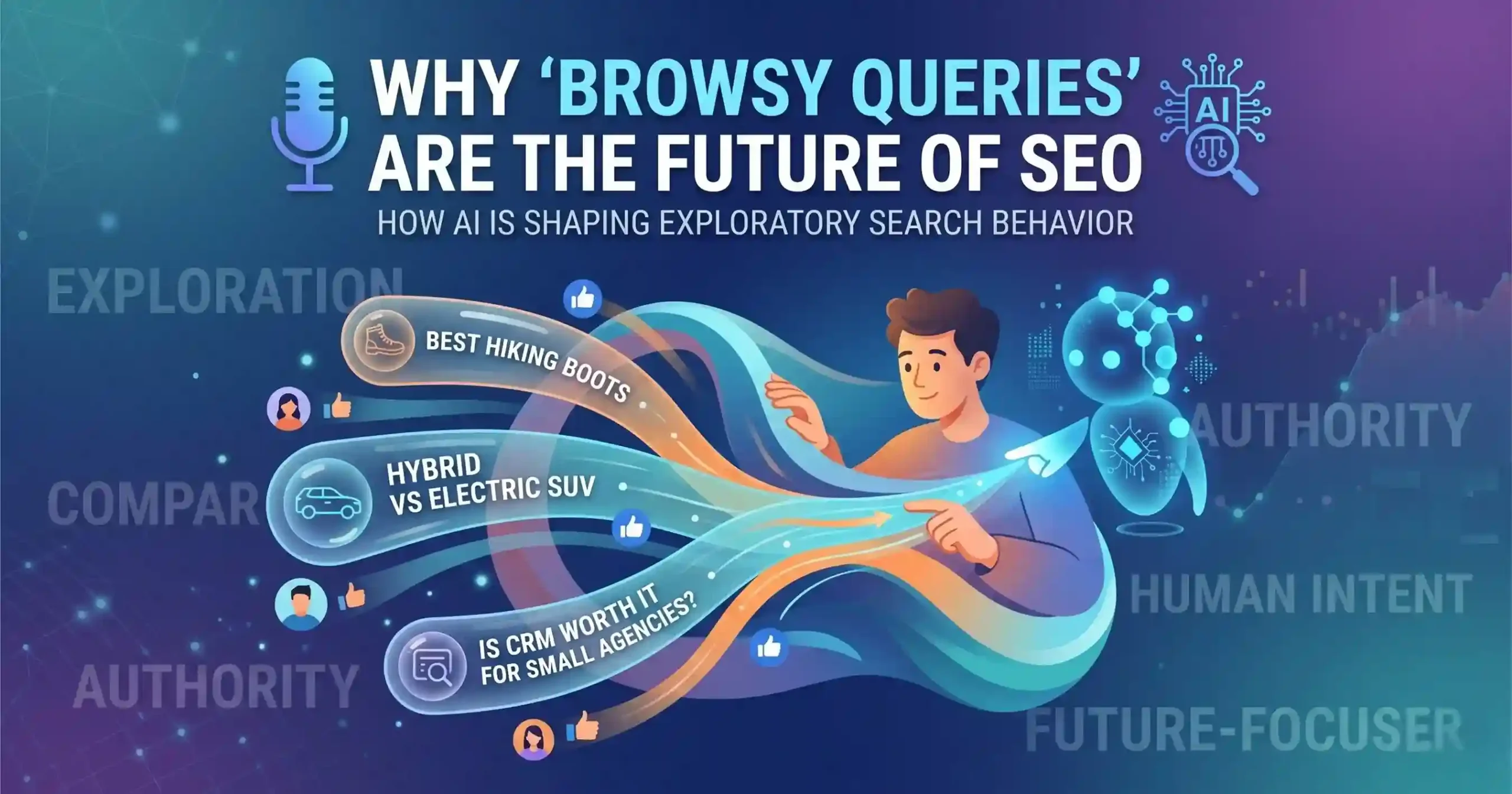
We have been taught to conduct searches as a machine would for many years now. Typing in broken keywords, pressing the Enter button, and then scrolling through blue links to find what we require. However, the trend is changing now with the incorporation of AI technology in the search engine, as searching becomes an act of exploring rather than finding.
The big debate in the Digital Marketing world right now is whether AI will kill the traditional search result page. The answer isn’t a simple yes or no—it lies in understanding a shift toward what we call Browsy Queries.
Also Read: How the URL Structure of AI Shapes the Future of Search Visibility
What Are Browsy Queries?
Think of a “Browsy Query” as the digital equivalent of window shopping. Unlike a “Transactional Query” (where you know exactly what you want, like “buy iPhone 15 Pro”) or a “Navigational Query” (going straight to a site), a Browsy Query is exploratory.
Examples from real life include:
- “Top hiking boots for wide feet and rocky areas.”
- “Should a boutique agency invest in a CRM?”
- “Comparison between hybrid and electric SUVs in urban areas.”
In all these cases, what the user is not seeking is one fact but rather the landscape. What they seek to do is compare, explore, and verify their feelings before they make their next step.
How Traditional Search (SERP) Works
Traditionally, the Search Engine Results Page (SERP) acted like a giant library index. You’d get ten blue links, and the “power” was in your hands. You could click three different sites, compare their tones, check their reviews, and decide who to trust.
This variety provided a sense of control. SEO Services focused heavily on getting you into those top spots because being visible meant being part of that initial “browsing” phase.
The Rise of AI in Search
AI doesn’t just give you links; it gives you a synthesis. Tools like Google’s SGE (Search Generative Experience) or Perplexity provide:
- Direct Answers: No more clicking through three pages to find a specific specs list.
- Comparison Tables: Instant side-by-side views of products.
- Pros and Cons: Curated sentiment from across the web.
AI improves efficiency by doing the “heavy lifting” of reading for you. It’s like having a personal assistant who goes into the library, reads five books, and gives you a one-page summary.
Can AI Replace Browsy Queries?
This is where the industry is divided.
- The “Yes” Camp: Argues that if AI can give me a perfect comparison of three software options, I have no reason to click on three separate blogs. Efficiency wins.
- The “No” Camp: Argues that humans are inherently skeptical. We don’t just want the “answer”; we want to see the source. We want to see the photos, read the human comments, and feel the “vibe” of a brand.
The Reality: AI is replacing the tedium of browsing, but not the desire to browse.
The Real Shift: AI-Guided Browsing
We are moving into an era of AI-Guided Browsing. Imagine entering a massive department store.
The Analogy: Old-fashioned searching was like entering alone and meandering around the store. The new kind of AI searching is more like having a concierge lead you to the shoe area, showing you the top three pairs that match your style, and letting you try them on.
The process is not over, however, it has only narrowed down. You are now “browsing” through the same set of shoes, but you did not spend time looking at other items such as kitchenware while trying to find these shoes.
Impact on Digital Marketing & SEO Services
For those providing SEO Services, the goalposts have shifted. Ranking #1 for a high-volume keyword is still great, but it’s no longer the only metric that matters.
- Visibility via Citation: Being the source that the AI cites in its summary is the new “Position Zero.”
- The “Selection” Phase: If AI narrows down a user’s choices from 50 to 3, your content needs to be high-quality enough to make that “shortlist.”
- Click Behavior: We will likely see fewer “low-intent” clicks and more “high-intent” clicks. Users who arrive at your site via an AI recommendation are further down the funnel and readier to convert.
Practical Takeaways for Marketers
How do you optimize for Browsy Queries in an AI world?
- Comparison-Driven Content: Don’t just talk about yourself. Create content that compares your solution to others fairly. AI loves structured comparisons.
- Focus on Trust Signals: Since users are looking for validation, ensure your site has robust reviews, expert bios, and clear authority markers (E-E-A-T).
- Structured Data: Use Schema markup to help AI “read” your data easily so it can include you in its tables and summaries.
- Be Opinionated: AI is great at facts, but it struggles with nuance. Give your brand a unique voice that a machine can’t replicate.
Conclusion
Browsing is not dead; it is evolving. We are moving away from the era of “Search” and into the era of “Discovery.” As a marketer, your job is no longer just to show up—it’s to be the most helpful, most trusted, and most “selectable” option in a curated world. The future of Digital Marketing belongs to those who stop trying to beat the algorithm and start trying to guide the user.
FAQs (Frequently Asks Questions)
1. What are Browsy Queries?
Browsy queries are queries done with no destination at all in mind by the user. This is an information search aimed at making comparisons and gaining insights into fresh ideas (for example, “Weekend trips to Europe”).
2. Will AI replace SEO?
No, but it will change it. SEO Services will shift from keyword stuffing to focusing on intent, structured data, and building brand authority so that AI models recognize and cite your content.
3. How does AI impact Digital Marketing?
AI changes the funnel. It speeds up the “awareness” and “consideration” stages by providing instant answers, which means marketers need to focus more on deep, high-value content that helps users make a final decision.
4. What should businesses do now to prepare?
Businesses need to concentrate on providing quality and professional content. Make sure that your website is technologically equipped to attract artificial intelligence crawlers and that you establish a good brand reputation as a trusted source.
5. Are people still clicking on websites?
Yes, but they are clicking differently. Users tend to click through to verify AI-generated summaries or to perform deep-dive research that an AI summary cannot fully cover.