
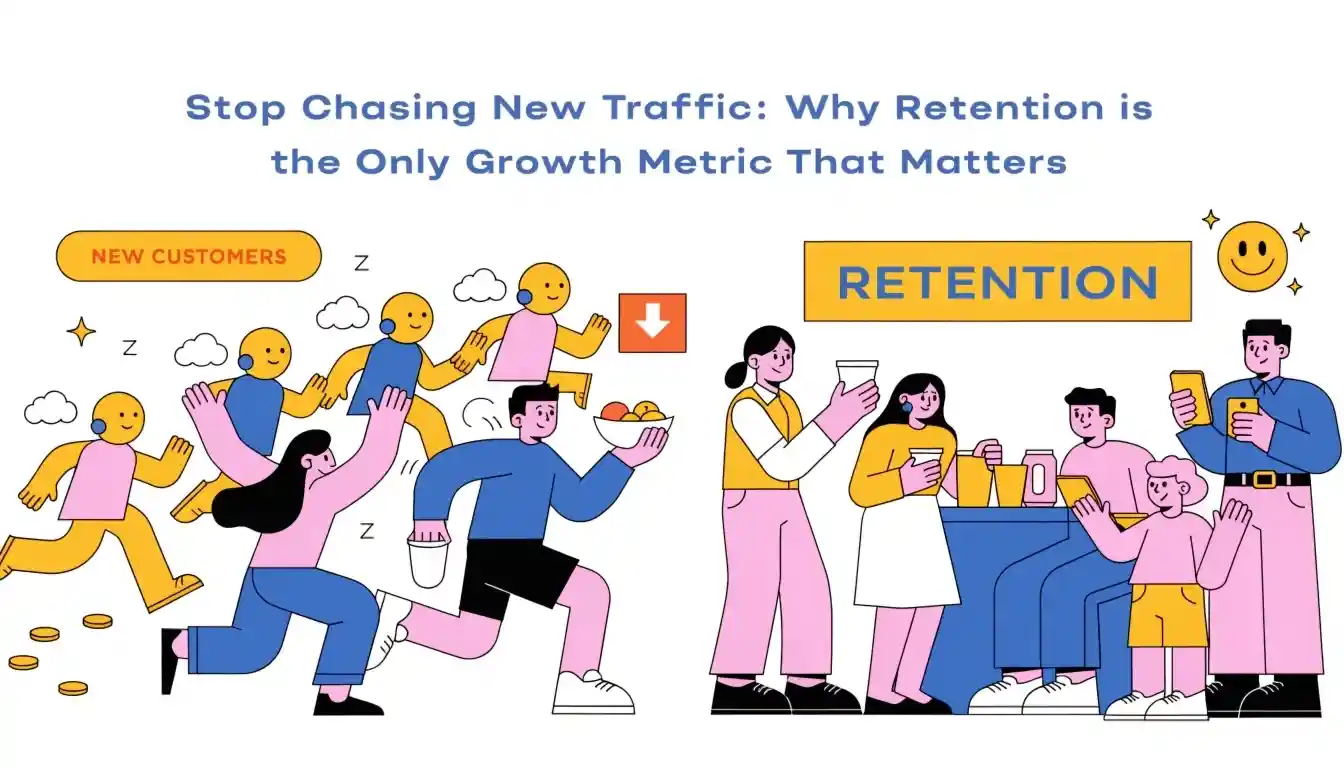
The charts don’t lie. You have been killing it with your Digital Marketing team; the traffic numbers are through the roof, and the SEO Report shows that you rank high on every single term. Yet something seems to be lacking i.e., Retention Rate.
That’s what’s called the “Leaky Bucket” problem. While you’re dumping water (users) into the bucket as fast as possible, it’s draining out through the hole at an equal speed. To make your business sustainable in the long run, you have to stop focusing on how much you’re dumping into it and start plugging up all the leaks.
Also Read: A Step-by-Step Guide to Set up GA4 for Better SEO and Ad Performance
1. Retention Rate: The Silent Growth Engine
Consider retention rates as a way of measuring how “sticky” your business is. It is expressed in percentages and represents the proportion of those users who keep returning to your site after the initial visit.
Let us say that there are 100 new users who downloaded your application today, but only 20 of them will return within the following month. The retention rate, in this case, is 20%. While everyone is focused on customer acquisition, it should be remembered that the money comes from retention.
2. Churn Rate: The Ghost in the Machine
Churn Rate is the opposite of Retention Rate. It is the percentage of users who say “so long” and never return.
In case the Retention Rate is 20%, then the Churn Rate will be 80%. That hurts, doesn’t it? A high Churn Rate indicates that there are deep problems, perhaps with your onboarding process, the software itself, or even with your SEO Services, which have brought in low-intent visitors.
3. Churn vs. Retention: The Real Problem
Most founders and marketers make the mistake of trying to “out-grow” their churn. They think, “If we lose 10% of customers, we’ll just buy 20% more traffic!”
This is a death spiral. High growth hides high churn—until your marketing budget runs dry. You can’t scale a business on a foundation of disappearing customers.
4. How Google Analytics (GA4) Actually “Sees” You
In the old days, Google used cookies. Now, it’s a bit more like a detective putting together a puzzle. GA4 uses three main methods to track users:
- User ID: If they log in, Google knows exactly who they are across devices.
- Google Signals: If they aren’t logged in but have “Ads Personalization” turned on in their Google account, GA4 can guess who they are.
- Device ID: The “fallback” plan that tracks the specific browser or phone.
The Reality Check: GA4 isn’t perfect. If a user clears their cookies or switches from their work laptop to their personal phone without logging in, GA4 thinks they are a brand-new person.
5. Why You Can’t Fully Trust GA for Retention
Here is a hot take: GA4 is a marketing tool, not a financial ledger. GA4 tracks User Retention (did they open the site?), but it’s terrible at tracking Customer Retention (did they actually pay their invoice?). For the “truth,” you need your CRM or backend database. GA4 is great for seeing trends, but don’t bet your mortgage on its specific numbers.
6. Enter the Cohort Strategy
If you want to get serious, you need a cohort strategy. A “cohort” is just a fancy word for a group of people who share a common characteristic over a specific time.
Instead of looking at your total traffic (which is a messy soup of everyone), you look at:
- Users who joined in January.
- Users who joined in February.
This allows you to see if your product is actually getting better over time. If the January group has a 10% retention rate and the February group has a 15% rate, you’re winning!
7. Cohort Exploration in GA4
GA4 has a specific report called “Cohort Exploration.” It looks like a colorful heat map. It shows you exactly when people drop off.
Do they leave after Day 1? (Your landing page lied to them).
Do they leave after Day 30? (Your product isn’t providing long-term value).
8. What You Can Actually Do with This Data
Once you stop looking at “Total Users” and start looking at cohorts, you can:
- Identify Drop-offs: Fix the specific page where everyone quits.
- Compare Channels: Does your Digital Marketing on LinkedIn bring in more loyal users than TikTok?
- Measure Quality: See if your latest SEO Services update brought in “lookers” or “buyers.”
9. Bringing it Home: SEO and ROI
Traffic without retention is just a vanity metric. If you’re paying for SEO Services to rank for high-volume keywords, but those users churn immediately, your ROI is zero.
A smart cohort strategy helps you pivot. It tells you to stop chasing “empty” traffic and start chasing the “sticky” traffic that actually pays the bills.
Actionable Takeaways
- Find your “Day 1” Retention: If people leave immediately, fix your messaging.
- Check your CRM: Compare your GA4 data against your actual sales data.
- Run a Cohort Report: Look at your last three months in GA4 and find the “drop-off” point.
- Stop over-valuing New Users: Give some love to the ones who already like you.
Conclusion:
Growth isn’t about how many people walk through the front door; it’s about how many of them decide to stay for dinner. Sustainable growth is built on the back of retention. If you fix the leak, you don’t need a bigger hose.
FAQs
1. What is the main difference between churn rate and retention rate?
Retention is the percentage of people who stay; churn is the percentage who leave. Together, they always add up to 100%.
2. How does Google Analytics track users across different devices?
Mainly through “User IDs” (if they log in) and “Google Signals” (if they are logged into a Google account like Gmail or YouTube).
3. What is cohort analysis in simple terms?
It’s the practice of grouping users by “start date” to see how their behavior changes over time, rather than looking at everyone all at once.
4. Why is retention so important in digital marketing?
Because acquiring a new customer is 5 to 25 times more expensive than keeping an existing one. High retention makes your marketing spend much more efficient.
5. How can I reduce my churn rate?Improve your onboarding process, ask for feedback to find “pain points,” and ensure your Digital Marketing is targeting the right audience with the right expectations.