

If you checked your Google Search Console on March 25 2026 morning and saw fewer impressions, less clicks or some pages moved down. It’s not your imagination.Google finished the March 2026 Spam Update. It happened quickly catching most SEO experts by surprise.
The update rollout was really fast.What Google initially said might take a few days wrapped up in under 20 hours. That speed alone tells you something important: this was not a broad recalibration of how Google thinks about content. This was a targeted, precise enforcement action — and if you were already doing things right, you probably did not feel it at all.
But if you did see movement, or if you are simply trying to understand what happened and what it means going forward, this article breaks it all down. We will cover what the update actually targeted, how spam updates work differently from core updates, what you should check right now, and how to think about recovery if your rankings took a hit.
One thing worth clarifying upfront: this update appears focused on spammy SEO practices and manipulative ranking tactics — not just low-quality content. That is an important distinction, and we will come back to it throughout this article.
Also Read: Google Discover Core Update – February 2026 Explained
What Is the Google March 2026 Spam Update?
Sometimes Google makes changes to the way it finds spam and tells everyone about it. When this happens people call it a spam update. The one from March 2026 is a deal because Google got a lot better at finding websites that break its spam rules.
Google is always looking for spam in the background using a system called SpamBrain. This system is like a computer that uses intelligence to help Google. Every and then Google makes big improvements to SpamBrain and that is what happened with the March 2026 update.
When did the update start and finish?
The update started rolling out on March 24, 2026 at 12:18 PM PDT. It was completed the following morning on March 25, 2026 at 7:30 AM PDT. That puts the total rollout time at approximately 19 hours and 30 minutes.
How long did the rollout take, and why does that matter?
To understand just how fast this was, some context helps. The August 2025 spam update took nearly 27 days to complete. The December 2024 spam update took seven days. The March 2026 spam update is now the shortest confirmed spam update rollout in Google’s recorded dashboard history.
That speed is significant because it suggests Google already knew exactly which sites it was targeting. This was not a gradual adjustment — it was enforcement that had likely been in the pipeline for some time, executed quickly and decisively.
Was this a global update?
Yes, completely. The update applied to all languages and all regions simultaneously. No matter where your website’s audience is based, this update covered it.
Google described it on LinkedIn as a normal spam update. No companion blog post was published. No new spam policy categories were announced. This was enforcement of existing rules, not the introduction of new ones.
March 2026 Spam Update: Quick Reference
| Detail | Information |
| Update Name | Google March 2026 Spam Update |
| Start Date & Time | March 24, 2026 at 12:18 PM PDT |
| End Date & Time | March 25, 2026 at 7:30 AM PDT |
| Rollout Duration | ~19 hours 30 minutes (fastest spam update in Google’s recorded history) |
| Scope | Global — all languages and regions |
| New Policies Introduced? | No — enforces existing spam policies only |
| Companion Blog Post? | No |
| Previous Spam Update | August 2025 (took ~27 days to complete) |
| Core System | SpamBrain (Google’s AI-based spam detection system) |
Why This Spam Update Matters in 2026
You might wonder — Google runs spam detection constantly, so why does a spam update feel like a bigger deal? The answer is that spam updates represent notable jumps in Google’s ability to detect and act on manipulation. They are not gradual refinements; they are meaningful improvements that can shift rankings at scale.
Why Google is becoming stricter about spam
Over the past few years, the tools available to create content, build links, and game search results have become vastly more powerful and accessible. That means the volume and sophistication of spam has grown too. Google’s response has been to invest heavily in SpamBrain and other automated systems that can identify manipulation patterns more accurately than ever before.
The March 2026 update is a direct reflection of that investment paying off. Google is not changing the rules — it is simply getting much better at enforcing the rules that already exist.
How spam updates are different from core updates
This distinction is often missed in SEO talks. Let me make it clear.
Core updates are about how Google judges if content’s good and relevant. They reevaluate which pages should rank high based on how useful they’re to users. A site that gets hit by a core update might not have made any mistakes. It might just not be as good as the pages that rank higher.
Spam updates work differently. They focus on policy violations. If your site gets affected by a spam update it means Google found something on or linked to your site that breaks its spam rules. This is an issue and getting back on track looks very different.
Why manipulative SEO is becoming riskier
For a time people did things that were not really against the rules but not exactly okay either. This middle ground is getting smaller. Google is getting better at catching things and what people thought was an idea a couple of years ago is now likely to get them in trouble. The update in March 2026 shows that trying to find ways to cheat or take shortcuts is not going to work for longer. Google’s detection systems are improving fast and what was a calculated risk with Google a couple of years ago is becoming a near-certain penalty, from Google today.
What This Update Is Likely Targeting
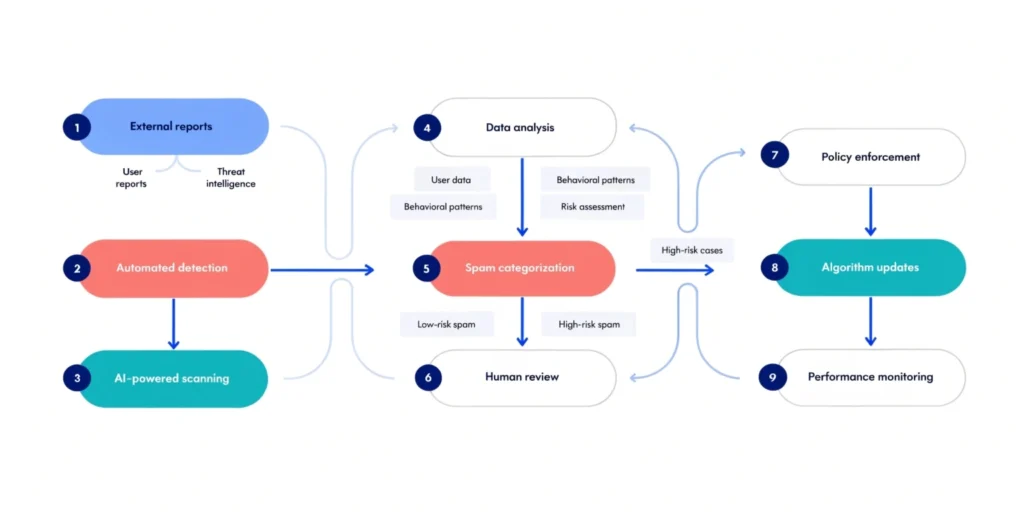
Google did not release a public list of specific tactics this update addresses. That is fairly standard — Google rarely spells out exactly which signals its spam systems are weighing. So the following is based on what we know about Google’s existing spam policies and the patterns that typically surface after spam updates. These are likely targets, not confirmed ones.
- Scaled low-value content: This covers sites that publish large volumes of content primarily designed to capture search traffic rather than genuinely help readers. Think articles that cover every possible keyword variation without any real depth, expertise, or original insight. If your content strategy is built around volume over value, this update may have had something to say about it.
- Spammy backlink practices: Paid links, link schemes, and networks of sites built specifically to pass PageRank are squarely in Google’s crosshairs. SpamBrain has been specifically trained to identify link spam patterns, and each new update tends to make that detection more accurate. If your backlink profile includes links that were bought or manipulated, that risk does not go away — it compounds.
- Parasite SEO and site reputation abuse: This is one of the clever tactics that has drawn more attention from Google. It involves publishing content on high-authority websites. Through partnerships or sponsored sections. To rank for competitive terms the host site has no real authority for. Google added site reputation abuse as a spam policy category in 2024 and continues to enforce it.
- Scraped or lightly rewritten content: Content that is copied from sources and lightly rewritten. Without adding any original value. Is a clear spam signal. This has been against the rules for years. Detection is getting better.
- Doorway pages and programmatic spam: Pages created to rank for a keyword and then send users elsewhere, or pages generated using templates with little unique value are classic spam patterns. If your site has thousands of templated pages targeting location or keyword variations, it is worth checking.
- Expired domain abuse: Buying a domain with existing authority and using it for different content. Hoping to inherit the domain’s trust. Is a tactic Google has specifically named as spam.
It does not work like it used to. This update likely tightened that enforcement. - Thin affiliate and lead-gen pages: Pages that exist to send users to another site or collect their information without providing meaningful value have long been a spam concern.
If a page’s primary purpose is the conversion action than genuinely helping the reader it is in risky territory.
What Google Means by ‘Spam’ in SEO
The word spam makes you think of hacked websites or fake content.
Google’s definition of spam for SEO purposes is broader than that and understanding it is crucial if you want to evaluate your own risk.
Spam is not always hacked or illegal SEO
You can have a completely legitimate business hire professional SEO help and still end up with practices that Google classifies as spam.
This happens when tactics cross from optimisation into manipulation. Not through bad intent but through prioritising rankings over user value.
How Google defines manipulative search behaviour
According to Google’s spam policies, spam in search includes any attempt to manipulate rankings in ways that are not intended to serve users.
That includes creating content for search engines rather than people manufacturing links to artificially inflate authority and exploiting systems that were designed to reward genuine trust.
Why some pages look optimised but still feel spammy
This is where things get genuinely nuanced. A page can be technically well-structured, have targeted keywords, include a call to action, and still be spam in Google’s eyes — if its primary purpose is to capture a position in search results rather than to deliver something truly useful to the person searching. The test is not whether the page looks good. The test is whether it would exist, in its current form, if search engines did not exist.
Good SEO amplifies genuinely useful content. Spammy SEO tries to substitute for it.
Parasite SEO, Guest Posting, and Site Reputation Abuse — What Is the Difference?
This is one of the most common areas of confusion after spam-related updates, and understandably so. The line between legitimate outreach and manipulation can seem blurry from the outside. Let us clear it up.
What is parasite SEO?
Parasite SEO specifically refers to publishing content on a well-established, high-authority domain in order to rank for keywords that the host site has no real topical authority for. The motivation is entirely about borrowing authority, not contributing relevant content. For example: a gambling site publishing content on a reputable news outlet’s subdomain to rank for casino-related terms. The host site has nothing to do with gambling, but the domain authority carries the content into rankings it would never achieve on its own.
Is guest posting still safe?
Yes — when done properly. Genuine guest posting, where you contribute relevant, useful content to a site in a related field, is a completely legitimate practice. The key word is relevant. If you run a digital marketing agency and you contribute a thoughtful article to a marketing industry publication, that is natural. That is how expertise travels across the web.
The problem arises when guest posting becomes a link-building formula with no regard for topical relevance or actual reader value. A fitness brand placing sponsored content on a financial news site to get a backlink to their protein powder store is not guest posting — that is site reputation abuse.
When does contributed content become risky?
The risk increases with each step away from genuine topical relevance. Ask yourself honestly: does this content belong on this site? Would the site’s readers find it genuinely useful? Is the link placement natural, or is the link the entire reason the content exists? If the honest answers point toward the link being the purpose, rather than the content, you are in territory that spam updates increasingly target.
Signs Your Website May Be Affected by the March 2026 Spam Update
The update completed by March 25, so if there was an impact on your site, the effects are already showing in your data. Here is what to look for.
- Ranking drops: Check your position data in Google Search Console, particularly for the dates March 24 to March 26. If specific pages have dropped significantly — even if they were previously stable — this update may be the cause. Filter by page to see which URLs were most affected.
- Traffic decline in Google Search Console or GA4: A drop in organic clicks alongside a drop in impressions for the same date range is a strong indicator. If your impressions held steady but clicks dropped, that might be a positioning issue rather than removal. If both dropped, that suggests a more direct ranking impact.
- Specific pages losing impressions: Spam updates tend to be surgical rather than sweeping. You may find that certain pages or sections of your site were affected while others were completely untouched. The affected pages often share a common characteristic — similar content type, link profile, or purpose.
- Commercial pages drop more than informational ones: Spam patterns often concentrate on commercial-intent pages, where the financial motivation to manipulate is highest. If your money pages took a hit while your blog or educational content remained stable, that pattern is worth noting.
What to Do If Your Website Was Hit
First, stay calm and methodical. Reactive changes made in a panic rarely help, and they can sometimes make things worse. Here is a practical recovery approach.
- Audit your content quality: Go through the pages that lost rankings and ask honestly: does this page offer something genuinely useful, original, or insightful? Or does it exist primarily to rank? If you cannot defend a page’s value to a real user who lands on it, that page needs work.
- Review your backlink profile: Use a tool like Google Search Console’s Links report, or a third-party tool like Ahrefs or Semrush, to look at what kinds of sites are linking to you. Look for patterns: irrelevant sites, networks of low-quality domains, or link placements that look paid. If you identify toxic links, consider the disavow tool — but use it carefully.
- Check for over-optimised or thin pages: Pages that are heavily keyword-stuffed, have very thin content, or follow an obviously templated structure with minimal unique value are worth reviewing. Consolidating, improving, or removing weak pages can strengthen your overall site quality.
- Remove manipulative SEO patterns: If you or a previous SEO agency was using tactics that you now recognise as manipulation — doorway pages, paid link schemes, scraper content, or parasite SEO arrangements — those need to be addressed. Not quickly patched, but genuinely remedied.
Alternative Recovery checklist
- Identify which pages lost traffic and impressions between March 24 and 26
- Evaluate the purpose and quality of affected pages honestly
- Review your backlink profile for manipulative or low-quality links
- Improve topical relevance and depth of thin content
- Remove or consolidate doorway-style or near-duplicate content
- Reduce aggressive anchor text patterns in your internal linking
- Stop any active practices that fall under Google’s spam policies
- Document all changes so you can track whether recovery follows
Can Websites Recover from a Google Spam Update?
Yes — but recovery is slower and more uncertain than most website owners hope for, and it is important to have realistic expectations going in.
How long recovery may take
Google is clear that recovery from a spam update takes time, and improvements may only appear once its automated systems detect sustained compliance over a period of months. There is no shortcut. You cannot patch the problem, submit a reconsideration request, and expect rankings to bounce back the following week.
Why cleanup does not always mean instant recovery
Fixing the underlying problem is necessary, but it is not sufficient on its own. Google’s systems need to re-crawl and reassess your site over time. That reassessment happens on Google’s timeline, not yours.
There is also a specific complication for link spam. Google has stated clearly that when its systems remove the ranking benefit of spammy links, that benefit cannot be regained — even after you clean up the links. So if your site was boosted by manipulative links, recovery may mean rebuilding authority through legitimate means, not just removing the bad links.
What Google says about reassessment
Google’s documentation on spam updates notes that affected sites can recover, but the process requires genuine compliance over time. There are no manual review shortcuts for algorithmically-detected spam in the way there are for manual actions. Patience and consistency are the only reliable tools.
What This Update Means for SEO in 2026
If you step back from the immediate noise of which sites were affected and by how much, the March 2026 Spam Update tells a clear story about where SEO is heading — and it is a direction that has been building for years.
- SEO is moving away from shortcuts: The tactics that reliably produced results five years ago are increasingly unreliable today, and the ones that still produce results are often producing them on borrowed time. Each spam update narrows the window further. The investment required to maintain shortcut-based rankings is growing, while the return is shrinking.
- Topical trust matters more: One of the clearest signals from Google’s recent updates — both core and spam — is that topical authority matters. Sites that have deep, consistent expertise in a subject area are more insulated from algorithmic disruption than sites that publish across a wide range of topics with no coherent editorial identity.
- Real authority is becoming more important: Authority built through genuine expertise, original research, cited content, and earned links behaves very differently from authority manufactured through link schemes. The manufactured kind is increasingly being identified and discounted. The real kind compounds over time.
- Search-first content is becoming easier to detectL AI has given Google powerful tools to assess whether content was created to genuinely serve readers, or primarily to serve rankings. The signals it can pick up on — structural patterns, linguistic tells, topical coherence, engagement signals — are becoming more sophisticated with every update.
The future of sustainable SEO looks like this: real relevance, strong topical alignment, natural authority built over time, and content that would be worth reading even if search engines did not exist. Less like this: domain authority exploitation, mass publishing strategies, aggressive anchor text manipulation, and content that exists only because a keyword has volume.
Also Read: What is Integrated Marketing? How is it Helping Modern Brand
Final Thoughts
The Google March 2026 Spam Update is a warning shot for anyone still relying on manipulative SEO. It happened fast — faster than any spam update before it — and that speed is itself a message. Google’s systems are getting better, more confident, and more precise. The update is not just enforcement; it is a signal of direction.
For businesses building visibility the right way — with genuinely useful content, legitimate link relationships, and real topical authority — an update like this is ultimately good news. Every time Google gets better at filtering manipulation, the value of doing things properly increases.
If you were not affected, stay the course and keep raising the bar. If you were affected, treat it as useful information rather than a disaster. Diagnose honestly, fix genuinely, and rebuild with the kind of foundation that does not need to worry about what Google’s next update looks like.
That is, ultimately, what this update is nudging everyone toward.
FAQs (Frequently Ask Questions)
What is the Google March 2026 Spam Update?
The Google March 2026 Spam Update is an improvement to Google’s spam detection systems, released on March 24, 2026. It targets websites that violate Google’s existing spam policies and was completed in under 20 hours, making it the fastest spam update in Google’s recorded dashboard history. No new spam policies were introduced — it enforces the rules that were already in place, primarily through Google’s AI spam prevention system, SpamBrain.
How long did the March 2026 Spam Update take to roll out?
Approximately 19 hours and 30 minutes — from 12:18 PM PDT on March 24 to 7:30 AM PDT on March 25, 2026. For comparison, the previous spam update in August 2025 took nearly 27 days to complete. This makes March 2026 the shortest confirmed spam update rollout in Google’s history.
What kind of websites does a Google spam update affect?
Spam updates affect websites that violate Google’s spam policies. This can include sites with manipulative link profiles, scaled low-value or scraped content, doorway pages, expired domain abuse, parasite SEO arrangements, and other tactics designed to artificially inflate rankings rather than serve users. Importantly, spam updates do not target content quality issues — that is the domain of core updates. If your site was hit by this spam update, there is a specific policy violation that Google’s systems identified.
Can AI-generated content be affected by a spam update?
AI-generated content is not automatically spam. Google’s position has been consistent on this: what matters is the quality and purpose of the content, not how it was produced. However, if AI-generated content is being used to produce content at scale specifically to capture search traffic — with no genuine value added — that falls under scaled content abuse, which is a spam policy violation. The issue is not the tool; it is the intent and outcome.
Is guest posting considered spam after this update?
Legitimate guest posting is not spam. Contributing relevant, useful content to related sites in your industry remains a perfectly acceptable practice. What this update targets is the exploitation of high-authority domains to publish off-topic content for the primary purpose of gaining links or rankings — a practice known as site reputation abuse. Relevance, genuine editorial quality, and transparent intent are what separate safe guest posting from risky manipulation.
What is parasite SEO in Google’s eyes?
Parasite SEO is the practice of publishing content on an established, high-authority domain in order to rank for keywords that have nothing to do with the host site’s topic. The motivation is entirely to borrow the domain’s authority rather than contribute relevant content. Google formally named site reputation abuse as a spam policy in 2024, and it has been enforcing it — including through this update.
How do I know if my site was hit by the spam update?
Check Google Search Console for date ranges around March 24 to 26, 2026. Look for drops in organic impressions and clicks for specific pages. Filter by URL to identify which pages were most affected. Cross-reference with GA4 for organic traffic changes on the same dates. Spam updates tend to be surgical, so you may find that certain sections of your site were affected while others were not — that pattern itself can give you useful diagnostic information.
How long does recovery from a spam update take?
Google’s own guidance says that recovery takes months, not days or weeks. Automated systems need to re-crawl and reassess your site over a sustained period of compliance before rankings recover. There is no quick fix. If the spam involved link manipulation, it is also worth noting that Google has stated ranking benefits from spammy links cannot be recovered even after cleanup — rebuilding authority through legitimate means is the only path forward.