
Introduction: Google Search Is Changing — and So Is the Way We Measure It
Those who have kept an eye on Google in recent months know that the search engine doesn’t work the same way anymore. Rather than just displaying a bunch of blue links, AI generated overviews, conversational responses, and interactive elements are now being displayed at the very top of Google search pages. This feature, which goes by the name of AI Overview or AI Mode, is drastically altering how searches are done, how content is consumed, and most importantly, how many clicks your website gets.
This raises a critical concern for businesses, content writers, publishers, or any person spending money on SEO Services as to how will they ascertain whether their content is actually appearing within the search results generated by Google AI. Even if they are visible, how will you find out whether anyone is clicking on them or not?
Google has now taken a significant step toward answering those questions. In June 2026, the company officially introduced Search Generative AI performance reports inside Google Search Console — a new set of dedicated reporting views designed to show website owners how their content is performing within AI-powered search experiences like AI Overviews and AI Mode.
This is a breakthrough time for both digital marketing and SEO. We’ll explain everything that these reports can tell you, what they don’t tell you, and everything else there is to know about them and how they will help your online marketing strategy moving forward.
What Are the AI Performance Reports in Google Search Console?
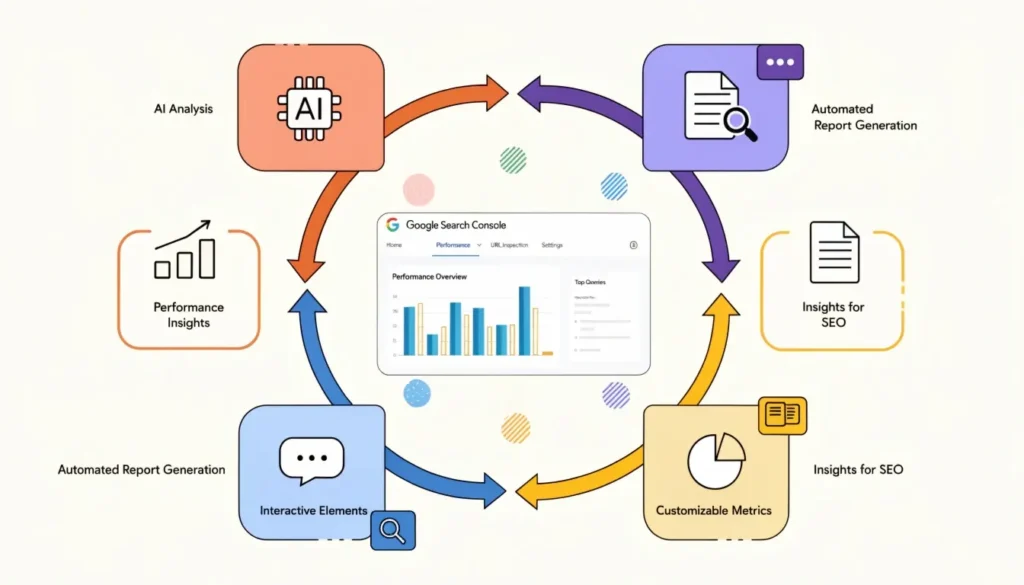
Google Search Console (GSC), being the free utility provided by Google to website owners, marketers, and SEO practitioners, is the way through which users can understand how their website is performing in Google Search. This tool has always served as the primary medium to check factors such as keyword performance, frequency of listing, and click-through rate.
Until then, these reports would only cover classic organic search: the usual list of search results provided by Google for decades. But now, as Google is covering more and more of its search results with AI-driven experiences, classic Search Console data started ignoring a bigger blind spot.
The new Search Generative AI performance reports fill part of that gap. According to Google’s official announcement on the Google Search Central Blog, these reports are “designed to give you dedicated views of your impressions within generative AI features on Search, such as AI Overviews and AI Mode, as well as generative AI features in Discover.”
In Plain Language: Google has made it possible to understand how many times your website page contents are used by AI in the creation of the search result snippets. This is a big deal and something that the SEO industry has been looking forward to ever since the inception of AI Overviews.
What needs to be pointed out is that this is a beta version of the feature. Initially, these analytics will be available only to a select few website owners from the United Kingdom, and later on, once the testing is done, to more site owners worldwide.
How Is Google Search Evolving Through AI?
In order to comprehend why these reports are relevant, one should first look at what has been going on with the Google Search service itself. Over the past couple of years, Google has made a number of significant changes in its approach to generative AI implementation. The two key innovations are:
AI Overviews
AI Overviews are automated summaries created by AI algorithms and shown directly on Google’s results pages. If you do a search for something like “benefits of intermittent fasting,” you may find that Google is now providing a summary created by its algorithm — using information pulled from different sources on the Web — before even showing any blue links with traditional search results. Your website may be one of the sources used to create an answer, but users may never actually click on it.
AI Mode
Google Search AI Mode is an interactive way for people to use Google Search to ask further questions and hold a multi-turn conversation with Google’s AI. In a way, it can be considered a ChatGPT type service integrated into Google Search itself. People can ask a complicated question and then receive an answer, asking more questions, etc.
Both of these experiences are powered by Google’s large language models and pull from indexed web content, including your website. The fundamental challenge for publishers and marketers is that even when their content contributes to these AI-generated answers, the user interaction looks very different from a traditional search click. That’s the measurement gap that the new AI Performance Reports in Google Search Console are beginning to address.
Also Read: Google Hosted Lead Form: What It Is, How It Works, and Whether Google Shares Your Leads
What Do the New AI Performance Reports Actually Show?
Let’s get into the specifics. According to Google’s official documentation, the new Search Generative AI performance reports provide the following metrics and dimensions:
-
- Impressions: How often URLs from your site appeared in generative AI features in Search and Discover. This is the headline metric — it tells you how frequently your pages are being surfaced inside AI-generated results.
-
- Pages: Which specific URLs from your site appeared within AI features. This helps you understand which content Google’s AI considers authoritative or useful enough to include.
-
- Countries: Where in the world your content is appearing in AI-powered search results, giving you geographic insight into your AI visibility.
-
- Devices: What types of devices (desktop, mobile, tablet) people are using when they see your content in AI search results. This dimension is available for Search results specifically.
-
- Dates: How your AI impressions trend over time, with granularity options including hourly, daily, weekly, and monthly views.
What’s NOT Included: The Click Data Gap
Here’s the most important thing to understand about these initial reports: they do not include click data. Google is showing you impressions — how often your content appears in AI responses — but the reports do not currently tell you how many users actually clicked through from those AI experiences to visit your site.
When Search Engine Land asked Google about click data, a spokesperson confirmed that the company is “continuing to work with website owners to understand what insights will be most helpful to inform their strategies” and will “introduce additional metrics over time.” So click data may come eventually — but it’s not part of the launch. For marketers used to tracking click-through rates as a core SEO metric, this absence is significant and worth keeping in mind when interpreting the reports.
Traditional Search Console Metrics vs. AI Performance Metrics: What’s the Difference?
If you’ve used Google Search Console before, you’re probably familiar with the core metrics in the Performance report. Let’s compare what those mean traditionally versus how AI search experiences change the picture.
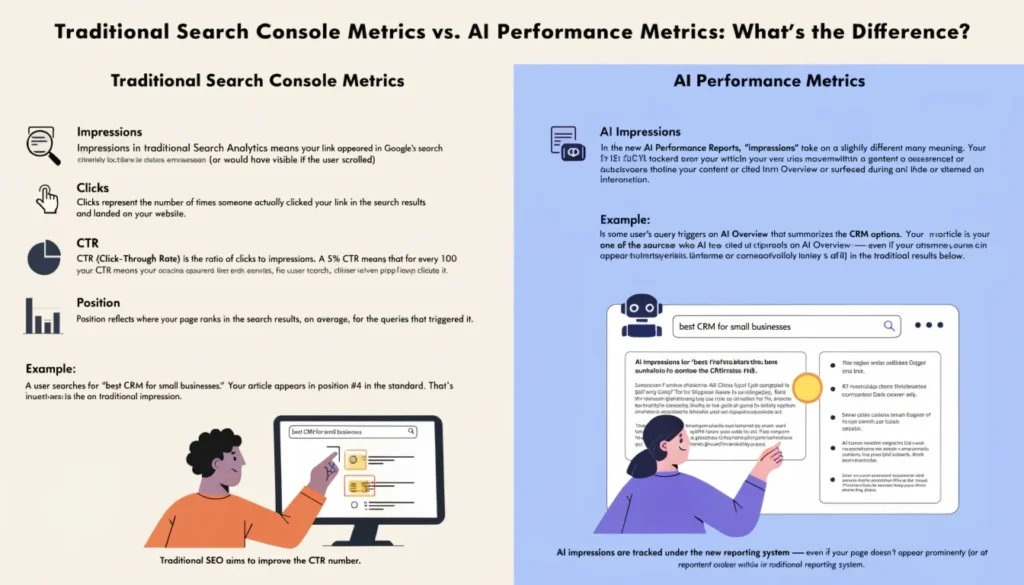
Traditional Search Metrics
Impressions in traditional Search Analytics means your link appeared in Google’s search results and was visible on screen (or would have been visible if the user scrolled). It’s a signal that Google has ranked your content for a particular query.
Clicks represent the number of times someone actually clicked your link in the search results and landed on your website. This is organic traffic in the traditional sense.
CTR (Click-Through Rate) is the ratio of clicks to impressions. A 5% CTR means that for every 100 times your link appeared in search results, five people clicked it. Traditional SEO aims to improve this number.
Position reflects where your page ranks in the search results, on average, for the queries that triggered it. A position of 1 means you’re the top result.
AI Impressions: A Different Kind of Visibility
In the new AI Performance Reports, “impressions” take on a slightly different meaning. An AI impression is counted when a URL from your site appeared within a generative AI feature — meaning your content was cited or referenced in an AI Overview or surfaced during an AI Mode interaction.
Here’s a simple example to illustrate the difference:
Traditional impression: A user searches for “best CRM for small businesses.” Your article appears in position #4 in the standard results. That’s a traditional impression.
AI impression: The same user’s query triggers an AI Overview that summarizes the top CRM options. Your article is cited as one of the sources in that AI Overview. That’s an AI impression under the new reporting system — even if your page doesn’t appear prominently (or at all) in the traditional link results below.
This distinction matters enormously for businesses and SEO professionals. You could be receiving significant AI impressions — meaning Google’s AI considers your content authoritative — while simultaneously seeing your traditional click traffic decline, because users are finding their answers in the AI response itself without clicking through.
Understanding the Different Traffic Types in Google Search Console
One of the most common points of confusion around these new reports is understanding what Google Search Console does and doesn’t measure. Let’s be very clear about the boundaries.
Google Search Console measures traffic and visibility within Google Search. Period. It does not measure traffic from other websites, social platforms, or external AI tools. Within Google Search itself, we now have three distinct types of interactions:
-
- Traditional Organic Search Traffic: When a user enters a query and clicks a standard blue-link result to visit your website. This has always been tracked in the Search Performance report.
-
- AI Overview Traffic: When your page appears as a cited source in an AI Overview. These impressions are now captured in the new AI Performance Reports. Click data is not yet included.
-
- AI Mode Traffic: When your content is referenced during an AI Mode conversational session. As of June 2025, Google confirmed that AI Mode clicks and impressions are included in Search Console performance data.
The key takeaway: Google Search Console is your window into how your content performs within Google’s ecosystem — and now that includes Google’s AI-powered search experiences. But it only measures what happens inside Google Search, not on external AI platforms.
Will Google Search Console Measure ChatGPT, Claude, Perplexity, Copilot, or Gemini Traffic?
This is one of the most frequently asked questions in digital marketing circles right now — and the short, clear answer is: No. Google Search Console does not and will not measure traffic from ChatGPT, Anthropic’s Claude, Perplexity, Microsoft Copilot, or Google’s standalone Gemini assistant.
Here’s why. Google Search Console is a tool built by Google, specifically to measure performance within Google Search. It has no visibility into what happens on ChatGPT’s platform, on Perplexity’s search interface, within Microsoft Copilot, or even within Google’s Gemini when used as a standalone assistant app (as opposed to within Google Search itself).
When a person conducts their research using ChatGPT, Perplexity, or Claude, and these applications provide a link leading to your site and the person follows the link, it leads to what is referred to as AI referral traffic. Such traffic will be reported by your web analytics application (for example, Google Analytics 4) as referral traffic from the relevant domains or as direct traffic.
To track AI referral traffic from external AI tools, you need to:
-
- Use Google Analytics 4 (GA4) or another web analytics platform to monitor referral traffic sources.
-
- Look for referral traffic from domains like chatgpt.com, perplexity.ai, bing.com/chat, or gemini.google.com (the standalone app).
-
- Create custom segments or reports in GA4 to track and trend this AI referral traffic over time.
AI referral traffic is becoming an increasingly important category in modern digital marketing analytics. As more users turn to AI-powered assistants and search tools for research and recommendations, businesses that rank well within those AI systems — not just in traditional Google Search — will gain a meaningful competitive advantage. This is where the emerging discipline of Generative Engine Optimization (GEO) comes into play.
Generative Engine Optimization (GEO) and AI Visibility: The New Frontier
Generative Engine Optimization, or GEO, refers to the practice of optimizing your content and digital presence to appear favorably within AI-generated search responses — not just traditional search engine results pages (SERPs).
Traditional SEO focuses on getting your pages to rank highly in organic search results so that users will click them. GEO goes a step further: it’s about ensuring that when AI models like those powering Google’s AI Overviews, AI Mode, ChatGPT, or Perplexity synthesize answers to user queries, your brand, product, or content is among the sources they cite and reference.
The new AI Performance Reports in Google Search Console are essentially the first official tool for measuring one dimension of GEO success: your AI impressions within Google’s own AI-powered search experiences. Being able to see which pages Google’s AI is referencing — and how frequently — gives you actionable intelligence about where your GEO strategy is working and where it needs improvement.
AI visibility — the measure of how prominently your content appears in AI-generated responses across search platforms — is quickly becoming a key performance indicator alongside traditional metrics like organic traffic, keyword rankings, and domain authority. For businesses investing in SEO Services and content strategy, integrating GEO thinking is no longer optional; it’s becoming essential.
Also Read: How Googlebot IP Address Verification Helps Protect Your Website SEO
What Remains Uncertain: The Open Questions Around These Reports
While the launch of the Search Generative AI performance reports is a meaningful step forward, there’s still a lot that remains unclear or underdeveloped. Here’s an honest look at what we don’t yet know:
Will Click Data Be Added?
The most glaring omission in the initial reports is click data. Right now, you can see that your pages appeared in AI-generated responses, but you cannot see how many users actually clicked through to your site as a result. Google has signaled that more metrics will be introduced over time, but there’s no confirmed timeline for when click data will be added.
Will There Be a Dedicated AI Dashboard?
It’s currently unclear whether Google will eventually create a standalone AI performance dashboard within Search Console, or whether these reports will remain as a section integrated into the existing Performance reports. Many SEO professionals are hoping for a more robust, standalone view — but Google hasn’t committed to a specific format yet.
Will AI-Specific Filters Be Introduced?
The existing Performance report already has some AI Mode data integrated, as Google confirmed in mid-2025 that AI Mode clicks and impressions count toward totals in Search Console. However, the ability to cleanly separate and filter traditional organic data from AI-specific data has been limited. Whether future updates will introduce more granular filtering options, separate AI-specific search appearance categories, or new segmentation tools remains an open question.
How Will Rollout Expand?
At launch, these new AI performance reports are being rolled out to a subset of website owners in the UK. Google has indicated it will expand access after sufficient testing, but hasn’t specified whether global availability is months or quarters away. If you’re based outside the UK, you may not see these reports yet — so don’t panic if they’re missing from your Search Console account.
What This Means for Businesses, Publishers, and SEO Professionals
Whether you run a small business website, manage content for a major publisher, or provide SEO Services to clients, the introduction of these reports has practical implications for how you think about search performance.
For Business Owners
Your website traffic patterns may be shifting in ways that your current analytics setup doesn’t fully capture. You might be generating significant AI-powered visibility — your content being cited in Google’s AI responses thousands of times — while seeing your traditional click traffic plateau or decline. The new reports will help you understand the first half of that equation.
For Content Creators and Publishers
Content that’s well-structured, factually authoritative, and clearly written is more likely to be cited in AI-generated responses. The AI Performance Reports will give you a direct signal about which content formats and topics are earning AI citations — valuable intelligence for future content planning.
For SEO Agencies and Professionals
These reports are the beginning of a reporting evolution that will require SEO Services to evolve alongside it. AI impressions will likely become a new KPI category that clients want to track and grow. Agencies should start familiarizing themselves with these reports now and building GEO strategy capabilities before demand peaks.
What This Means for the Future of SEO
The launch of AI Performance Reports in Google Search Console is more than a product update — it’s a signal about the direction of the entire SEO industry. Here’s what to expect as this plays out over the coming months and years.
SEO and GEO Will Merge
For years, traditional SEO and emerging GEO strategies have been discussed as parallel disciplines. As Google’s AI search features become the primary experience for more and more users — rather than a supplementary feature — the distinction will blur. Optimizing for AI visibility within Google Search will become a standard part of SEO work, not an advanced specialty.
Impressions Will Matter More Than Ever
In a world where users increasingly get their answers directly from AI-generated summaries, click-through rates may structurally decline even as brand awareness from AI citations grows. This could change how businesses and SEO professionals define “success.” Impressions within AI experiences — being cited, referenced, and recommended by AI systems — may become as important a metric as organic traffic.
Content Quality Will Drive AI Citations
Google’s AI systems, like all large language models, tend to cite content that is factually accurate, well-sourced, clearly written, and genuinely authoritative. This means the fundamentals of great content — depth, accuracy, original research, clear structure — will become even more important, not less. There’s no shortcut to AI visibility; it’s earned through content quality.
Measurement Complexity Will Increase
Marketers will need to track performance across a more complex landscape: traditional Google Search, Google AI Overviews, Google AI Mode, external AI tools like ChatGPT and Perplexity, and social search experiences. Each channel has its own measurement approach. This complexity will drive demand for more sophisticated analytics setups, better attribution models, and integrated reporting dashboards that bring all these signals together.