
Key Takeaways
- Create content that people will really want to link to, like research or comprehensive guides that are actually useful.
- You should try to get links from different kinds of places. This means getting links from editorial sites, directories, guest posts and places that you get links from because of public relations.
- When you get a link that you paid for, or that is sponsored, you should always tag it with rel=’sponsored’ or rel=’nofollow’.
- If you are going to put your content on websites, you should use canonical tags.
- You need to keep an eye on the links that come to your website. You can use tools like Ahrefs or SEMrush, or Google Search Console to do this.
- If you see any really bad links, you should use Google’s Disavow Tool to get rid of them.
- Do not buy links. Use automated systems to build links or exchange links too much.
- Try to get links with kinds of text. Do not just use the same keywords over and over.
- You should also try to find places where links are broken or where people are talking about your brand but not linking to it, and see if you can get them to link to you.
- Your strategy for getting links should match where your website is now. First, you need to build a strong foundation, and then you can try to grow more.
Introduction: Why Backlink Strategy Still Matters
If you have been doing Search Engine Optimization for a while, you have probably heard people say that backlinks are not important anymore. That is not true. Backlinks are still one of the important things that Google looks at when it decides how to rank websites. That has not changed. What has changed is the way Google looks at backlinks.
In the past, having a lot of links usually meant that your website would rank higher. Now it is not that easy. Google is much better at figuring out if a link is real or if it was just put there to trick them. Now Google cares more about the quality of links, not how many you have. It is more about earning links than building them.
Having a lot of good backlinks still makes a big difference in how high your website shows up in search results. If you do not pay attention to backlinks, you are missing out on a big opportunity to improve your ranking. A lot of websites are still making this mistake with their backlinks.
Common Misconceptions About Link Building
There are some myths about Search Engine Optimisation that people keep talking about, and they can get you into trouble if you believe them. Here are some of the myths about Search Engine Optimisation:
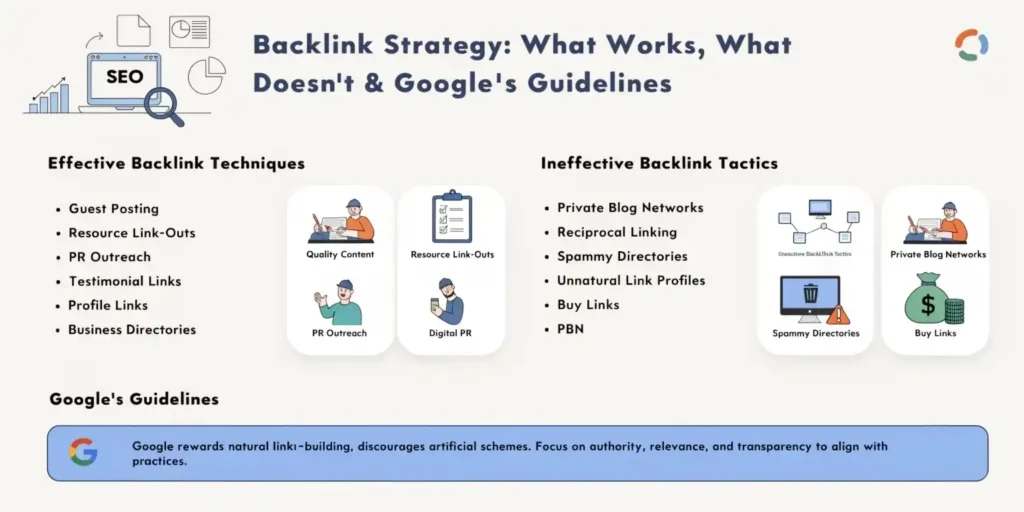
- ‘Any link is a good link. This was never really true. It is especially false now. A link from a website that is not relevant to your website can actually hurt your Search Engine Optimization rankings.
- Buying links is fine as long as you do not get caught. Google has gotten much better at finding paid links. The risk of getting caught is not worth trying to cheat the system.
- ‘NoFollow links are useless. NoFollow links do not help your website rank higher. They can still send people to your website, help people know about your brand and make your links look natural.
- ‘You need thousands of backlinks to rank. A few high-quality links from websites that are relevant to your website can be better than thousands of low-quality links from websites that are not relevant to your Search Engine Optimisation efforts.
Who Should Follow This Guide
This guide is for anyone who handles a website’s SEO. Whether you are a solo blogger, a startup founder doing your marketing, a content strategist or an SEO expert who wants to update their approach.
We will cover both the basics and the details of the backlink strategy as it is.
What Are Backlinks? (Quick Overview)
Definition of Backlinks
A backlink (also called an inbound link or incoming link) is simply a hyperlink on one website that points to another website. When Site A links to Site B, Site B has earned a backlink from Site A.
Think of the internet as a giant web of connections. Every time someone links to your site, they’re creating a thread that connects their page to yours. These connections are what search engines use, among many other signals, to understand how pages relate to each other.
How Search Engines Like Google Interpret Backlinks
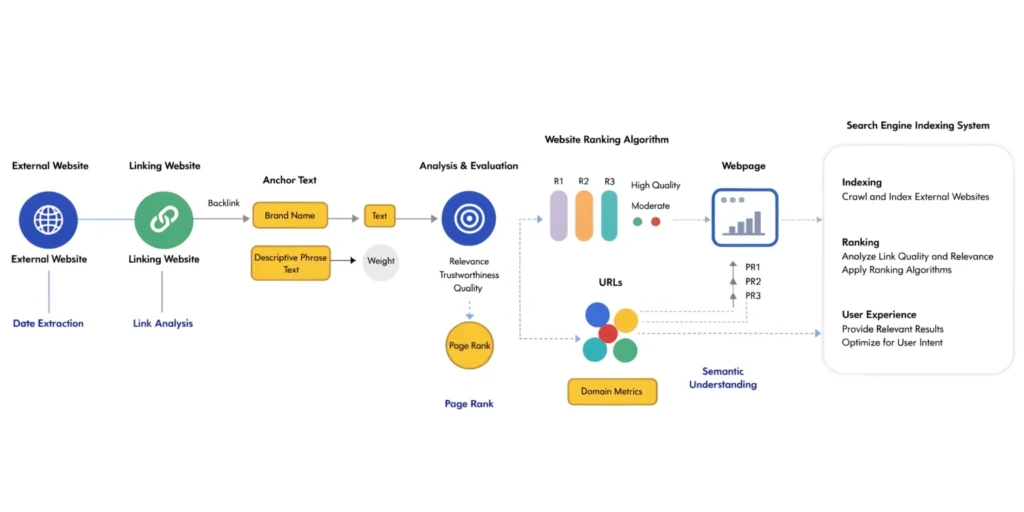
Google’s big innovation, the PageRank algorithm, was based on an idea. The idea is that links to a webpage are like people saying that the webpage is good. If a lot of people link to a webpage, that webpage is probably very good. If those people have good webpages themselves, then the webpage they are linking to is even better.
Google still uses this idea today. It does a lot more to figure things out. Google looks at how good the webpage that has the link is. It checks if the link is related to what’s on the webpage. Google also looks at the words used for the link, where the link is on the webpage and if the link looks real or not. Google wants to know if someone put the link there on purpose or if it just happened naturally. Google still uses the PageRank algorithm. It is still all about links. The PageRank algorithm is what makes Google so good at finding the Google webpage that people are looking for.
The Concept of ‘Votes of Trust’
Backlinks are like votes that people trust. When a good website links to your stuff, it is like they are saying, “We think this is good enough to send our readers to you.” The more the website, the more it means.
It is like real elections, not all votes are the same. Some votes are not real. Can get you in trouble. A link from a known news place is a lot better than a link from a new blog that is not very good. If someone pays for a link, it might be found out and ignored or even get you in trouble.
Why Backlinks Are Important for SEO
- Impact on Search Rankings: Let’s get straight to the point: pages with backlinks tend to rank higher. Google says backlinks are one of the three things they look at, along with content and their machine learning system. Though how important they are has changed over time, they are still important.
When your page gets links from relevant websites, Google thinks your content is useful and trustworthy. This affects where you show up in search results for keywords. - Building Domain Authority: Domain authority is a measure of how strong your whole website is based on links. A higher domain authority means it’s easier to get new pages to rank because Google already trusts your website.
Every good backlink you get helps your website’s authority. Over time, a built backlink profile makes your whole website more competitive. Not just individual pages. - Referral Traffic Benefits: Backlinks aren’t just for SEO. When a relevant website links to you, their readers can click on the link to visit your site. If the source is a website in your niche that can bring you a lot of targeted visitors.
The best backlinks do two things at the same time. They help your rankings and bring you real visitors who are interested in what you have to say.
The best backlinks help your rankings. Bring you real visitors.
Good backlinks make your website more competitive. - Faster Indexing: When Google crawls a page and finds a link to your site, it can follow that link and discover (or re-crawl) your content faster. For new websites or new pages, backlinks from regularly crawled sites can dramatically speed up the time it takes for your content to appear in search results.
Google’s Official Stance on Backlinks
- Natural vs Manipulative Links: Google makes a difference between links that are real and links that are not. Real links are the ones people give you because they really like your stuff. I think it is useful or interesting. They are worth looking at.
Links that are not real are the ones you make or pay for to get a better ranking on Google.
Google has some rules called Google Search Essentials. These rules say that if you try to trick Google with links to get a better ranking, it can actually make your ranking worse.
What Are Link Schemes?
Google says link schemes are practices that try to cheat the system by getting links to a website to improve its search rankings.
Some common examples are:
- Selling links that help a site rank higher
- Swapping links with others. Like ‘link to me. I’ll link to you’
- Using robots to create lots of links to your site
- Writing articles with links that have target keywords
- Creating links through networks of blogs
The main issue is manipulation. Google is not against all link building. They know that some outreach and promotion is normal for a website.
They are targeting actions that hurt the way links are formed on the web through link schemes and manipulation tactics.
Google wants to keep search rankings not controlled by link schemes.
Why Google Discourages Artificial Link Building
Google’s whole business is based on giving people search results that are relevant and trustworthy. If someone can easily cheat their way to the top of the rankings by buying or making links, then the quality of the search results goes down. People will start to trust Google less, which means they will do fewer searches and Google will make less money from ads.
From Google’s point of view, link schemes are a kind of spam that hurts the quality of their search results. Google sees link schemes as a problem, which is why they have spent a lot of time and money on things like the Penguin algorithm and teams that review spam manually to find and punish people who build fake links.
The Concept of Earning vs Creating Backlinks
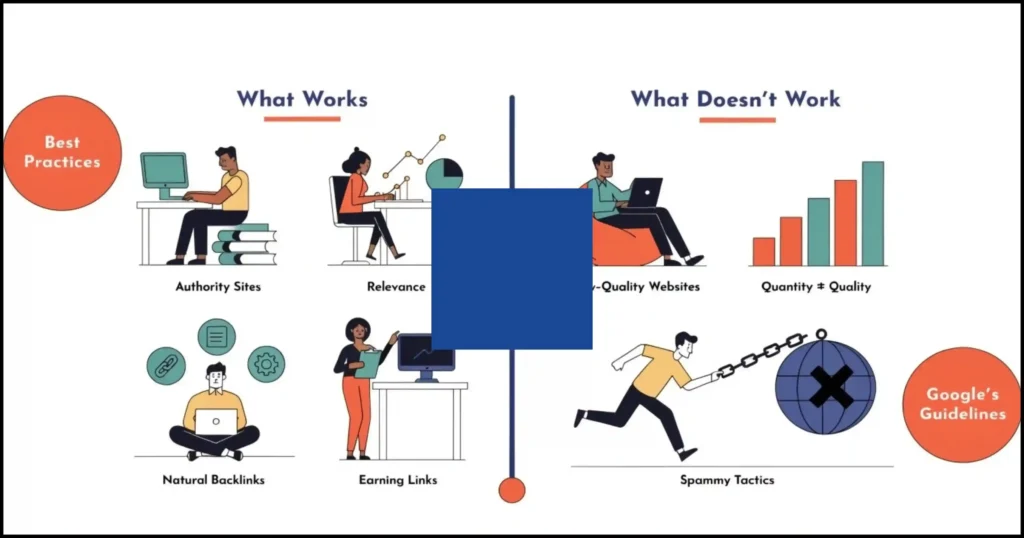
Google’s ideal world is one where backlinks happen on their own. This happens when you create something valuable, and others link to it without you asking them to.
In reality, this is easier said than done. It is especially hard for websites. Google makes a distinction between creating content that people want to link to and faking links. They do not mind you telling people about your content so they can link to it.
However, they do not like it when you pay websites to link to you.
- Creating content that attracts links is okay.
- Paying sites to link to you is not okay.
Google wants backlinks to happen naturally. They want to see that your content is genuinely useful. This way, they know that your website is trustworthy.
Types of Backlinks You Should Know
- DoFollow vs NoFollow: Normally, links are DoFollow, which means they help the destination page by passing on importance from the page that links to it. A NoFollow link is different because it has a tag that tells search engines not to pass on this importance.
NoFollow links were created in 2005 to stop spam comments. Now, many big websites like Wikipedia, Quora and social media sites use NoFollow links by default. Even though these links do not directly improve rankings, they can still bring people to your site. Make your links look more natural and varied. - Sponsored Links (rel=’sponsored’): In 2019, Google introduced ways to label links so website owners have more control over them. The Sponsored Links tag is for links that’re part of paid advertisements or promotions.
If you pay for someone to write about you or your product, the link to your site should have the Sponsored Links tag. This way, Google knows that the link is there because you paid for it, not because someone chose to link to you on their own. - UGC Links: The UGC tag is for links that are created by users, such as comments on forums or blogs. These links should be labelled as UGC so it is clear that they were not put there by the site owner.
- Editorial vs Manually Built Links: Links are the best kind. These are links that a website’s editors choose to include because they think your content is valuable to their readers. They look natural. They are very important.
Manually Built Links are the ones you get by asking sites to link to you, writing guest posts or adding your site to directories. These are not against the rules as long as the link makes sense and you do not pay for it.
Sponsored Links: Are They Safe or Spam?
- When Sponsored Links Are Allowed: Sponsored links are okay as long as people know about them. If a company pays you to write about their product or service, or they put a link in a sponsored post on your site, then that is a deal. Google does not want to stop all advertising; they just want people to say when something is an ad.
The main thing is that sponsored links need to say they are sponsored. This means they should have the rel=’sponsored’ attribute, or rel=’nofollow’ is also okay. This tells Google that the link is there because someone paid for it, not because it is a product. - Proper Tagging (NoFollow vs Sponsored): Many people who own websites use rel=’nofollow’ for all paid links. That is okay. Google looks at ‘nofollow’ as a hint. Sponsored’ is a clearer signal.
Using rel=’sponsored’ is the way to do paid links. Using rel=’nofollow’ is also okay. Lots of people do it. The important thing is that paid links do not get the treatment they are recommended by someone who likes them. - Risks of DoFollow Paid Links: If you pay for a link and it looks like a link without saying it is an ad, you are doing something Google does not allow. Both the site that sells the link and the site that buys it can get in trouble.
The consequences can be bad, like your site not showing up in search results much, or Google’s spam team can give you a penalty that takes a lot of time to fix. It is not worth paying for links that do not say they are ads, especially since Google is very good at finding them. Sponsored links need to be labelled as sponsored links, so Google knows what they are.
Outbound Linking: Does Linking to Other Sites Affect SEO?
- Linking to Authoritative Sites (Safe Practices): Linking to other good websites is a good idea. It helps the people who read your website. It shows that you have done your research, and it tells Google that your website has information. No proof linking to websites will hurt your website’s ranking.
In fact, some people have found out that websites with links to good websites tend to do better than websites with no links. This makes sense because a good article will always say where the information came from. - When Outbound Links Can Become Risky: The problem with linking to other websites is when you link to bad websites. If you link to websites that’re not good or that try to trick people, Google can tell that your website is not good either.
Also, be careful when you link to another website, and they link back to you. This is called a link exchange. Google does not like it. - Myths About ‘Losing Link Juice’: Some people think that when you link to another website, you lose some of your website’s power. This is not true. A long time ago, people thought this was true, so they did not let other websites get credit when they linked to them. Now we know this is not true.
Linking to websites that have good information is a normal part of how the internet works. Google will not punish you for doing it if you do it in a certain way.
Content Syndication & Backlinks (Medium, Tumblr, etc.)
- Risks of Duplicate Content: When you put your writing on websites like Medium, LinkedIn Articles or Tumblr, that is called content syndication. This can be a thing because it helps more people see your work. There is a problem. Google might think that your work is a copy of something that’s already on the internet.
When the same article is on websites, Google has to choose which one to show when people search for something. Usually, Google will pick the one it found first or the one it thinks is important. That might not be your website.
Why Platforms May Outrank Your Site
Medium is an example. It has a lot more power on the internet than most personal blogs. If you put your article on Medium without telling Google that your website is the original, then Medium’s version might be the one that people see when they search. That means you are helping another website be better than your own.
- Canonical Tags and Best Practices: The answer is to use something called a tag. When you put your work on websites, you can ask them to add a tag that points back to your original work. This tells Google that your version is the one.
Medium allows people who write for them to add this tag when they import work from another website. You should always do this if you are putting your article on another website. - Summary vs Full-Content Strategy: A way to share your work is to only put a little bit of it on other websites and then link back to the whole thing on your own website. This brings people to your website. Helps your website be more important. It also avoids the problem of content. This is what most people who know about search engines recommend doing.
Is There a Limit to How Many Backlinks You Should Build?
Why There Is No Fixed Number
There is no number when it comes to backlinks. The right number of backlinks for your website depends on the type of industry you’re in, the competition you have, how old your site is, how much authority it has and the types of links you are building. A local restaurant does not need the number of backlinks as a national e-commerce platform.
What matters more than the total number of backlinks is whether the number of links you are getting is growing in a way, and whether these links are coming from good sources that are related to your website.
- Understanding Link Velocity: There is no number when it comes to backlinks. The right number of backlinks for your website depends on the type of industry you’re in, the competition you have, how old your site is, how much authority it has and the types of links you are building. A local restaurant does not need the number of backlinks as a national e-commerce platform.
What matters more than the total number of backlinks is whether the number of links you are getting is growing in a way, and whether these links are coming from good sources that are related to your website. - Quality vs Quantity Debate: If you had to choose between ten backlinks from important and related sites and one thousand backlinks from low-quality sites the ten good backlinks would be better. One backlink from a known industry publication can help your website rankings more than hundreds of backlinks from average sites.
That being said, you do not have to choose between quality and quantity. Ideally, you want to have a mix of types of backlinks, including some from important sites, some from smaller sites that are related to your niche and some basic backlinks from directories and citations. - Safe Backlink Growth Patterns: For websites, it is safest to grow the number of backlinks in a steady and consistent way. If you are creating content regularly and reaching out to other sites, backlinks will usually grow naturally over time. You should avoid any methods that promise a lot of backlinks quickly because these methods are usually shortcuts that can cause problems in the long run.
What Makes a High-Quality Backlink?
Not all backlinks are created equal. Here’s a quick breakdown of what separates a genuinely valuable backlink from a mediocre or harmful one:
| Factor | What It Means | Why It Matters |
| Authority of the Linking Site | The site linking to you has a strong domain authority and a trusted reputation | High-authority links pass more ranking value than links from low-quality sites |
| Relevance to Your Niche | The linking site covers topics closely related to yours | Google weighs topical relevance heavily — a link from a relevant site is far more valuable than one from an unrelated site |
| Contextual Placement | The link appears naturally within body content, surrounded by relevant text | In-content links are considered more valuable than footer or sidebar links |
| Natural Anchor Text | The anchor text used for the link reads naturally and isn’t over-optimised | Excessive keyword-rich anchor text is a red flag for manipulation |
| Traffic of the Linking Page | The page linking to you actually gets visitors | A link from a live, trafficked page can drive real referral visitors, not just ranking signals |
| Link Placement on Page | The link is prominent and contextual, not buried in a crowded list | Placement matters — a link in the middle of a well-read article is worth more than one at the bottom of a page nobody reads |
- Authority of the Linking Site: Links from good and trustworthy websites are the most important. I am talking about news websites, respected blogs in your industry, government websites and schools. One link from a source like this is better than many links from websites that are not well-known.
- Relevance to Your Niche: A link from a website that talks about things related to your website is very valuable. If you have a blog about fitness and you get a link from a website about nutrition, that makes sense. If you get a link from a website that sells car parts to your fitness blog, that would be weird and not very useful.
- Contextual Placement: Where the link is on the page is important. Links that are part of an article and have text around them are considered good links and are better than links in the footer, sidebar or just a list of links.
- Natural Anchor Text: The text you click on to follow a link is called anchor text. In the past, people tried to get links with the words they wanted to be known for, like “best running shoes”, to get a higher ranking. Google figured out that people were cheating, and now having too many of these links can actually be bad for you.
Natural anchor text is what it looks like. The words that the person writing the article chose. It could be the name of your company, the title of your article, a phrase, like “this study”, or a few words that are related to what you do. Having a variety of anchor texts is a sign that your links are good and natural.
What to Avoid in Backlink Strategy
- Buying Backlinks: It is really tempting to buy backlinks. There are services that say they can get you one hundred high authority backlinks for a hundred dollars. You should not give in to this temptation. Paid backlinks that are meant to influence rankings without being marked as sponsored go against Google’s rules. Can result in penalties that hurt your rankings very badly.
Beyond the risk of getting a penalty, paid backlinks usually do not deliver what they promise. A lot of these backlinks are placed on websites that are not very good and have fake authority metrics, and they do not get many real visitors. - Link Exchanges: The idea of saying “you link to my website and I will link to yours” sounds harmless. Google says that exchanging links too much is a bad thing. If you link to another website that is related to yours, one time, it is not a big deal. However, if you have a system where you exchange links with websites, that is a different story.
- Spammy Directories: Not all directories are bad. If you get listed in a directory that’s well-known and respected in your industry, or if you get a legitimate business listing, that is okay. The problem is with directories that’re not very good and only exist to host links. These directories do not offer value and can actually hurt your backlink profile if you get listed in too many of them.
- Automated Link Building: Any software that automatically creates backlinks to your website on a large scale is against Google’s rules. This includes things like comment spam bots and forum profile links. Even if each link looks harmless, having thousands of backlinks that are all the same or not very good is a warning sign to Google. Google does not like backlinks that are created by automated link-building software. It can hurt your website’s rankings. Buying backlinks and using automated link-building software can both hurt your website’s rankings, so you should avoid them. Focus on getting high-quality backlinks from reputable sources.
Effective Backlink Strategies That Work
- Content-Driven Link Earning: The way to get backlinks is to create content that is so good people will want to link to it. This is what Google means by “earning” links. When you do research, create comprehensive guides or make unique data sets and tools, people will naturally want to link to them.
You need to ask yourself if your content is really the resource on this topic. If someone writes about this subject, would they want to reference your article?
If the answer is yes, then you have created content that’s worth linking to. - Guest Posting (Done Right): Guest posting is not dead; it has just changed. Writing a high-quality article for a publication in your niche is still a good way to get backlinks. You need to write something really useful and good.
The key is to write for a publication. What does not work is writing guest posts on low-quality sites just to get links. If you are guest posting to get links, then you are doing it wrong. - Digital PR and Outreach: Digital PR is about getting your brand or content featured in publications. This can be news sites, blogs or podcasts. You might need to pitch a story to journalists or share your research with them.
You can also position yourself as an expert in your field. The links you get from this are really good because they are from sources. - Brand Mentions and Citations: Sometimes people mention your brand without linking to you. You can use tools to find out when someone mentions your brand online. Then you can ask them to add a link to the mention.
It is also important to get your business listed in directories and review sites. This is especially important for search engine optimisation. - Broken Link Building: Broken link building is when you find links on websites that do not work anymore. You can then reach out to the website owner. Suggest replacing the link with one to your content.
This is a way for both you and the website owner to benefit. You can use tools to find links on websites. It takes some effort. The links you get are really good.
Backlink Strategy for Different Website Stages
- New Websites: When you are starting, your main goal is to create a presence. You need to do the things: get your business listed in good directories, claim your Google Business Profile, set up profiles on important industry platforms and make sure your website is listed where your competitors are.
At this point, a few real and relevant links can help a lot. Do not try to do too much too soon. Focus on making good and basic content first. - Growing Websites: Once you have some content and people are starting to notice you, it is time to do more. Start asking to write guest posts for websites, look for broken links to replace and invest in content that can attract links (like original research, data studies and complete guides).
Use tools like Ahrefs, SEMrush or Moz to see what is working and where your links are coming from. Look at what your competitors are doing to find link opportunities you have not used yet. - Established Websites: For websites that are already established, the focus is on keeping what you have and making it better. This means checking your links to find and remove bad links, making more of the content that has worked for you and doing digital PR to keep getting new links.
Established websites can also use their reputation to get better guest posting spots, attract links naturally and keep track of when people mention their brand.
Best Practices for a Safe & Sustainable Backlink Profile
- Maintain Natural Growth: Your backlinks should look like they are from people who are really interested in what you have to say. You want to get good links over time, not all at once. Do not do things that make your links look fake.
- Diversify Link Sources: You want links from all sorts of places: websites, different kinds of sites like blogs and news sites and different types of content. If all your links look the same, that is not good.
- Focus on User Value First: The way to get backlinks is to make content that people really want to read. When you make something that helps people, they will link to it. If you only think about getting links, you might do things that hurt you in the run.
Ask yourself this with everything you write: Is this something that people would want to link to? Would I link to it if I saw it elsewhere? If you say yes, then you are doing the thing. - Regular Backlink Audits: Check your backlinks every now and then using tools like Ahrefs or Google Search Console. Look for things that do not look right, like a lot of links all at once or links from bad websites.
If you find links, you can tell Google to ignore them. This is like a shield to protect you. Be careful not to block good links by mistake because that can hurt you.
Conclusion: Focus on Earning, Not Just Building
Here’s the main point: the best way to get backlinks is still to create really useful content, make genuine connections in your industry and get links because you deserve them, not because you tricked someone. The difference now is that Google is much better at finding tactics, and most industries are more competitive. The quick fixes that worked in 2015 will probably hurt you. The websites that keep growing their traffic are the ones that focus on quality content, build a reputation and get links honestly. It’s not the way to get results. It’s the only way that will keep working in the long run.
Backlinks are still one of the most powerful tools in your SEO arsenal. Use them wisely, earn them honestly, and they’ll serve your site well for years to come.
FAQs (Frequently Ask Questions)
What is a backlink in SEO?
A backlink is a link from one website to another. In SEO, backlinks help search engines understand the credibility, relevance, and authority of a webpage.
Why are backlinks important for SEO?
Backlinks are important because they can improve search rankings, increase website authority, drive referral traffic, and help search engines discover new pages faster.
Does Google recommend creating backlinks?
Google does not recommend artificially creating backlinks to manipulate rankings. Instead, it encourages earning natural backlinks through high-quality, useful, and relevant content.
Are backlinks still important in 2026?
Yes, backlinks remain one of the most important ranking factors in SEO in 2026, especially when they come from relevant and authoritative websites.
What is the difference between DoFollow and NoFollow backlinks?
DoFollow backlinks can pass SEO value from one website to another, while NoFollow backlinks usually do not pass direct ranking value but may still help with traffic and visibility.
Are sponsored backlinks considered spam by Google?
Sponsored backlinks are not considered spam if they are properly labeled with attributes like rel=”sponsored” or rel=”nofollow”. Problems arise when paid links are used to manipulate rankings.
How many backlinks should a website build each month?
There is no fixed number of backlinks a website should build. The focus should always be on quality, relevance, and natural growth rather than quantity alone.
Can posting the same article on Medium or Tumblr affect SEO?
Yes, reposting the same article on platforms like Medium or Tumblr can create duplicate content concerns and may cause those platforms to rank higher than your original website.
What makes a high-quality backlink?
A high-quality backlink usually comes from a relevant, trustworthy, and authoritative website, and is placed naturally within useful content.
What backlink practices should be avoided?
You should avoid buying backlinks, excessive link exchanges, spammy directory submissions, automated link building, and any linking practices meant only to manipulate search rankings.