
Introduction
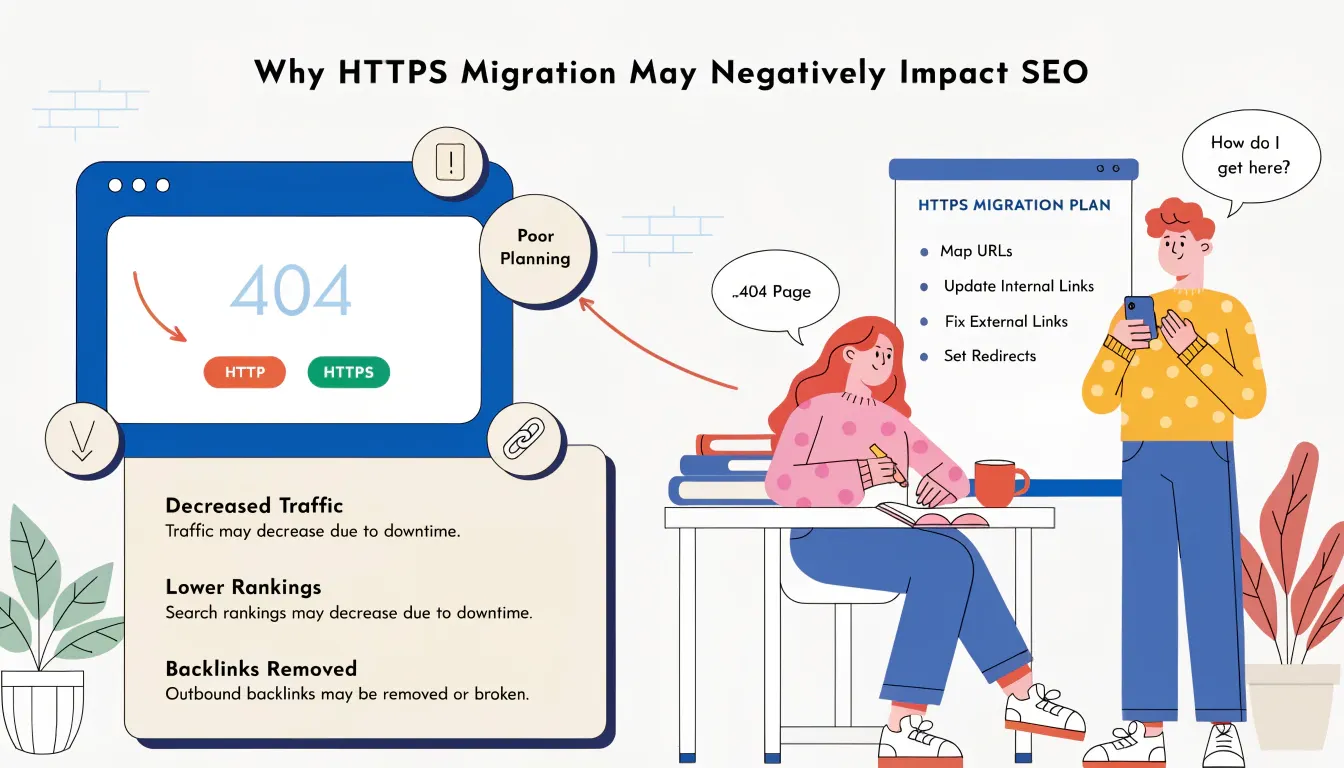
If you run a website or work with a digital marketing agency, you have probably heard the advice many times: “Move your website to HTTPS.” It makes your website more secure, protects user data, and builds trust with visitors. Search engines also prefer secure websites, which is why many businesses decide to migrate from HTTP to HTTPS.
However, there is something else that surprises most site owners after this migration process. After migrating to HTTPS, site owners notice that their site’s rankings have decreased significantly. They experience fewer impressions, and this leads to panic. Most businesses, with the help of an SEO Agency or Social Media Agency, experience this and assume that something has gone wrong with the migration process. The fact, however, is that this is more common than people imagine, and HTTPS migration affects SEO temporarily.
What Is HTTPS Migration?
Let’s start with the basics. HTTPS migration is essentially a change from HTTP to HTTPS. The difference between HTTP and HTTPS is that HTTP stands for Hypertext Transfer Protocol, and HTTPS stands for Hypertext Transfer Protocol Secure. The difference between them is that the “S” in HTTPS stands for “Secure,” which means that the connection between the user and the website is encrypted.
When someone visits an HTTPS website, the data exchanged between the browser and the server is protected. This is particularly important for websites that collect sensitive information like login details or payment data. Because of this security benefit, most modern websites are now moving toward HTTPS.
A digital marketing agency usually recommends HTTPS migration as part of technical SEO improvements. However, the migration is not just about installing an SSL certificate. It involves several technical updates across the entire website, and those changes can temporarily influence how search engines crawl and index the site.
Does HTTPS Affect SEO?
Yes, HTTPS does affect SEO, but maybe not in the way many people expect. Search engines treat HTTPS as a minor ranking signal. This means that secure websites may have a slight advantage over non-secure ones.
However, switching to HTTPS alone will not suddenly push your website to the top of search results. Instead, the benefits appear gradually because HTTPS improves user trust and website credibility.
Businesses often migrate to HTTPS for several reasons:
- To improve website security
- To protect user information
- To build trust with visitors
- To follow search engine recommendations
For companies working with an SEO Agency or digital marketing agency, HTTPS migration is usually part of a larger SEO strategy rather than a quick ranking trick.
Why HTTPS Migration Can Temporarily Hurt SEO
Here is where things get interesting. Even though HTTPS is good for websites, the migration process can sometimes cause temporary ranking drops. When a website changes from HTTP to HTTPS, search engines must update their records and process the new version of every page.
Think of it like changing the address of a business. Even though the business remains the same, people need time to learn the new location. Search engines work in a similar way.
For businesses working with a digital marketing agency, SEO Agency, or Social Media agency, these temporary changes are usually expected and manageable.
Search Engines Treat It Like a Site Migration
One important thing to understand is that search engines treat HTTPS migration almost like a site migration.
Even though your content stays the same, the URL technically changes.
For example:
- http://example.com/page
- https://example.com/page
To humans, these look almost identical. But for search engines, they are two different URLs. This means search engines must discover the new HTTPS pages and evaluate them again.
During this transition, rankings may fluctuate because search engines are still learning that the HTTPS pages are the correct versions.
Reprocessing and Reindexing Takes Time
Another reason rankings can drop temporarily is the time needed for search engines to reprocess the website.
After HTTPS migration, search engines must:
- Crawl the new HTTPS pages
- Understand the redirects from HTTP
- Update the search index
- Transfer ranking signals
If your website has hundreds or thousands of pages, this process may take time. This is why businesses working with an experienced SEO Agency closely monitor indexing after migration.
The good news is that once search engines finish processing the changes, rankings usually stabilize.
Link Signals Need to Be Transferred
Backlinks are one of the strongest signals that influence search rankings. When a website migrates to HTTPS, most backlinks still point to the old HTTP URLs.
Search engines must transfer the value of those backlinks to the new HTTPS pages through redirects.
This usually happens automatically if redirects are configured correctly. However, if the migration is poorly implemented, some link signals may not pass efficiently. That is why many companies rely on an experienced digital marketing agency or SEO Agency to manage migrations carefully.
Common HTTPS Migration Mistakes That Damage SEO
Temporary ranking fluctuations are normal during migration. However, bigger SEO problems often occur because of technical mistakes.
Even small errors can confuse search engines and slow down the migration process. A reliable digital marketing agency, SEO Agency, or Social Media agency usually performs a complete technical audit before and after migration to prevent these issues.
Before we explore the mistakes in detail, the following table highlights some of the most common HTTPS migration issues and their impact.
| Migration Issue | What Happens | SEO Impact |
| Missing 301 Redirects | HTTP pages do not redirect to HTTPS | Loss of rankings and link authority |
| Internal Links Still HTTP | Website links point to old URLs | Search engines crawl outdated pages |
| Canonical Tags Not Updated | Canonical tags reference HTTP | Search engines may index wrong version |
| HTTP URLs in Sitemap | Sitemap still contains HTTP pages | Slower indexing of HTTPS pages |
| Mixed Content Issues | HTTPS pages load HTTP resources | Security warnings and reduced trust |
Now let’s briefly talk about these issues.
Missing or Incorrect 301 Redirects
Redirects are the backbone of HTTPS migration. A proper 301 redirect tells search engines that the page has permanently moved from HTTP to HTTPS.
Without proper redirects, search engines may treat both versions as separate pages. This can split ranking signals and reduce search visibility.
This is why most businesses allow an SEO Agency to handle redirect implementation carefully during migration.
Internal Links Still Pointing to HTTP
Internal links help search engines understand the structure of your website. After HTTPS migration, all internal links should point to the HTTPS version.
If internal links still point to HTTP pages:
- Search engines continue crawling old URLs
- Crawl budget is wasted
- Migration becomes slower
A professional digital marketing agency usually performs an internal link audit to ensure everything points to the correct HTTPS pages.
Canonical Tags Still Using HTTP
Canonical tags tell search engines which version of a page should be considered the main one. During HTTPS migration, canonical tags must also be updated.
If canonical tags still reference HTTP pages, search engines may assume the HTTP version is the preferred page. This creates confusion and may affect rankings.
An experienced SEO Agency checks canonical tags during migration to prevent this problem.
HTTP URLs in XML Sitemap
An XML sitemap helps search engines discover important pages on your website. After HTTPS migration, the sitemap should include only HTTPS URLs.
If the sitemap still contains HTTP URLs, search engines may continue prioritizing outdated pages.
Updating the sitemap and resubmitting it helps search engines recognize the new secure pages more quickly. Most digital marketing agencies include this step in their migration checklist.
Mixed Content Issues
Mixed content occurs when an HTTPS page loads resources such as images, scripts, or stylesheets from HTTP links.
This can cause browser warnings and make your website appear less secure.
From an SEO perspective, mixed content suggests that the migration is incomplete. Businesses working with a Social Media agency or SEO Agency usually fix these issues quickly to ensure the website is fully secure.
How Long Does SEO Recovery Take After HTTPS Migration?
One of the most common questions website owners ask is: “How long will my rankings take to recover?”
The answer depends on several factors, such as:
- Website size
- Crawl frequency
- Backlink profile
- Technical implementation
Smaller websites may recover within a few days. Larger websites may take several weeks while search engines process all the changes.
Businesses working with a digital marketing agency usually track indexing and rankings closely during this period to ensure everything moves in the right direction.
Best Practices for a Safe HTTPS Migration
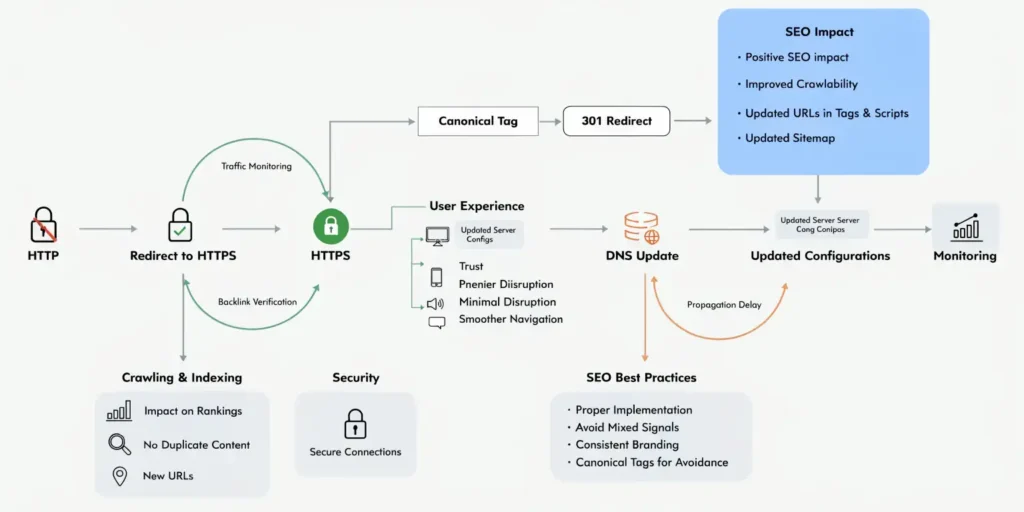
A well-planned migration significantly reduces the risk of SEO issues. Most agencies follow a structured process to make the transition smooth.
Some important best practices include:
- Implementing 301 redirects from HTTP to HTTPS
- Updating internal links across the website
- Updating canonical tags
- Updating XML sitemaps
- Fixing mixed content issues
- Monitoring crawl and indexing reports
When these steps are handled by an experienced SEO Agency, digital marketing agency, or Social Media agency, the migration usually happens without major problems.
How to Monitor SEO After HTTPS Migration
The work does not stop after migration. Monitoring the website’s performance is just as important.
During the first few weeks, rankings and traffic may fluctuate. That is completely normal. However, monitoring helps identify any technical problems early.
An SEO Agency typically keeps an eye on several things:
- Crawl errors
- Indexing status
- Redirect performance
- Ranking trends
Some businesses also rely on their Social Media agency during this period to maintain website traffic through social channels while organic rankings stabilize.
Conclusion
HTTPS migration is an important step for improving website security and user trust. However, the process can temporarily affect SEO because search engines need time to process the new URLs.
Businesses working with a digital marketing agency, SEO Agency, or Social Media agency should understand that short-term ranking fluctuations are normal. With proper redirects, updated links, and careful monitoring, most websites recover quickly and continue benefiting from the long-term advantages of HTTPS.
FAQs
Does switching to HTTPS improve SEO?
Yes, HTTPS supports SEO by improving security and user trust. Although it is only a small ranking factor, it contributes to a better browsing experience.
Why did my rankings drop after HTTPS migration?
Rankings may drop temporarily because search engines need time to crawl and reindex the new HTTPS pages.
How long does HTTPS migration affect SEO?
For most websites, rankings stabilize within a few days to a few weeks depending on the website size and crawl frequency.
Do I need redirects after moving to HTTPS?
Yes, proper 301 redirects are essential to guide users and search engines from old HTTP pages to the new HTTPS pages.
Should I update my sitemap after the HTTPS migration?
Yes. Updating the XML sitemap ensures that search engines discover and index the HTTPS pages quickly.