
Key Takeaways
- Email marketing continues to deliver one of the highest returns in digital marketing, but its success depends on implementing a well-planned Email Marketing Strategy. Businesses that focus on audience segmentation, personalization, and consistent communication are more likely to build stronger customer relationships and achieve higher engagement rates.
- A strong Email Marketing Strategy helps businesses guide potential customers through every stage of the marketing funnel—from awareness to conversion and retention. By aligning email campaigns with business goals, companies can nurture leads effectively and turn subscribers into long-term customers.
- Successful Email Marketing Campaigns such as welcome emails, newsletters, promotional emails, and re-engagement campaigns work best when they are supported by a clear Email Marketing Strategy. Strategic planning ensures that each campaign delivers the right message to the right audience at the right time.
- Building a high-quality subscriber list is the foundation of any effective Email Marketing Strategy. Businesses should focus on organic list growth through signup forms, lead magnets, landing pages, and valuable content that encourages users to voluntarily subscribe.
- Email Marketing Automation plays a crucial role in executing a scalable Email Marketing Strategy. Automated workflows such as welcome sequences, abandoned cart reminders, and lead nurturing campaigns help businesses maintain consistent engagement while saving time and resources.
- Choosing the right Email Marketing Tools is essential for managing and optimizing campaigns. Modern platforms allow marketers to automate emails, segment audiences, analyze performance metrics, and improve the overall effectiveness of their Email Marketing Strategy.
- Tracking important metrics like open rate, click-through rate (CTR), conversion rate, bounce rate, and deliverability rate helps marketers refine their Email Marketing Strategy and identify areas where campaigns can be improved for better results.
- Implementing proven Email Marketing Best Practices—such as personalization, segmentation, A/B testing, and mobile optimization—can significantly strengthen an organization’s Email Marketing Strategy and increase customer engagement.
- Businesses must avoid common mistakes like purchasing email lists, sending irrelevant messages, or ignoring analytics, as these practices can weaken an Email Marketing Strategy and reduce campaign performance.
- For companies that want to maximize results, working with a professional Digital Marketing Agency can help develop a data-driven Email Marketing Strategy, implement automation systems, and create high-converting campaigns that support long-term business growth.
Email marketing remains one of the most powerful and reliable channels in the digital marketing ecosystem. Despite the emergence of social media platforms, messaging apps, and new advertising technologies, email continues to deliver exceptional engagement and conversion rates. Businesses of all sizes—from startups to global enterprises—use email marketing to build relationships, nurture leads, and generate consistent revenue.
For any Digital Marketing Agency, email marketing is a core service because it offers measurable results, deep personalization, and long-term customer engagement. When implemented correctly, a strong Email Marketing Strategy can turn prospects into loyal customers while maintaining ongoing communication with existing clients.
This comprehensive guide explains how email marketing works, the different types of Email Marketing Campaigns, the most effective Email Marketing Tools, and the Email Marketing Best Practices that can help businesses achieve higher conversions in 2026 and beyond.
Introduction to Email Marketing
Email marketing is a digital marketing technique that involves sending targeted emails to a group of subscribers for the purpose of promoting products, services, or valuable content. These emails may include promotional offers, newsletters, educational content, or transactional messages triggered by user activity.
The goal of email marketing is to build meaningful relationships with subscribers and guide them through the customer journey—from awareness to purchase and eventually to brand advocacy.
Unlike many marketing channels where businesses must compete for visibility, email provides direct access to a user’s inbox. This direct communication channel allows brands to deliver personalized content, maintain consistent engagement, and track measurable performance metrics such as open rates, click-through rates, and conversions.
A well-planned Email Marketing Strategy focuses on delivering the right message to the right audience at the right time. When businesses combine audience segmentation, personalization, and Email Marketing Automation, they can significantly improve engagement and drive more sales.
For a Digital Marketing Agency, email marketing also plays a crucial role in nurturing leads and maintaining long-term relationships with clients.
The Evolution of Email Marketing in Digital Marketing
Email marketing has evolved significantly since the early days of the internet. In the 1990s, email marketing was primarily used for mass promotional messages, often resulting in spam-like communication that offered little value to recipients.
However, with the advancement of marketing technology, email marketing has transformed into a sophisticated communication channel powered by automation, data analytics, and artificial intelligence.
Today, modern Email Marketing Tools allow businesses to:
- Segment audiences based on behavior
- Automate complex marketing workflows
- Personalize content for individual users
- Track campaign performance in real time
- Optimize campaigns using data insights
The rise of marketing automation platforms has enabled marketers to create highly targeted Email Marketing Campaigns that deliver relevant content based on customer behavior, purchase history, and engagement patterns.
As a result, email marketing is no longer just about sending messages—it is about building personalized customer experiences.
Why Email Marketing Still Works in 2026
Even in a world dominated by social media and mobile apps, email marketing remains one of the most effective digital marketing channels.
Several factors contribute to its continued success:
- First, email provides a direct line of communication with the audience. Unlike social media platforms where algorithms control visibility, emails are delivered directly to the subscriber’s inbox.
- Second, email marketing offers exceptional return on investment. Many studies show that email marketing consistently generates one of the highest ROI among digital marketing channels.
- Third, email marketing allows deep personalization. Businesses can tailor content based on customer preferences, purchase behavior, and engagement patterns.
- Fourth, Email Marketing Automation enables businesses to send the right message at the right time without manual intervention.
For businesses working with a Digital Marketing Agency, email marketing becomes an essential tool for customer retention, lead nurturing, and revenue growth.
Role of Email Marketing in Modern Marketing Funnels
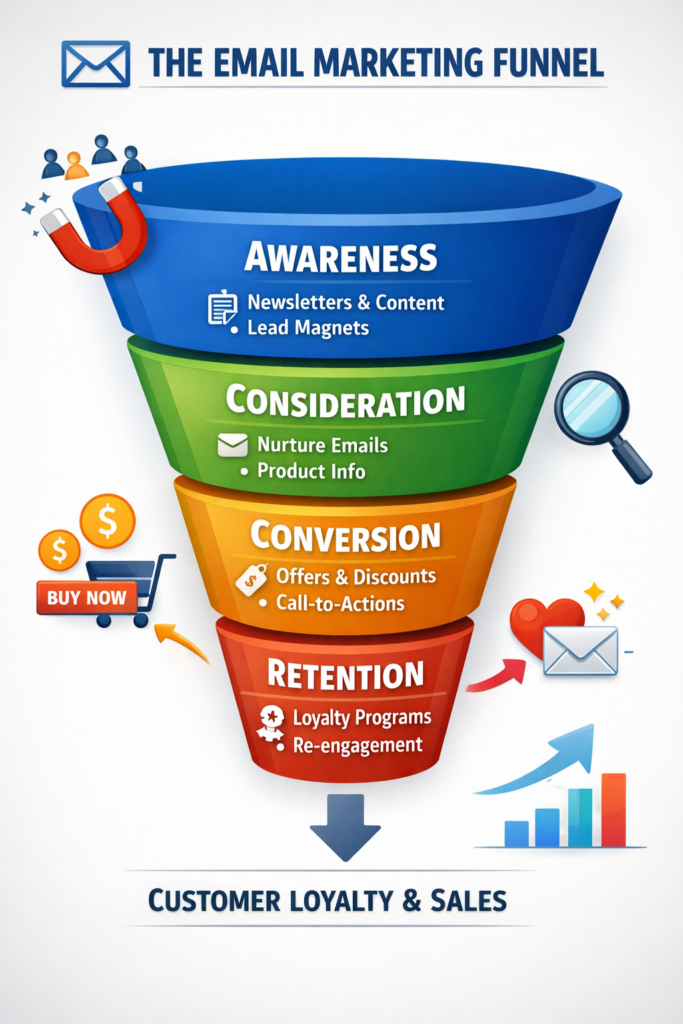
Email marketing plays a critical role in guiding customers through the marketing funnel.
The marketing funnel typically consists of four stages:
- Awareness
- Consideration
- Conversion
- Retention
Email marketing supports each stage of this funnel.
- At the awareness stage, businesses use newsletters and educational content to introduce their brand and attract potential customers.
- During the consideration stage, targeted Email Marketing Campaigns provide valuable information, product comparisons, and case studies that help prospects make informed decisions.
- At the conversion stage, promotional emails and limited-time offers encourage customers to complete a purchase or sign up for a service.
- Finally, in the retention stage, personalized emails maintain engagement with customers and encourage repeat purchases.
A strategic Email Marketing Strategy ensures that subscribers receive relevant content at every stage of the customer journey.
How Email Marketing Works
The email marketing process begins with building a subscriber list and continues through campaign creation, automation, and performance analysis.
The typical process includes several key steps:
- First, businesses collect email addresses through website signup forms, landing pages, or lead magnets.
- Next, subscribers are segmented into groups based on factors such as interests, demographics, or past interactions.
- Then marketers create targeted Email Marketing Campaigns designed to deliver relevant information or promotional offers.
- After sending emails, marketers analyze performance metrics to determine what works and what needs improvement.
Modern Email Marketing Tools make this process efficient by providing automation, analytics, and campaign management features.
Building an Email Marketing Funnel
An email marketing funnel is a structured process that moves subscribers from initial interest to becoming paying customers.
The funnel typically includes the following stages:
- Lead capture
- Lead nurturing
- Conversion
- Customer retention
For example, when a user subscribes to a newsletter, they may receive a welcome email followed by a series of educational emails that build trust and provide value. As engagement increases, businesses introduce promotional offers and product recommendations to encourage conversions. Using Email Marketing Automation, marketers can automatically send emails based on user actions such as website visits, downloads, or purchases.
Email Marketing vs Other Digital Marketing Channels
Compared to other marketing channels, email marketing offers unique advantages.
- Social media marketing helps businesses reach large audiences but relies heavily on platform algorithms.
- Paid advertising can generate immediate traffic but requires ongoing investment.
- Email marketing, on the other hand, provides a direct communication channel with subscribers who have already expressed interest in the brand.
- Unlike paid advertising campaigns that stop generating results once the budget is exhausted, email marketing campaigns can deliver long-term engagement and customer loyalty.
This is why most successful Digital Marketing Agency strategies include email marketing as a core component of their marketing mix.
How Businesses Generate Leads Through Email
Email marketing is a powerful lead generation tool when used strategically. Businesses typically attract leads through valuable content such as eBooks, webinars, industry reports, or free trials. When users download or access these resources, they provide their email addresses in exchange for value. Once leads are captured, businesses use Email Marketing Automation to send a series of follow-up emails designed to educate prospects and guide them toward a purchase decision. These automated sequences help maintain consistent communication and ensure that leads receive relevant information at the right time.
Key Benefits of Email Marketing for Businesses
High Return on Investment (ROI)
One of the biggest advantages of email marketing is its high return on investment. Compared to traditional marketing methods and paid advertising channels, email marketing requires minimal costs while delivering significant revenue potential. Businesses only need reliable Email Marketing Tools, a subscriber list, and well-crafted content to launch campaigns. Once the infrastructure is in place, companies can reach thousands of subscribers with minimal incremental costs. For a Digital Marketing Agency, this high ROI makes email marketing an essential service for clients who want measurable marketing results.
Direct and Personalized Communication
Email marketing allows businesses to communicate directly with their audience. Unlike social media platforms where content visibility depends on algorithms, emails are delivered directly to subscribers. Personalization is another key advantage. Marketers can customize emails based on subscriber data such as name, location, interests, and purchase history. Personalized emails often achieve significantly higher open rates and engagement compared to generic messages.
Increased Customer Engagement
Email marketing encourages ongoing engagement with customers by delivering relevant content regularly. Newsletters, product updates, and educational content help maintain brand visibility and keep customers informed about new offerings. Through targeted Email Marketing Campaigns, businesses can encourage customers to revisit their websites, explore new products, and participate in promotional events.
Building Brand Loyalty
Consistent communication builds trust between businesses and customers. When subscribers regularly receive valuable content, helpful tips, and exclusive offers, they begin to view the brand as a trusted resource. Over time, this trust translates into brand loyalty and repeat purchases.
Driving Website Traffic and Sales
Email marketing is an effective tool for driving website traffic. Strategic calls-to-action encourage subscribers to visit product pages, blog articles, or promotional landing pages. Many businesses rely on email campaigns to announce product launches, seasonal promotions, and limited-time discounts. These campaigns often generate significant spikes in website traffic and sales.
Types of Email Marketing Campaigns
- Promotional Emails: Promotional emails are designed to encourage customers to purchase products or services.
- These emails often include discount offers, special promotions, or exclusive deals.
- They typically feature clear calls-to-action directing recipients to product pages or checkout pages.
- Newsletter Campaigns: Newsletter campaigns focus on delivering valuable information rather than direct sales messages.
- They may include blog articles, industry insights, company news, or educational resources.
- Regular newsletters help maintain engagement with subscribers and position businesses as industry experts.
- Welcome Emails: Welcome emails are sent immediately after a user subscribes to an email list.
- These emails introduce the brand, set expectations for future communication, and often include a special offer or incentive.
- Welcome emails typically achieve some of the highest open rates among all Email Marketing Campaigns.
- Lead Nurturing Emails: Lead nurturing campaigns guide potential customers through the decision-making process.
- These emails provide helpful content, case studies, and product information that gradually build trust and encourage conversions.
- Transactional Emails: Transactional emails are triggered by specific user actions such as purchases, account registrations, or password resets.
- Examples include order confirmations, shipping updates, and payment receipts.
- These emails have extremely high open rates because they contain information that customers expect and need.
- Re-engagement Campaigns: Re-engagement emails target inactive subscribers who have stopped opening or clicking emails.
- These campaigns often include special offers or feedback requests designed to renew customer interest.
- Seasonal and Holiday Campaigns: Seasonal campaigns take advantage of holidays and special events such as Black Friday, Christmas, or New Year promotions.
- These campaigns create urgency and encourage customers to make purchases during limited-time sales periods.
Building a High-Quality Email List
A high-quality email list is the foundation of successful email marketing.
- The effectiveness of Email Marketing Campaigns depends heavily on the quality of the subscriber list.
- A targeted list ensures that emails reach people who are genuinely interested in the brand’s products or services.
- Businesses that focus on organic list growth often achieve higher engagement rates and lower unsubscribe rates.
Organic vs Paid Email List Growth
- Organic email list growth occurs when users voluntarily subscribe to receive emails from a brand.
- This typically happens through website signup forms, blog subscriptions, and content downloads.
- Paid list growth may involve advertising campaigns that encourage users to join an email list through lead generation forms.
- Organic subscribers generally show higher engagement levels because they have actively chosen to receive communication from the brand.
Lead Magnets for Email Marketing
Lead magnets are incentives offered in exchange for a user’s email address.
Common examples include:
- Free eBooks
- Industry reports
- Online courses
- Discount coupons
- Free trials
Lead magnets provide value while helping businesses grow their email lists.
Signup Forms and Landing Pages
Signup forms and landing pages play a crucial role in capturing subscriber information.
Effective forms should be simple, visually appealing, and clearly communicate the benefits of subscribing.
Many Email Marketing Tools provide customizable signup form templates that can be embedded on websites and landing pages.
Email List Segmentation Strategies
Segmentation involves dividing subscribers into smaller groups based on specific characteristics.
Common segmentation criteria include:
- Demographics
- Purchase behavior
- Engagement level
- Geographic location
Segmentation allows marketers to send more relevant messages, resulting in higher engagement and conversion rates.
Email Marketing Strategy for Maximum Conversions
Defining Email Marketing Goals
- Every successful Email Marketing Strategy begins with clear objectives.
- These goals may include increasing sales, generating leads, improving customer retention, or driving website traffic.
- Clear goals help marketers measure campaign performance and refine their strategies over time.
Identifying Target Audience
- Understanding the target audience is essential for creating effective email campaigns.
- Marketers must analyze customer data to determine subscriber preferences, needs, and behaviors.
- This information allows businesses to deliver personalized content that resonates with their audience.
Creating a Content Calendar
- A content calendar helps marketers plan and schedule email campaigns in advance.
- It ensures consistent communication with subscribers and prevents sending too many or too few emails.
- Content calendars often include newsletters, promotions, educational emails, and seasonal campaigns.
Email Personalization Strategies
- Personalization is one of the most powerful techniques in email marketing.
- Personalized emails may include the recipient’s name, product recommendations based on browsing history, or location-based offers.
- Advanced Email Marketing Automation systems can dynamically generate personalized content for each subscriber.
Behavioral and Trigger-Based Emails
Trigger-based emails are automatically sent when subscribers perform specific actions.
Examples include:
- Welcome emails after signup
- Cart abandonment reminders
- Product recommendation emails
These emails are highly effective because they respond to real-time user behavior.
How to Write High-Converting Email Content
- Writing Powerful Subject Lines
- The subject line is the first element recipients see when they receive an email.
- A compelling subject line encourages users to open the email and engage with the content.
- Effective subject lines often include curiosity, urgency, or personalization.
- Crafting Engaging Email Body Content: The email body should be clear, concise, and focused on delivering value to the reader.
- High-performing emails often include:
- Short paragraphs
- Clear messaging
- Strong calls-to-action
- The goal is to guide readers toward a specific action.
- Using Storytelling in Email Marketing
- Storytelling helps create emotional connections with readers.
- Brands can share customer success stories, product development journeys, or behind-the-scenes insights to make emails more engaging.
- Designing Effective Call-to-Action (CTA): Every email should include a clear call-to-action.
- Common CTAs include:
- Shop Now
- Download Now
- Learn More
- Book a Consultation
- Using Images and Visual Content
- Visual elements enhance the overall appeal of email content.
- Images, infographics, and product visuals can help convey messages quickly and increase engagement.
What is Email Automation?
- Email Marketing Automation refers to the use of software to automatically send emails based on predefined triggers and workflows.
- Instead of manually sending messages, marketers can create automated sequences that deliver emails when specific conditions are met.
Benefits of Marketing Automation
Automation offers several advantages:
- Saves time and resources
- Improves campaign consistency
- Delivers timely and relevant messages
- Enhances personalization
These benefits make automation an essential part of modern email marketing.
Types of Automated Email Workflows
Common automated workflows include:
- Welcome sequences
- Lead nurturing sequences
- Abandoned cart reminders
- Post-purchase follow-ups
These workflows ensure continuous engagement with subscribers.
Drip Campaigns
- Drip campaigns are automated email sequences sent over time to nurture leads.
- Each email in the sequence provides valuable information designed to guide subscribers toward a purchase decision.
Lifecycle Email Marketing
- Lifecycle email marketing focuses on delivering relevant messages at every stage of the customer journey.
- From initial signup to repeat purchases, automated emails help maintain engagement and drive long-term customer value.
Best Email Marketing Tools and Platforms
Features to Look for in Email Marketing Software
When choosing Email Marketing Tools, businesses should consider features such as automation, segmentation, analytics, and integration capabilities. A good email marketing platform should also offer user-friendly design tools and reliable deliverability.
Email Automation Platforms
Modern email automation platforms allow businesses to create sophisticated marketing workflows.
Popular platforms include:
- Mailchimp
- HubSpot
- Brevo
- Constant Contact
These platforms provide advanced Email Marketing Automation, analytics dashboards, and integration options.
CRM Integration in Email Marketing
Integrating email marketing with customer relationship management systems helps businesses manage customer data more effectively. CRM integration allows marketers to track interactions, analyze customer behavior, and deliver personalized experiences.
Important Email Marketing Metrics to Track
| Email Marketing Metric | What It Measures | Why It Matters for Businesses | Ideal Benchmark |
| Open Rate | Percentage of recipients who open an email | Indicates how effective your subject line and sender reputation are | 20% – 30% |
| Click-Through Rate (CTR) | Percentage of users who click a link in the email | Shows how engaging your email content and call-to-action are | 2% – 5% |
| Conversion Rate | Percentage of users who complete the desired action (purchase, signup, etc.) | Measures the real success of your Email Marketing Campaigns | 1% – 3% |
| Bounce Rate | Percentage of emails that fail to reach recipients | Helps identify issues with email lists and deliverability | Below 2% |
| Unsubscribe Rate | Percentage of users who opt out of emails | Indicates audience dissatisfaction or excessive emails | Below 0.5% |
| Email Deliverability Rate | Percentage of emails successfully delivered to inboxes | Ensures your emails are not going to spam folders | Above 95% |
Email Marketing Best Practices
- Personalization and Segmentation: Effective Email Marketing Best Practices include segmenting audiences and delivering personalized messages tailored to subscriber interests.
- A/B Testing for Better Performance: A/B testing allows marketers to experiment with different subject lines, designs, and content variations to determine what works best.
- Mobile Optimization: Many users check emails on mobile devices. Ensuring that emails display properly on smaller screens is essential for maintaining engagement.
- Sending Emails at the Right Time: Timing can significantly impact email performance. Analyzing audience behavior helps marketers determine the optimal days and times to send campaigns.
- Maintaining Email List Hygiene: Regularly cleaning email lists by removing inactive or invalid addresses improves deliverability and engagement rates.
Common Email Marketing Mistakes to Avoid
- Buying Email Lists: Purchased email lists often contain unqualified contacts who did not consent to receive emails, leading to low engagement and potential spam complaints.
- Sending Too Many Emails: Overloading subscribers with frequent emails can lead to fatigue and increased unsubscribe rates.
- Poor Subject Lines: Weak subject lines reduce open rates and limit the effectiveness of email campaigns.
- Ignoring Analytics: Data analysis is essential for optimizing campaigns. Marketers should continuously monitor performance metrics.
- Not Optimizing for Mobile Devices: Emails that are not mobile-friendly may appear difficult to read, causing users to delete them without engagement.
Email Marketing Compliance and Regulations
- Understanding Email Marketing Laws: Businesses must follow legal guidelines when sending marketing emails to protect user privacy and prevent spam.
- Permission-Based Email Marketing: Permission-based marketing requires explicit consent from users before sending promotional emails. This approach improves engagement and protects brand reputation.
- GDPR and Data Privacy Considerations: The General Data Protection Regulation requires businesses to protect personal data and obtain clear consent from European users.
- CAN-SPAM Compliance: The CAN-SPAM Act establishes rules for commercial email communication, including accurate sender information and clear unsubscribe options.
Future Trends in Email Marketing
- AI-Powered Email Personalization: Artificial intelligence is transforming email marketing by enabling deeper personalization and predictive recommendations.
- Interactive Emails: Interactive email features such as polls, surveys, and embedded forms enhance user engagement without requiring recipients to leave the inbox.
- Predictive Email Marketing: Predictive analytics allows marketers to anticipate customer behavior and deliver highly relevant content.
- Hyper-Personalized Customer Journeys: Future email campaigns will focus on delivering individualized experiences based on real-time behavioral data.
Conclusion
Email marketing continues to be one of the most powerful digital marketing channels for businesses seeking sustainable growth. With the right Email Marketing Strategy, companies can build meaningful relationships with their audience, nurture leads, and drive consistent revenue.
Modern Email Marketing Tools and Email Marketing Automation technologies make it easier than ever to create personalized experiences and scalable campaigns.
For any Digital Marketing Agency, email marketing remains a vital component of successful marketing strategies because it combines personalization, automation, and measurable performance.
Businesses that invest in high-quality email content, follow Email Marketing Best Practices, and continuously optimize their Email Marketing Campaigns will be well-positioned to succeed in the evolving digital landscape of 2026 and beyond.
Frequently Asked Questions (FAQs)
1. What is Email Marketing?
Email Marketing is a digital marketing method where businesses send emails to a targeted audience to promote products, share updates, and build relationships with customers. It helps businesses engage users, generate leads, and increase conversions through personalized communication.
2. What is an Email Marketing Strategy?
An Email Marketing Strategy is a structured plan that businesses use to send targeted emails to subscribers. It includes defining goals, segmenting audiences, creating valuable content, scheduling campaigns, and using automation to improve engagement and conversions.
3. Why is Email Marketing important for businesses?
Email Marketing is important because it allows businesses to communicate directly with their audience, nurture leads, and drive sales. It is also one of the most cost-effective marketing channels and often delivers a high return on investment compared to other digital marketing methods.
4. What are the main types of Email Marketing Campaigns?
Common types of Email Marketing Campaigns include promotional emails, newsletters, welcome emails, lead nurturing emails, transactional emails, re-engagement campaigns, and seasonal marketing campaigns.
5. What are the best Email Marketing Tools?
Some of the most popular Email Marketing Tools used by businesses include:
- Mailchimp
- HubSpot
- Brevo
- Constant Contact
These platforms help manage email lists, automate campaigns, and analyze performance.
6. What is Email Marketing Automation?
Email Marketing Automation is the process of automatically sending emails based on user behavior or predefined triggers. Examples include welcome emails, abandoned cart reminders, and follow-up messages that help nurture leads and improve conversions.
7. How can businesses build a high-quality email list?
Businesses can build a high-quality email list by offering valuable lead magnets such as eBooks, newsletters, webinars, or discounts. Using signup forms, landing pages, and content downloads also helps attract genuine subscribers.
8. What are the most important Email Marketing metrics to track?
Key Email Marketing metrics include open rate, click-through rate (CTR), conversion rate, bounce rate, unsubscribe rate, and email deliverability rate. These metrics help marketers evaluate campaign performance and optimize their Email Marketing Strategy.
9. What are the best Email Marketing Best Practices?
Some important Email Marketing Best Practices include audience segmentation, personalization, mobile optimization, A/B testing, sending emails at optimal times, and maintaining a clean email list to improve deliverability.
10. How can a Digital Marketing Agency help with Email Marketing?
A Digital Marketing Agency can help businesses design and implement effective Email Marketing Strategies, create engaging campaigns, manage automation workflows, analyze campaign performance, and optimize email marketing for better conversions.